
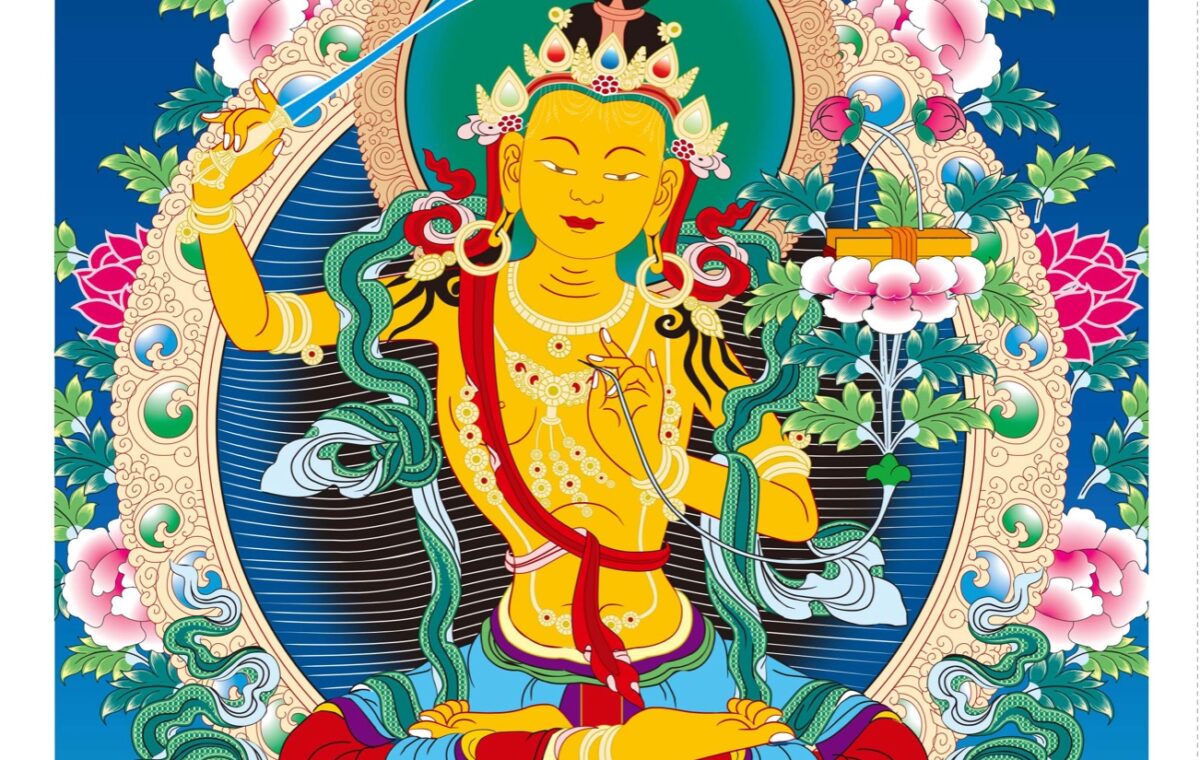
Manjushri is the bodhisattva of wisdom and one of the most recognizable subjects in Buddhist art. In many thangka paintings, a raised sword and a lotus supporting a book immediately draw the eye. These attributes are often described as symbols of wisdom cutting through confusion and the transmission of Buddhist teaching. Yet Manjushri appears in several forms, so reliable identification still depends on the whole image.
This guide focuses on the peaceful, youthful form commonly encountered in Tibetan Buddhist painting. It explains how to read the sword, book, lotus, gestures, body color, ornaments, and surrounding figures without treating every variation as an error.
Who is Manjushri?
Manjushri represents transcendent wisdom. Artists usually depict him as a youthful bodhisattva rather than an aged scholar. The youthful appearance communicates clarity and immediacy rather than wisdom acquired only through age. He is richly adorned, seated on a lotus, and surrounded by the visual signs of a bodhisattva.
Names and transliterations vary across languages and catalogues. When searching collections, it can help to compare “Manjushri,” “Mañjuśrī,” and regional names, while keeping the standardized English title consistent within the archive.
The flaming sword of wisdom
The raised sword is Manjushri’s most striking attribute. It is commonly held in the right hand above or beside the head. Flames may surround the blade or rise from its edge, although the degree of detail varies with scale and style.
The sword is not read as an ordinary weapon. Within the iconographic system it represents discerning wisdom that cuts through ignorance and mistaken views. For visual identification, note the hand that holds it, the angle of the blade, and whether a flame treatment is visible. Do not assume that every sword-bearing figure is Manjushri; wrathful deities and protective figures may also carry blades.
The book on the lotus
A second key attribute is a book, often identified as a Prajnaparamita text, resting on a lotus near the shoulder. The flower’s long stem may begin near Manjushri’s hand and rise beside the body. In some paintings the book is carefully rendered as a rectangular manuscript; in others it appears as a small block that is easy to miss.
The book and sword form a powerful pair. The sword expresses penetrating discernment, while the book connects wisdom with teaching and textual tradition. When both are visible alongside a peaceful youthful bodhisattva, the identification becomes much stronger.
Body color and youthful appearance
Manjushri is frequently shown in yellow, golden, orange, or saffron tones, although other forms and colors exist. Digital reproductions can shift these hues dramatically. A golden figure with a sword and book is a familiar pattern, but color should confirm the attributes rather than replace them.
The face is generally peaceful and youthful, with a composed expression. A crown, earrings, necklaces, bracelets, scarves, and patterned garments identify him as a bodhisattva. This combination separates him visually from a monk or historical teacher.
Hands and gestures
The sword-bearing hand creates dynamic movement in the upper part of the composition. The other hand may form a teaching gesture or hold the stem of the lotus supporting the book. Depending on the form, workshop, and scale, the precise finger positions can differ.
For catalogue work, describe the visible action before assigning a technical mudra name. “Left hand holds the stem of a lotus supporting a book” is often more useful and verifiable than an uncertain gesture label.
Lotus throne, halo, and sacred space
Manjushri is commonly seated cross-legged on a lotus throne. A halo frames the head, and a larger aureole may surround the body. Clouds, flowers, mountain forms, offerings, or architectural details can fill the remaining space.
These elements help create the sacred setting but are not unique to Manjushri. Focus first on the sword and book, then use the seat, ornaments, and composition to confirm that the central figure belongs to the peaceful bodhisattva category.
Manjushri in mandalas and multi-figure paintings
Not every Manjushri image presents a single large central figure. He may appear within a mandala, as one member of a group of bodhisattvas, beside Shakyamuni Buddha, or in a lineage composition. In such cases, his attributes may be reduced to tiny details.
Use the highest-resolution image available and compare the figure’s position with a reliable catalogue or inscription. If the sword or book is not visible, avoid forcing an identification solely because the figure is yellow.
Different forms of Manjushri
Catalogues may contain multiple forms distinguished by color, number of arms, posture, implements, or ritual context. Black Manjushri, multi-armed forms, and mandala cycles can look very different from the familiar golden peaceful figure. A broad “Manjushri” label may therefore be correct at the subject level but incomplete at the form level.
When the precise form cannot be verified, use a conservative title and preserve the more specific historical filename as a note rather than presenting it as confirmed fact.
Common identification mistakes
The first mistake is identifying every sword-bearing bodhisattva as Manjushri. Check for the lotus and book, the peaceful youthful appearance, and the wider composition. The second is assuming every yellow bodhisattva is Manjushri. Body color is supporting evidence, not proof.
A third mistake is reading modern digital color as if it were the original pigment. Scans, screens, and restoration can change hue and contrast. Structure and attributes usually provide more dependable clues.
Identification checklist
- Peaceful, youthful, richly ornamented bodhisattva
- Raised sword, often with a flame treatment
- Lotus supporting a book near the shoulder
- Yellow, gold, orange, or related body color in many common forms
- Teaching gesture or hand holding the lotus stem
- Lotus seat and bodhisattva ornaments
- Surrounding figures consistent with the composition
- Catalogue title or inscription supporting the identification
The sword and book together are the strongest introductory pattern. From there, the exact form should be checked against written documentation.
Learning through side-by-side comparison
Compare several Manjushri paintings and note what remains stable: sword, book, lotus, youthful face, and bodhisattva ornaments. Then record what changes: body color, arm position, teachers, attendants, landscape, and painting style. This method builds recognition without turning living artistic traditions into a rigid checklist.
For a complete viewing method, see How to Read a Thangka, which explains how to combine central figure, gestures, attributes, color, composition, and source evidence.