
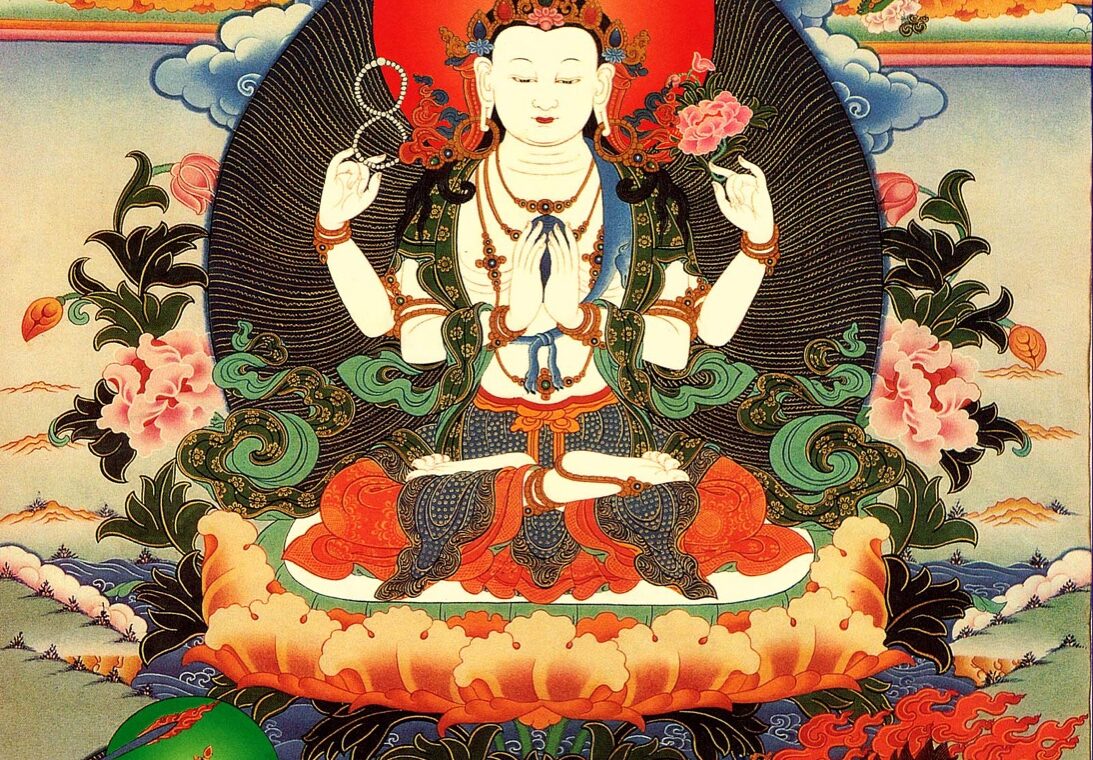
Four-Armed Avalokiteshvara is one of the best-known visual forms of the bodhisattva of compassion in Tibetan Buddhist art. The white body, four arms, clasped central hands, prayer beads, lotus, and peaceful seated posture create a distinctive iconographic pattern. Learning that pattern is useful not only for identifying this form, but also for understanding how thangka painters communicate identity through combinations of gestures and objects.
Avalokiteshvara appears in many forms, including two-armed, four-armed, eleven-headed, and thousand-armed manifestations. For that reason, “Avalokiteshvara” is not a single fixed image. Each form must be read on its own terms, and the title of a painting should be checked against the visible attributes.
Who is Avalokiteshvara?
Avalokiteshvara embodies compassion in Mahayana and Vajrayana Buddhist traditions. Across Asia, the bodhisattva developed a wide range of names and visual forms. Tibetan paintings frequently present Avalokiteshvara as a peaceful, ornamented bodhisattva, but the number of heads, arms, implements, attendants, and surrounding teachers can vary.
The four-armed form offers an especially clear example of structured iconography. Four arms allow several meanings and attributes to be shown at once while preserving a calm, symmetrical composition.
The white body and peaceful appearance
Four-Armed Avalokiteshvara is commonly shown with a white body. White can suggest purity and an unobstructed compassionate intention, but color alone is not enough for identification. White Tara, Vajrasattva, and other peaceful figures may also be white. The number and arrangement of arms provide the next essential clue.
The figure is usually youthful and richly adorned, wearing a crown, earrings, necklaces, bracelets, and flowing scarves. These ornaments distinguish the bodhisattva appearance from the simpler monastic robes commonly used for Shakyamuni Buddha.
Why four arms matter
The two central hands are generally joined near the heart. This creates the visual and devotional center of the figure. The outer hands extend to hold identifying attributes, commonly a string of prayer beads and a lotus flower. The four arms are balanced rather than chaotic: the central pair establishes stillness, while the outer pair expands compassionate activity into the surrounding space.
When studying a reproduction, count the arms before interpreting the objects. Cropping, damaged pigment, and dense jewelry can obscure the hands. A correct arm count quickly separates this form from two-armed Avalokiteshvara and from the much more complex thousand-armed form.
The clasped hands at the heart
The central hands are often joined in front of the heart, sometimes holding or enclosing a jewel. The gesture concentrates attention at the center of the chest and reinforces the figure’s peaceful symmetry. In a small image, the jewel may be difficult to see, so do not invent a detail that the reproduction cannot support.
This is a useful cataloguing principle: describe what is visible, distinguish it from what is expected, and record uncertainty when resolution is insufficient.
Prayer beads and lotus
One outer hand commonly holds a mala, or string of prayer beads. The beads may form a loop that stands out against the halo or dark background. The other outer hand commonly holds a lotus, often with a long stem rising toward the shoulder.
These attributes work together with the four arms and white body. A lotus alone would be too general, and prayer beads appear in other contexts. The complete combination makes the identification much stronger.
Lotus seat, halo, and body posture
Four-Armed Avalokiteshvara is usually seated cross-legged on a lotus throne. The posture is centered, calm, and symmetrical. A circular halo may surround the head, while a larger aureole or patterned field frames the body. Clouds, floral motifs, mountains, and offerings can create a complete sacred environment around the central figure.
The lotus seat should be read as part of the figure’s visual grammar, but it does not by itself identify the subject. Many Buddhas and bodhisattvas sit on lotuses. It is the relationship between seat, posture, arms, gestures, and attributes that matters.
The small figure in the crown
Some depictions of Avalokiteshvara include a small image of Amitabha Buddha in the crown or above the head. This can be an important supporting clue. In a highly detailed thangka it may appear as a tiny seated red Buddha, but in a small web image it may be reduced to a colored shape.
Use magnification carefully and verify the feature against a higher-resolution file. An enlarged blur is not evidence. If the crown figure cannot be securely read, leave it out of the description.
Related forms and common confusions
Two-armed Avalokiteshvara may hold a lotus or appear in forms associated with water-moon imagery. Eleven-Headed Avalokiteshvara is identified by stacked heads and a more complex arrangement of arms. Thousand-Armed Avalokiteshvara uses a radiating field of hands to visualize compassion extending in every direction.
Four-Armed Avalokiteshvara can also be confused with other white, peaceful bodhisattvas. Count the arms, locate the clasped central hands, identify the beads and lotus, and examine the crown. Never identify the figure from white body color alone.
Reading the figures around Avalokiteshvara
Many thangkas include additional figures above, beside, and below the central bodhisattva. A Buddha may appear at the top, related bodhisattvas or teachers may occupy the upper corners, and protective figures or offerings may appear below. These relationships can be specific to a lineage or ritual cycle.
When creating a catalogue record, describe the central figure first, then move clockwise or by register through the attendants. This makes the record easier to compare with museum catalogues and other paintings.
Identification checklist
- Peaceful bodhisattva with a white body
- Four clearly distinguishable arms
- Central hands joined near the heart
- Outer hand holding prayer beads
- Outer hand holding a lotus
- Rich bodhisattva ornaments and a lotus seat
- Possible small Amitabha image in the crown
- Title, inscription, or collection record that supports the identification
Several agreeing features are more reliable than any single attribute. This comparative method also helps expose incorrect filenames or inherited catalogue errors.
How to study this form
Compare four-armed images from several workshops and periods. Start with the central hands, then trace the beads and lotus. Examine how the crown, scarves, halo, and attendants change while the main iconographic structure remains recognizable. This distinction between stable attributes and stylistic variation is fundamental to reading thangka art.
Our guide to reading a thangka provides a broader viewing sequence for posture, gestures, attributes, color, surrounding figures, and source records.