
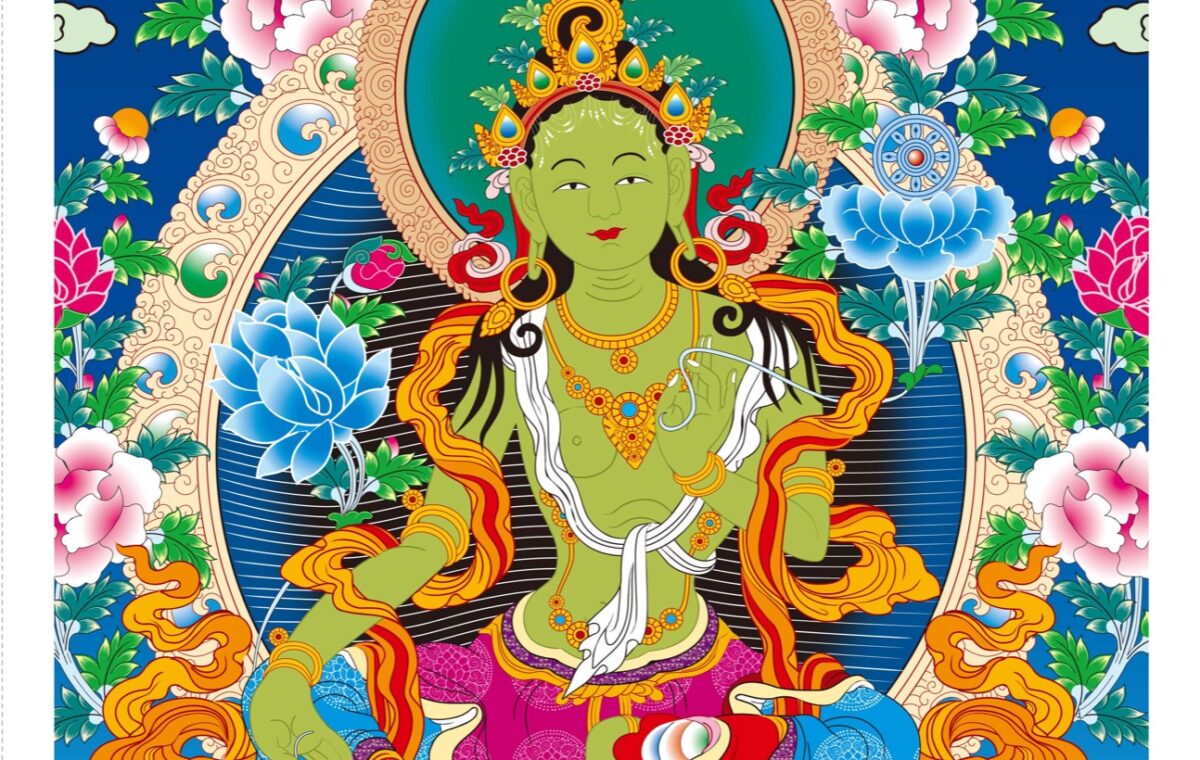
Green Tara is one of the most immediately recognizable figures in Tibetan Buddhist art. Her green body, relaxed yet alert posture, lotus flowers, and extended right leg form a visual language of compassionate activity. Yet identifying a Green Tara thangka requires more than noticing the color green. Artists work within different lineages and regional styles, and surrounding figures can change the meaning and ritual context of a painting. A careful reading therefore combines body color, posture, hand gestures, attributes, and composition.
This guide explains the features most often used to recognize Green Tara and shows how those features work together. It is intended as an introduction to visual identification rather than a substitute for a catalogue record, inscription, or lineage-specific explanation.
Who is Green Tara?
Tara appears in many forms across Buddhist traditions. Green Tara is widely associated with active compassion: compassionate awareness expressed as a readiness to respond. In thangka painting she is usually shown as a youthful, peaceful female figure, richly adorned and seated on a lotus throne. Her expression is calm, but her posture is not completely withdrawn from the world.
The name “Green Tara” is useful for cataloguing, but it should not flatten the complexity of the subject. Texts, practices, and artistic traditions may emphasize different aspects of Tara. Some paintings place her alone; others include teachers, lineage figures, attendant Taras, protective deities, or scenes connected with a particular tradition.
The green body and what it tells us
The most obvious clue is Tara’s green body. In many explanations, green is connected with enlightened activity, movement, and an immediate compassionate response. It also distinguishes this form from White Tara and other color forms of Tara. Color, however, should never be used alone. Pigments age, reproductions shift hue, and artists sometimes work with unusual palettes. A green figure holding a lotus is a strong clue, but posture and gestures should confirm the identification.
When comparing digital images, remember that saturation, white balance, and scanning can substantially alter color. Look for repeated iconographic features rather than relying on a single shade.
The extended right leg: readiness to act
Green Tara is commonly seated in a posture of royal ease. Her left leg remains folded on the lotus seat while her right leg extends or lowers toward a smaller lotus. This asymmetry is central to the image. She is stable and composed, yet visually prepared to rise.
The extended leg is often interpreted as readiness to enter the world of beings. For identification, it is one of the clearest differences between Green Tara and figures shown in a fully symmetrical meditation posture. Study the feet and lotus supports carefully; cropped photographs sometimes hide this essential clue.
Hands, gestures, and lotus flowers
Green Tara’s right hand is often lowered in a gesture of generosity or granting, while the left hand is held near the heart in a gesture associated with protection or reassurance. The exact finger positions can vary in paintings and reproductions, so it is better to read the overall gesture than to force every hand into a single diagram.
Lotus stems commonly rise beside her shoulders. They may be held delicately between the fingers, with blossoms opening near the upper body. These flowers help frame the figure and reinforce her identity, but lotus blossoms appear with many bodhisattvas. The combination of green body, extended right leg, peaceful female form, gestures, and paired lotuses is much more reliable than any one feature.
Crown, ornaments, and garments
Unlike a Buddha shown in monastic robes, Green Tara is usually represented with the ornaments of a bodhisattva: crown, earrings, necklaces, bracelets, anklets, silk scarves, and patterned garments. These do not function merely as decoration. They locate her within a visual category of enlightened figures who remain actively engaged with the world.
Artists use these details to express regional taste and workshop style. A modern line drawing may have crisp blocks of color, while an older painting may model the body and textiles with layered mineral pigments. The iconographic identity can remain stable even when the artistic treatment changes.
How Green Tara differs from White Tara
Green Tara and White Tara are often confused by beginners because both are peaceful female figures associated with compassion and frequently hold lotuses. The most immediate distinction is body color. White Tara is usually white and is commonly depicted with seven eyes: two ordinary eyes, a third eye on the forehead, and eyes on the palms and soles. She is often seated with both legs folded in a more symmetrical meditation posture.
Green Tara is generally green, with one leg extended, and normally does not display the seven-eye arrangement. When color reproduction is unreliable, posture and eyes become especially useful.
Reading the surrounding composition
After identifying the central figure, move outward. Teachers or lineage figures may appear above Tara. Other forms of Tara or related bodhisattvas may sit at the sides. Guardians, offerings, donors, or protective figures may occupy the lower register. These additions can reveal whether the painting belongs to a larger cycle or was made for a particular practice.
Do not assume every surrounding figure is merely decorative. Their placement may establish transmission, hierarchy, and ritual relationships. Compare the painting with securely catalogued examples whenever possible.
A practical identification checklist
- Is the central figure a peaceful, richly adorned female bodhisattva?
- Is the body green?
- Is the right leg extended from the lotus seat?
- Are lotus stems or blossoms positioned near the shoulders?
- Do the hands express generosity and reassurance or protection?
- Do surrounding figures support a Tara identification?
- Does the title, inscription, or collection record confirm the visual reading?
If several of these features agree, the identification is strong. If only the color matches, record the image as uncertain until more evidence is available.
Why comparison matters
The most effective way to learn Green Tara iconography is to compare multiple works. Notice which features remain stable and which belong to a particular painter or period. The extended leg, lotus flowers, gestures, and green body usually remain recognizable, while landscape, textiles, teachers, attendants, and palette may vary dramatically.
For a broader method, read our beginner’s guide to reading a thangka. It explains how to move from the central figure to gestures, attributes, surrounding deities, and written records without guessing from a single clue.