
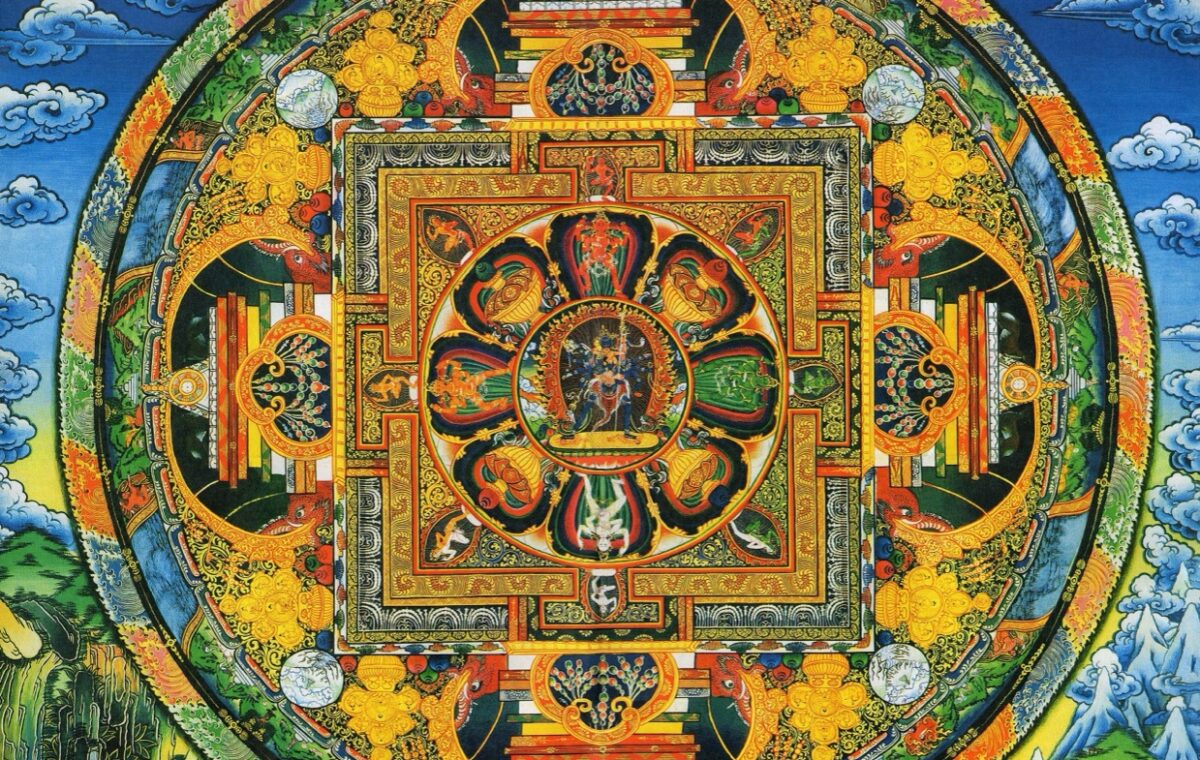
A Kalachakra mandala is one of the most complex images encountered in Tibetan Buddhist art. From a distance it may look like a brilliantly colored geometric design. Up close, it reveals a carefully ordered palace with gates, walls, platforms, circles, directional colors, protective boundaries, and a sacred center. The image is not intended to be understood as decoration alone; its structure organizes a complete contemplative world.
This introductory guide explains how to look at a Kalachakra mandala without pretending that a short article can decode every ritual detail. The safest approach is to begin with visible structure, move from the outer boundaries toward the center, and distinguish general visual observation from lineage-specific interpretation.
What is the Kalachakra mandala?
Kalachakra means “Wheel of Time.” The Kalachakra tradition includes an extensive body of teachings, ritual systems, cosmology, and contemplative practice. Its mandala is a visual and architectural representation connected with that tradition.
A painted mandala is best approached as a plan or sacred diagram rather than a naturalistic landscape. The viewer often looks down into a palace structure while also seeing walls, doors, and ornamental elements from several viewpoints. This deliberate combination allows relationships that would be hidden in an ordinary building plan to remain visible.
Begin at the outside
When first viewing the painting, resist the urge to jump immediately to the smallest details at the center. Start with the outermost circles and borders. These layers establish a protected and ordered space, separating the sacred palace from the unstructured world beyond it.
Depending on the painting, the outer region may include flames, vajra-like forms, lotus petals, geometric bands, offering figures, guardians, or landscape elements. Not every Kalachakra image contains the same amount of detail, and reproductions may crop important borders.
Read the mandala as a sequence of thresholds
A mandala is entered visually through successive thresholds. Outer circles lead toward a square palace. Gates open in the four directions. Inner walls and platforms lead toward increasingly concentrated spaces. The composition continually draws the eye inward.
This outside-to-inside movement is a useful viewing method even when the viewer does not know the technical name of every component. Record the order of forms: outer field, protective circles, lotus or patterned bands, palace walls, gates, inner chambers, and center.
The square palace and four gates
The square structure is one of the clearest features of the mandala. It is commonly oriented toward four directions, with elaborate gates projecting from the middle of each side. These gates may be shaped like architectural entrances with layered lintels, steps, wheels, animals, banners, or ornamental forms.
Because the palace is symmetrical, compare opposite sides. Repeated forms help identify damaged or unclear elements. Directional colors may distinguish the sides, although color assignments should be checked against a reliable source before being given a specific doctrinal interpretation.
Why the image uses several viewpoints
Western linear perspective is not the organizing principle here. Walls may appear folded outward, while gates and platforms face the viewer from multiple directions. This makes the palace legible as a complete symbolic structure.
What may initially look “flat” or inconsistent is therefore purposeful. The image prioritizes relationships and ritual orientation over the illusion of standing at one physical viewpoint.
Moving toward the center
As the eye moves inward, the geometry becomes denser. Smaller squares, circles, petals, colored fields, syllables, implements, or figures may appear. The center is the point of greatest concentration, but it cannot be separated from the paths and boundaries that lead to it.
In high-resolution images, zoom gradually rather than enlarging the center first. The relation between center and enclosure is one of the mandala’s essential visual ideas.
Figures, syllables, and symbolic forms
Some Kalachakra mandalas contain fully painted figures. Others represent figures through Sanskrit or Tibetan syllables, small symbols, or color fields. A viewer unfamiliar with the specific system may not be able to identify every presence from the image alone.
Catalogue descriptions should state what the image visibly contains. If the center uses syllables rather than anthropomorphic figures, record that fact. Detailed ritual identification should be supported by a reliable catalogue, inscription, or specialist source.
Color as organization
Color helps separate directions, architectural levels, and groups of forms. Strong reds, blues, greens, yellows, whites, and dark outlines make a dense image readable. At the same time, digital color is especially vulnerable to scanning and display differences.
Use color to follow the structure, but do not assign meaning based on hue alone. A reliable reading combines position, shape, repetition, and documentary evidence.
Kalachakra mandala and other mandalas
“Mandala” is a broad category. Many Buddhist traditions use mandalas, and their central figures, palace arrangements, retinues, symbols, and colors differ. A complex square palace with four gates does not automatically make an image a Kalachakra mandala.
Confirm the title with an inscription or trustworthy collection record. If documentation is missing, describe the visible composition conservatively instead of assigning a famous name to an unidentified mandala.
A step-by-step viewing method
- Check whether the complete outer border is visible or cropped.
- Identify the outer circular boundaries and repeated bands.
- Locate the square palace and its four gates.
- Compare directional colors and repeated architectural forms.
- Trace the sequence of inner walls and chambers.
- Examine whether figures, syllables, or symbols occupy the inner areas.
- Study the center only after understanding the enclosing structure.
- Compare the visual reading with the title, inscription, and source record.
Common mistakes when reading mandalas
The first mistake is treating the image as a decorative pattern. Its repetition and symmetry are structural. The second is trying to identify every tiny mark from a compressed web image. Some details require the original file or a specialist photograph.
A third mistake is assuming that any colorful geometric Buddhist painting is Kalachakra. Use documentation. A fourth is stripping the central area from the outer boundaries; the complete composition communicates relationships that a cropped detail cannot.
Using high-resolution images responsibly
Large mandala files are valuable for research because small inscriptions, directional markers, and repeated forms can disappear in thumbnails. Record the source, file history, rights status, and any modifications to color or crop. A high-resolution file improves observation but does not by itself prove a historical attribution.
To develop a general reading sequence for central figures, attributes, colors, and surrounding registers, begin with our guide to reading a thangka. The same principle applies here: combine observation with source documentation and make uncertainty visible.