
THANGKA BASICS
Reviewed August 8, 2026 · By TANGKAWORLD Editorial Team
A thangka is a portable sacred image used in Tibetan and Himalayan Buddhist traditions. Many thangkas are paintings made on prepared cotton or silk and mounted in textile borders so they can be hung, rolled, stored and transported. The term identifies a format, not one subject: a thangka may depict a Buddha, bodhisattva, teacher, protector, lineage, narrative scene or mandala. Painted examples are common, but thangkas can also be embroidered, woven, printed or made with appliqué.
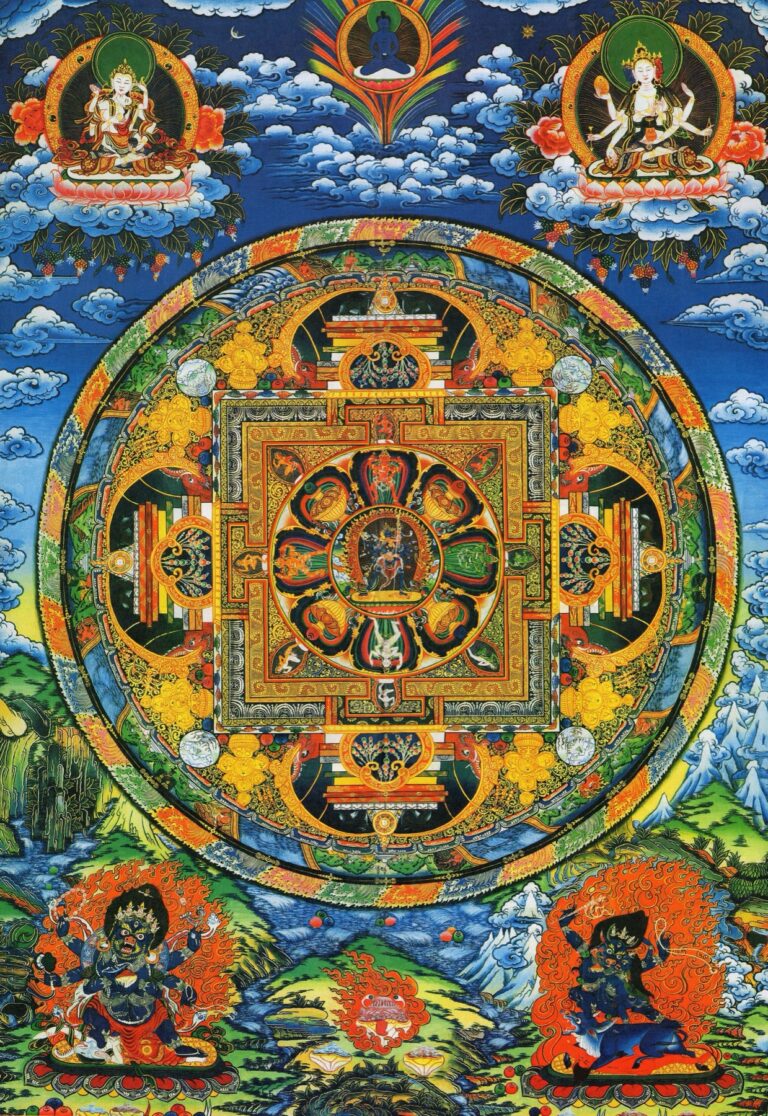
Thangka at a glance
- Format: a portable hanging image, often designed to be rolled.
- Common materials: pigments on prepared cotton or silk, frequently with a brocade mount.
- Possible subjects: Buddhas, bodhisattvas, teachers, protectors, mandalas, lineages and narratives.
- Common functions: teaching, meditation, visualisation, ritual, devotion and commemoration.
- Important distinction: “thangka” describes the portable image format; “mandala” describes a sacred diagram or organised symbolic space.
What makes an image a thangka?
A painted thangka usually consists of a prepared cloth support, a carefully drawn composition, layers of colour and fine outlines. Finished paintings may be sewn into a textile mount with a top hanging support and a lower rod that helps the image hang flat and roll from the bottom. The Rubin Museum’s process guide documents the preparation of the canvas, proportional drawing, colour application, detailing and brocade mounting.
Not every work keeps its original mount. Museums may preserve an unmounted painting, and modern reproductions may copy the image without its textiles. For that reason, cataloguing should consider the support, technique, composition and available documentation together. A decorative border by itself does not prove that an image is a historical thangka.
How traditional thangka paintings are made
The painter prepares and stretches the cloth, applies a ground, and lays out the composition. Sacred figures follow established systems of proportion known as iconometry. These systems help organise the body, seat, halo, implements and surrounding figures, while landscapes and decorative passages may allow more regional or individual variation. Colour is added in stages, followed by shading, outlines and selected gold details. The eyes are often completed near the end of the painting process.
This description is a general process, not a test of age or authenticity. Materials and workshop practices vary, later repairs may be present, and printed, woven or appliqué thangkas use different production methods. A high-resolution image can reveal visible brushwork and condition, but it cannot replace physical examination, technical analysis or documentation.
How thangkas are used
Thangkas may support meditation, teaching, visualisation, ritual and private devotion. They can be displayed in temples, shrines, teaching spaces or homes, then rolled for storage and transport. The Smithsonian’s Shadakshari Avalokiteshvara learning resource explains how a textile cover protected a painting when it was not being used. Some very large textile or painted images are displayed publicly during festivals, but their scale and function differ from smaller portable works.
The image is not simply an illustration. In a religious setting, its subject, proportions and iconographic attributes can guide recognition and practice. The Metropolitan Museum of Art notes that many Tibetan Buddhist paintings and sculptures were created as aids to meditation and were also commissioned for devotional or commemorative purposes.
How to read a thangka step by step
- Start at the visual centre. Identify the main figure, group or palace before interpreting small details.
- Record visible attributes. Note posture, hand gestures, body colour, number of arms and faces, implements, seat, halo and crown.
- Read the hierarchy. Teachers often appear above; attendants, donors, offerings or protectors may occupy side and lower registers.
- Follow the structure. In a mandala, move from outer protective circles and gates toward the central palace and resident deity.
- Check text and records. Inscriptions, titles and specific museum object pages can confirm or challenge a visual identification.
- Keep uncertainty visible. Similar colours or poses are not enough to establish a deity, date, artist, school or provenance.
For a fuller method, continue with our beginner’s guide to reading a thangka.
Thangka and mandala: what is the difference?
| Term | What it describes | Example |
|---|---|---|
| Thangka | A portable sacred image format, often painted on cloth and mounted for hanging and rolling. | A painted portrait of Green Tara in a brocade mount. |
| Mandala | A symbolic diagram or organised sacred environment centred on a deity or principle. | A square palace inside concentric protective circles. |
A mandala can be painted as a thangka, but many thangkas are not mandalas. They may present a single deity, a teacher, a lineage assembly or a narrative. Likewise, a mandala may be constructed in sand, modelled in three dimensions or represented in another medium. The Smithsonian’s Four Mandala Vajravali Thangka is a useful object-level example of mandala structure represented in a painted cloth work.
Why identification and dating require caution
Thangka traditions developed through long exchanges among Tibetan, Indian, Nepalese, Chinese and Central Asian artists and patrons. Styles can overlap, workshops can repeat older compositions, and many works are unsigned. The Met’s overview of Tibetan Buddhist art describes this regional diversity and notes that many artists remain anonymous. A precise attribution should therefore be tied to inscriptions, documented provenance, technical evidence or a reliable collection record. When that evidence is absent, “uncertain” is more accurate than a confident guess.
Frequently asked questions
Is every thangka painted?
No. Painting on cloth is common, but thangkas may also be embroidered, woven, printed or created with appliqué.
Is every thangka a mandala?
No. A mandala is one possible subject. Many thangkas portray a single figure, teacher, lineage or narrative scene.
Can a photo prove a thangka’s age or authenticity?
No. A photograph can support visual comparison, but reliable dating and authentication may require provenance, inscriptions, physical examination and technical analysis.
Sources and further reading
- Rubin Museum of Himalayan Art — Process of Thangka Painting
- The Metropolitan Museum of Art — Tibetan Buddhist Art
- National Museum of Asian Art — Shadakshari Avalokiteshvara
- National Museum of Asian Art — Four Mandala Vajravali Thangka
Explore more Thangka art
Visit Learn for guides to Buddhist deities, attributes, mandalas and visual identification. To study a broader range of examples at high resolution, view the complete Thangka image collection in JPG and high-resolution TIF.