
Good alt text for Thangka images helps a person using a screen reader understand what a picture contributes to the page. The task is visual description, not a list of Buddhist terms or a claim about an image’s history. A concise line can name the visible subject, describe one or two useful details, and leave uncertain identities open. This guide offers a repeatable method for Buddhist art collections, with a worked example from TANGKAWORLD image TK1111.
What alt text needs to do
Alternative text gives a textual equivalent for meaningful image content when the image itself cannot be seen or loaded. For Buddhist art, useful details may include the number and arrangement of figures, their posture, a distinctive object, and a feature of the surrounding composition. The reader needs enough information to follow the article’s point, not every color, ornament, or brush mark.
Alt text also supports the accessibility of an image archive and provides search engines with contextual information. Its first job, however, is to serve people. Repeating a target keyword, adding promotional wording, or guessing a deity’s name does not make a description more helpful.
A practical formula for alt text for Thangka images
Start with what a viewer can verify, then add only the detail that matters to the page:
- Subject: identify the visible object or group at the level of confidence the evidence supports.
- Action or arrangement: say what the figures are doing or how they relate to one another.
- One or two distinguishing details: mention an attribute, gesture, seat, halo, canopy, inscription panel, or landscape when it helps distinguish the image.
- Context only when useful: name a tradition or narrative if the identification is documented and relevant to the article.
- Stop: leave secondary decoration and unsupported interpretation to the caption or a longer description.
A compact pattern is: “[subject] [action or arrangement], with [distinctive visible detail].” For example: “A seated Buddha touches the earth, with two standing attendants beside the lotus throne.” If the exact Buddha is not confirmed, the visual description remains useful without inventing a name.
Worked example: describing TK1111 carefully
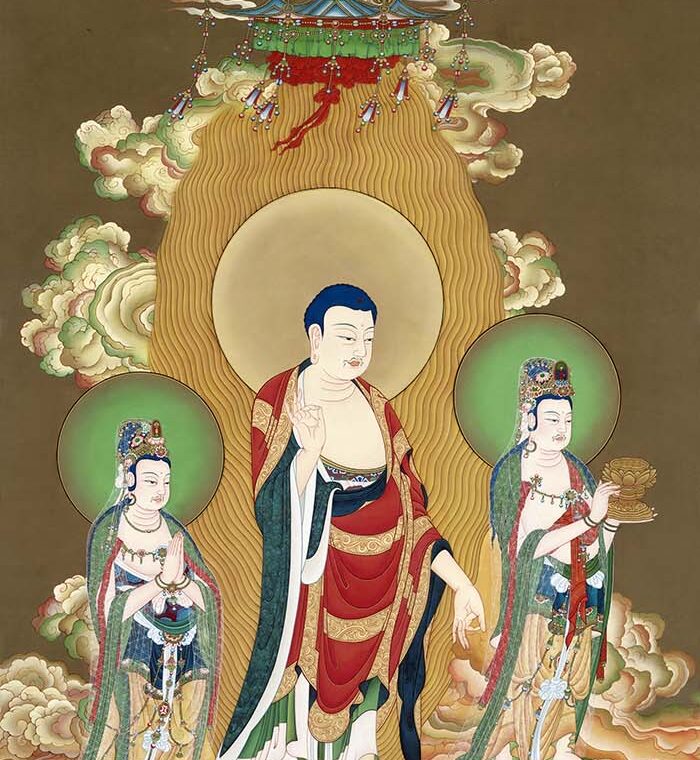
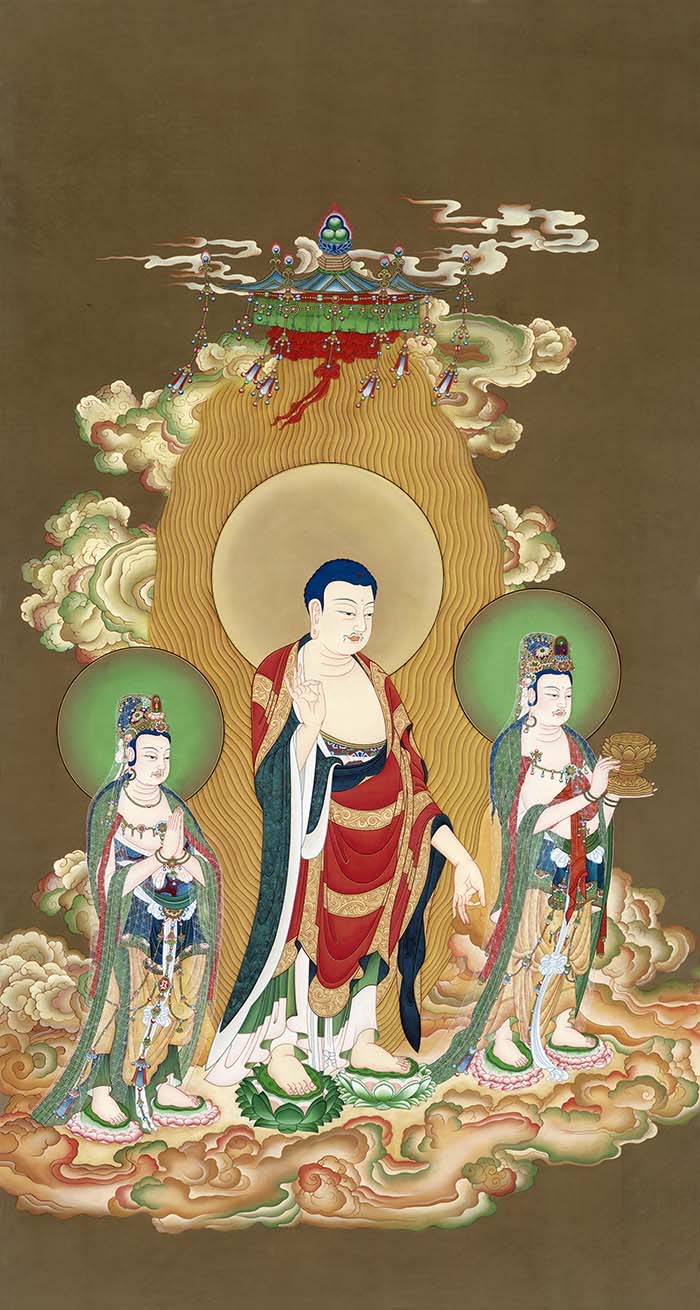
The source image for TK1111 shows three haloed figures standing on lotus bases above layered clouds. The central figure is larger and raises one hand; a jeweled canopy sits above the group. The local archive title places the work in a Western Pure Land triad category. That label is useful catalog context, but it does not independently confirm the identities of the two attendants.
A balanced alt text is: “Three haloed Buddhist figures stand on lotus bases above layered clouds; the larger central figure raises one hand beneath a jeweled canopy — TK1111.” It describes the composition and includes the archive identifier. It does not silently turn a catalog label into certainty about each figure.
If an article is specifically explaining the archive label, the caption can add that context and qualify it: “The archive labels this image as a Western Pure Land triad; the attendants’ identities remain uncertain.” Separating visible description from catalog interpretation keeps both statements clear. For broader guidance on reading figures and symbols, see how to read a Thangka.
When an iconographic name is uncertain
Buddhist figures can share crowns, robes, lotus flowers, jewelry, halos, and hand gestures. A single attribute rarely proves an identity. Check the whole figure, the surrounding assembly, inscriptions, ritual context, and a reliable catalog record before naming a deity or Bodhisattva. If the evidence is incomplete, describe what is visible and write “identity uncertain” in the caption or long description where that qualification is important.
This is especially useful in a mixed collection containing Tibetan Thangka, Chinese Buddhist paintings, ritual diagrams, and later copies. Similar-looking compositions may belong to different traditions, and digital reproductions cannot always resolve small attributes. Our guide to studying Thangka iconography with high-resolution images explains how to compare visible details while keeping attribution and identification separate.
Alt text, captions, filenames, and long descriptions
These fields do different jobs. The filename helps manage a digital asset. A caption can provide a title, date, source, or uncertainty note. A media description may hold fuller catalog information. Alt text should give the reader the image information needed at that point in the page. Copying the same paragraph into every field makes the page repetitive and can burden screen-reader users.
Some complex paintings require more than a short alt attribute. A dense Mandala, narrative scroll, or large assembly may contain many meaningful regions. Keep the alt concise, then offer a nearby caption or linked long description that explains the layout and important episodes in order. Readers who need the detail can reach it without hearing a miniature catalog essay every time the image is announced.
If an image is purely decorative and adds no information beyond nearby text, a blank alt attribute may be appropriate so assistive technology can skip it. A featured artwork used as evidence or the subject of discussion is informative, so it generally needs a meaningful description.
Common Buddhist art image-description mistakes
- Keyword stuffing: repeating “Thangka,” deity names, and search phrases makes the line awkward and less useful.
- Unsupported identification: naming a specific deity, artist, dynasty, school, or ritual use from appearance alone turns a guess into apparent fact.
- Vague wording: “Buddhist image” or “beautiful painting” omits the composition a reader needs.
- Excessive detail: listing every color, cloud, border, and jewel can obscure the main subject.
- Duplicate fields: repeating a long caption word for word as alt text makes listening cumbersome.
- Promotional language: “buy,” “best,” or “download now” does not describe the image.
For collection care and research, record uncertain identifications, condition, and provenance in the appropriate catalog fields rather than making the image description carry every qualification. The Thangka condition-report checklist separates visual observations from conclusions about an object’s history.
A quick editorial checklist
- Read the surrounding paragraph: what information does the image add?
- Look at the actual image at the size a reader will encounter it.
- Write one short sentence about the main subject and its arrangement.
- Add a distinctive visible feature only if it helps the reader.
- Verify every named figure and historical claim against a trustworthy record.
- Mark uncertain identities in a caption or long description instead of guessing.
- Remove repeated keywords, promotional phrases, and details already stated nearby.
- Listen to the page with a screen reader or text-to-speech preview when available.
Conclusion
Useful alt text for Thangka images gives readers a clear account of what is visible, why it matters on the page, and where identification remains uncertain. A short, evidence-led description makes Buddhist art collections easier to explore while keeping interpretation honest. Apply the same care to every file in an archive: describe the picture, document the source separately, and let well-supported catalog research carry historical claims.
Download the full Thangka image collection
Continue browsing and download the complete TANGKAWORLD gallery to study Buddhist iconography, composition, and visual details across the collection. Download the full Thangka image collection.