
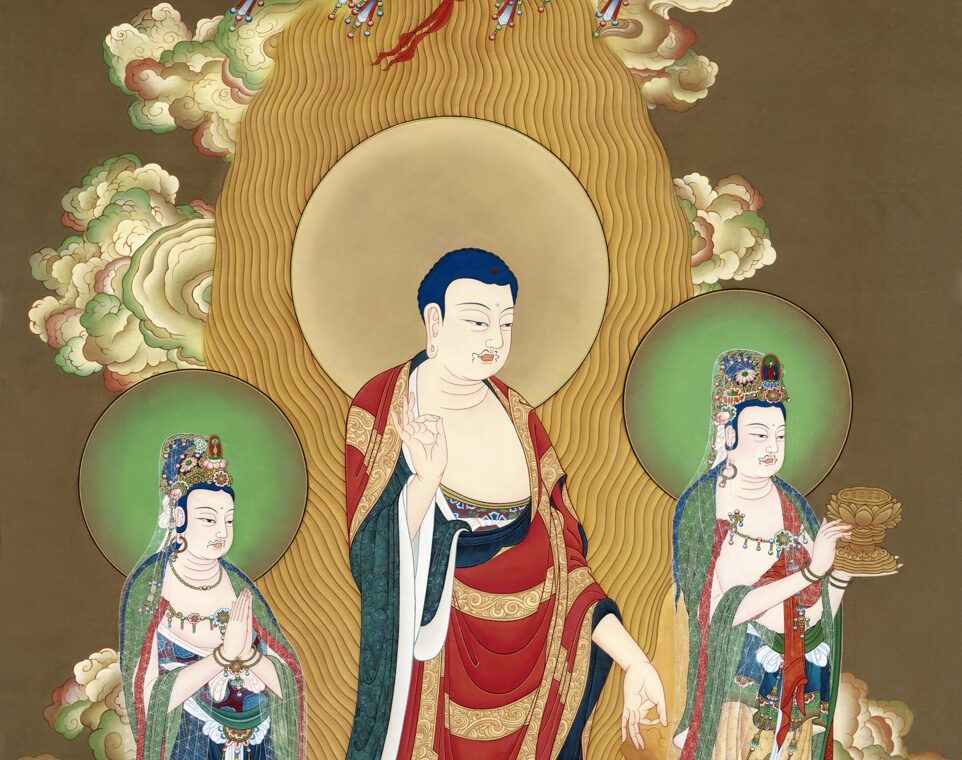
A jeweled canopy in Buddhist painting can draw the eye toward a principal figure, but its appearance alone does not establish a date, ritual function, or specific tradition. A careful reading starts with visible evidence: the structure’s position, form, ornament, and relationship to the figures beneath it. This guide applies that method to TANGKAWORLD image TK1112 and shows how to describe a canopy without turning visual resemblance into a historical claim.
Begin with what the canopy visibly is
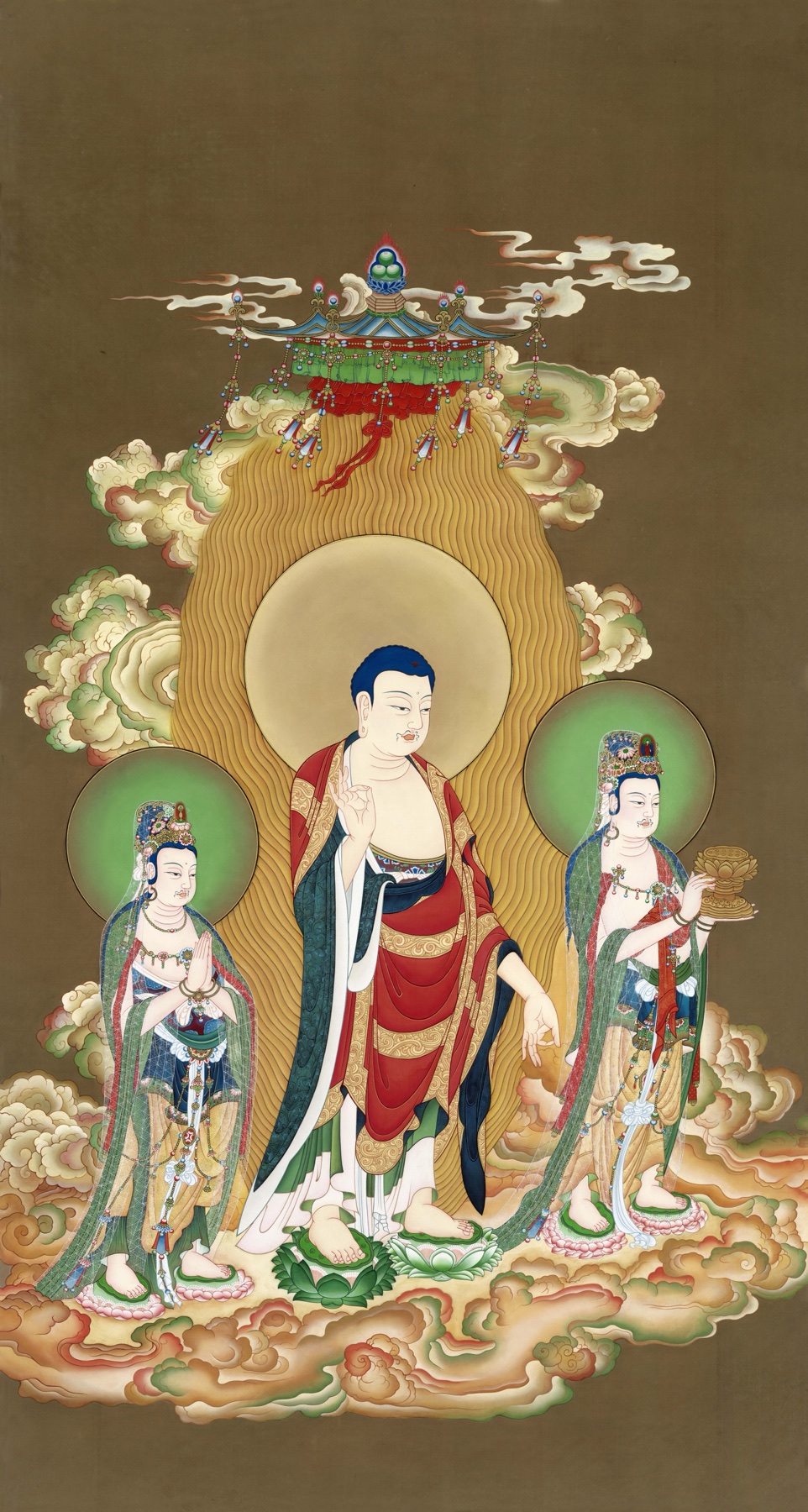
In TK1112, the upper structure sits above the central figure, near the vertical axis of the composition. It has a raised, roof-like frame, bright ornamental details, bands of green and red fabric, and hanging tassels. Clouds gather around the structure and continue across the background. These are observable features; describing them does not require deciding whether the painted form represents a particular building, a ceremonial object, or a symbolic realm.
Record a visual feature at the level the image supports. “A jeweled canopy with hanging fabric” is safer than naming a pavilion or ritual implement when no inscription or catalogue source confirms one. If a close view resolves a detail, describe it. If it does not, use “canopy-like structure” rather than guessing.
Read placement before assigning meaning
Ask where the canopy sits in relation to the main figure, halo, attendants, clouds, and borders. Does it align with the central axis? Does it cover only one figure or extend over an assembly? Does its lower edge overlap a halo, or remain visually separate? These observations explain how the composition directs attention even when the original meaning is uncertain.
For TK1112, the canopy is centered above the larger standing figure and is visually connected to that figure by the vertical arrangement. Its width does not simply repeat the halo’s circular outline: it forms a separate, layered element above the heads. The flanking figures remain visible on either side. This arrangement can be described as a visual frame; it should not automatically be translated into a claim about rank, ritual use, or historical setting.
Distinguish a canopy from nearby forms
Buddhist paintings can place several framing devices close together. A halo is usually organized around a head or body; a cloud bank is a natural or stylized atmospheric form; a tree canopy is built from branches and foliage; a parasol is generally recognizable as an umbrella-like object. Ornament may blur those categories, so follow the painted outlines instead of relying on a single color or shape.
In TK1112, the jeweled upper form has a constructed frame and hanging textiles, while the clouds form irregular contours around it. That visible difference is enough for a description. For a tree formed by branching lines and foliage, compare our guide to reading a sacred tree canopy in Buddhist art. The word “canopy” can describe both subjects, but a tree canopy and a built or textile-covered canopy are not interchangeable motifs.
How the canopy relates to the figures
Compare the canopy with the figures beneath it using four simple questions:
- Alignment: Is its highest point above the central figure, or does it shift toward one side?
- Scale: Is it wider than one halo, or does it span the whole group?
- Boundary: Do tassels, fabric, clouds, or frame lines touch or cross a halo?
- Repetition: Are jewels, roof tiers, or hanging elements repeated symmetrically?
These comparisons make a close-looking note useful to another reader. They also help separate composition from identity. In TK1112, the central figure is larger, stands on the main axis, and raises one hand; the left attendant joins the palms, while the right holds a lotus-like object. The canopy reinforces the central alignment. None of those observations alone proves the names of the figures.
For a broader method of separating scale, placement, and identification, see scale hierarchy in Buddhist art and the high-resolution iconography study guide.
What a jeweled canopy cannot prove by itself
A richly decorated canopy may look courtly, architectural, or ceremonial to a modern viewer. That resemblance is a starting observation, not evidence of the painting’s original use. Ornament by itself cannot securely establish the object’s date, workshop, patron, region, ritual setting, or whether the canopy represents a specific sacred structure. Nor can a repeated jewel pattern prove that two paintings belong to the same school.
TK1112’s local file grouping associates it with a Western Three Saints subject, but the current record does not independently verify that title or the identities of the attendants. Accordingly, this article describes the central figure, side figures, halos, clouds, and canopy without assigning names. If future research supplies an inscription reading, provenance record, or specialist catalogue, that evidence can be added with its source and level of certainty made explicit.
A documentation checklist for Buddhist painting canopies
- View the complete image before zooming in; record where the canopy sits in the whole composition.
- Describe the frame, tiers, fabric, tassels, jewels, and visible supports separately.
- Note its alignment and scale relative to figures, halos, clouds, and borders.
- Distinguish a built or textile-covered form from branches, foliage, clouds, and an umbrella-shaped parasol.
- Record damage, cropping, or obscured details only when visible; do not infer a cause from a web reproduction.
- Keep date, maker, school, patron, ritual function, and figure identities uncertain unless a reliable source supports them.
- Use a caption for catalogue context and image alt text for concise visual information.
This observation-first approach also complements our Thangka condition-report checklist. For accessible image wording, see the practical guide to alt text for Thangka images.
Conclusion
A jeweled canopy can organize attention and help readers understand how a Buddhist painting is composed. The reliable first step is to describe its visible structure and placement, then compare it with halos, clouds, trees, and parasols. Interpretive claims about a canopy’s date or purpose require evidence beyond ornament. With TK1112, the roof-shaped frame, colored hanging fabric, tassels, central alignment, and surrounding clouds can be documented clearly while the names and history remain open to verification.
Download the full Thangka image collection
Continue browsing and download the complete TANGKAWORLD image gallery to compare Buddhist paintings, canopies, figure arrangements, and other visual details across the collection. Download the full Thangka image collection.