
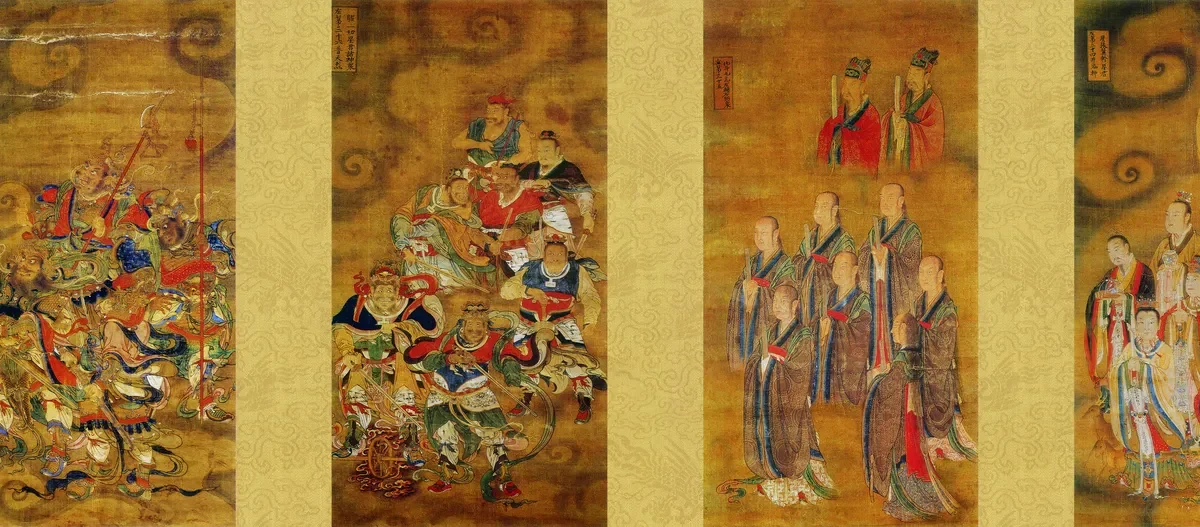
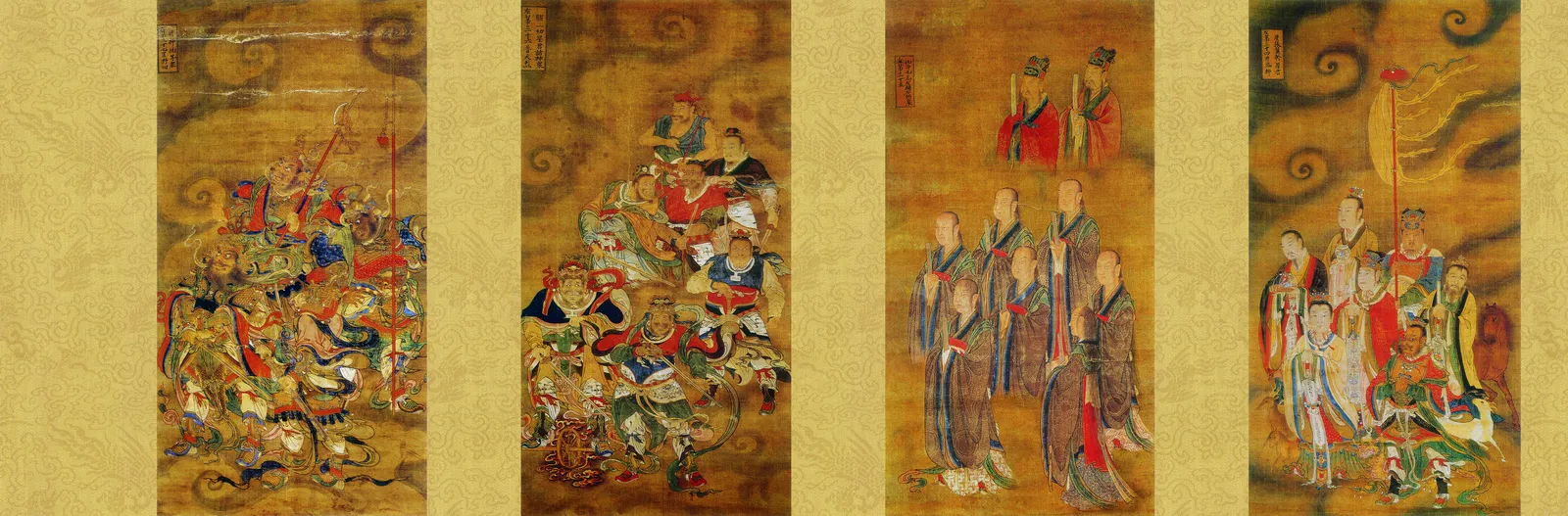
TK0181 is a long horizontal painting segment cataloged within an archive grouping titled “Shanxi Water-and-Land Ritual Painting Handscroll.” Its surface presents several contrasting gatherings: densely overlapping figures, more upright assemblies, varied costumes and attributes, and narrow dark-bordered inscriptions or labels. Those visible details invite careful comparison. They do not, by themselves, identify every figure, explain every inscription, or establish the object’s date, artist, original setting, or provenance. This guide reads TK0181 as an image first, keeping the archive title as useful context rather than treating it as independent proof.
Begin with the format, not a guessed story
A handscroll is not normally experienced as a single wall-sized scene. It is unrolled and viewed in sections, allowing attention to move gradually along the image. The Metropolitan Museum of Art describes this intimate, sequential mode of viewing and notes that inscriptions, colophons, and seals can form part of a scroll’s documentary history. That general guidance is useful for TK0181, but the museum’s essay is about handscrolls as a format; it does not document this particular image.
The available TK0181 reproduction is a long crop. It lets us compare the painted groups side by side, but it cannot confirm the original scroll’s full sequence, mounting, adjoining sections, or the direction in which a historical viewer encountered this particular passage. For now, describe what the crop shows and keep any proposed narrative provisional.
What stands out in TK0181
Dense, active clusters
Some groups are crowded with overlapping bodies, angled limbs, lifted hands, and strong changes in costume color. The figures appear to interact, but a static image alone may not reveal whether they are debating, performing a rite, moving in procession, or taking part in another activity. Record the pose and relationship before assigning an event: “two figures face one another,” “a raised arm crosses the group,” or “several bodies overlap” is more defensible than a named episode without corroborating evidence.
More upright assemblies
Other areas feel more ordered. Figures stand or sit closer to a shared vertical axis, and their garments create a steadier rhythm of red, pale, green, and dark tones. This contrast can help a reader see that the handscroll is not visually uniform. It may contain different kinds of gatherings or roles, but “formal assembly” is a description of composition, not proof of a specific court, deity group, or ritual station.
Labels and inscription panels
Several narrow, dark-bordered panels sit near the upper part of the scene. Their position makes them important visual anchors: they separate or mark passages and may connect writing to nearby figures. In this reproduction, however, the characters are too small to transcribe reliably. Their presence is observable; their reading and function remain uncertain. A close study should use a high-resolution file, compare the marks with the original object where possible, and document any transcription separately from interpretation.
How Water-and-Land context helps—and where it stops
The archive groups TK0181 with a Shanxi Water-and-Land ritual painting handscroll. The phrase “Water-and-Land” points toward a broad Buddhist ritual context, but the title alone cannot prove that every depicted figure belongs to a known roster or that the present crop preserves the original order. The Smithsonian National Museum of Asian Art’s record for a different scroll, Daoist deities and attendants, explains that one such painting belonged to a set used in a Water-Land Prayer Rite and that these services could bring Buddhist and Daoist divinities and beings from different realms into a ritual arena. This is valuable comparative context—not evidence that the Smithsonian object and TK0181 share an artist, date, collection, or exact function.
That distinction matters because mixed visual vocabularies are possible in Chinese religious painting. A figure’s clothing, crown, weapon, scroll, or animal companion may suggest an identity, yet attributes can be shared, altered, or difficult to read in a reduced image. Treat the archive’s category as a research lead. Confirm a specific identification through legible inscriptions, a reliable catalog, or a well-matched iconographic comparison.
A practical checklist for reading the image
- Map the crop: note the left and right edges, visible breaks, background changes, and any signs that the image continues beyond the frame.
- Separate groups: count approximate clusters and record how posture, spacing, and color distinguish them.
- Describe attributes literally: write “long object held upright” before calling it a staff, banner, or ritual implement.
- Log inscriptions carefully: record location, orientation, border, and legibility; mark unreadable characters as uncertain instead of guessing.
- Compare cautiously: use the site’s TK0180 guide to patterned dividers for a different segment in the archive grouping, and the Water-and-Land ritual painting overview for broader context. Do not transfer TK0180’s visual observations to TK0181.
- Keep an evidence trail: distinguish visible features, archive wording, published scholarship, and your own hypothesis in separate notes.
Use comparison without collapsing the differences
When comparing neighboring sections, make a simple table with one row per crop: number and approximate position of groups, dominant colors, posture, visible attributes, panel placement, and image condition. This creates a reproducible record and helps distinguish a recurring feature from a detail unique to one segment. TK0180, for example, was discussed for its pale patterned dividers; TK0181 instead offers contrasting figure density and bordered panels. A shared archive grouping is a reason to compare them, not a license to assume identical scenes or functions. If a proposed identification depends on a panel, preserve a close crop and note its source resolution so another researcher can assess the reading.
What a close reading can establish
TK0181 clearly rewards comparison: crowded, energetic groups sit alongside more upright assemblies, while bordered text panels punctuate the composition. These features support a structured visual description and a set of careful research questions. They do not settle the names of the figures, the transcription of the labels, the scroll’s original sequence, or its maker and date. Those points remain uncertain unless independently documented.
For further study, compare this segment with the separate TK0180 handscroll guide and the broader Water-and-Land overview. Read each image on its own terms, then use catalog records and museum research to test—not replace—what the surface shows.
Download the full Thangka image collection
Continue exploring and download the complete TANGKAWORLD image collection from the free downloads page. Browse the archive to compare Buddhist and Daoist figures, ritual scenes, and handscroll details while keeping uncertain identifications clearly labeled.