
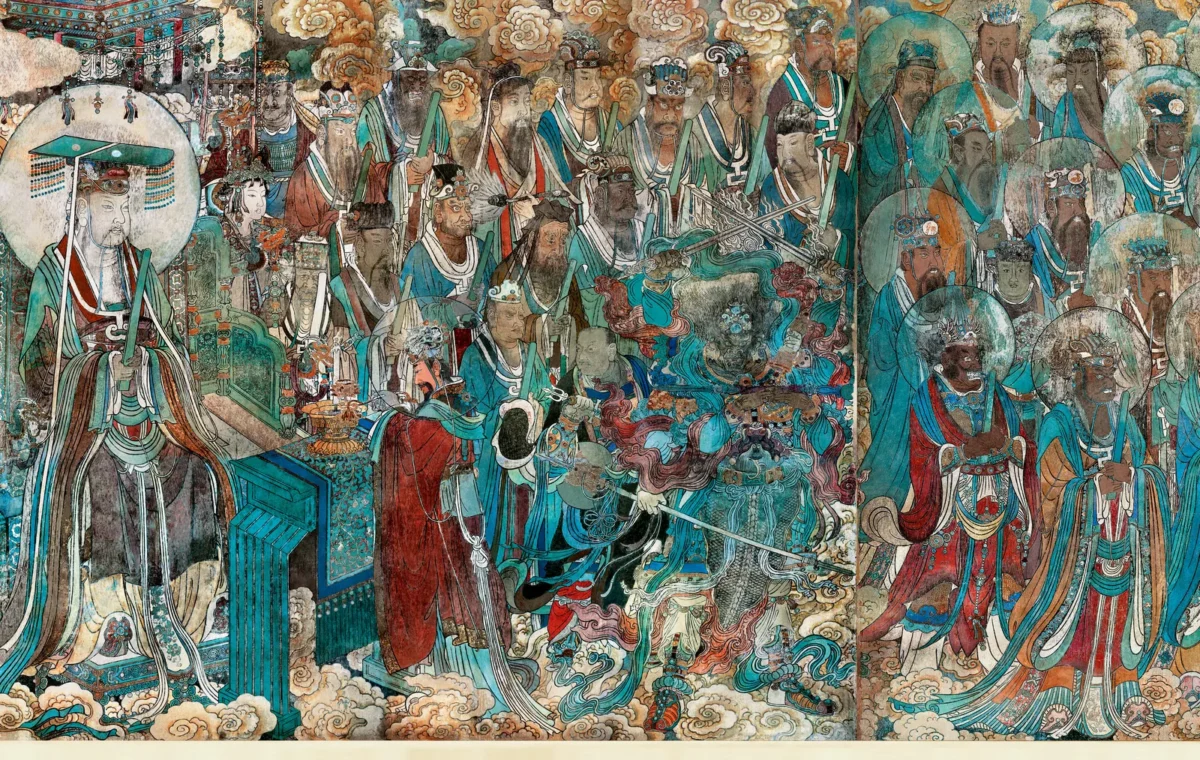
TK0676 is best approached as a cropped mural image, not as a fully identified scene. In this reproduction, a turquoise canopy and a stepped rectangular structure occupy the left foreground, while a dense group of robed figures and cloud forms fill the center and right. Those visible relationships make the crop useful for studying how architecture-like forms organize a procession. The exact purpose of the structure, the names of the figures, and the crop’s precise position in the original mural remain uncertain; careful looking is more informative than guessing.
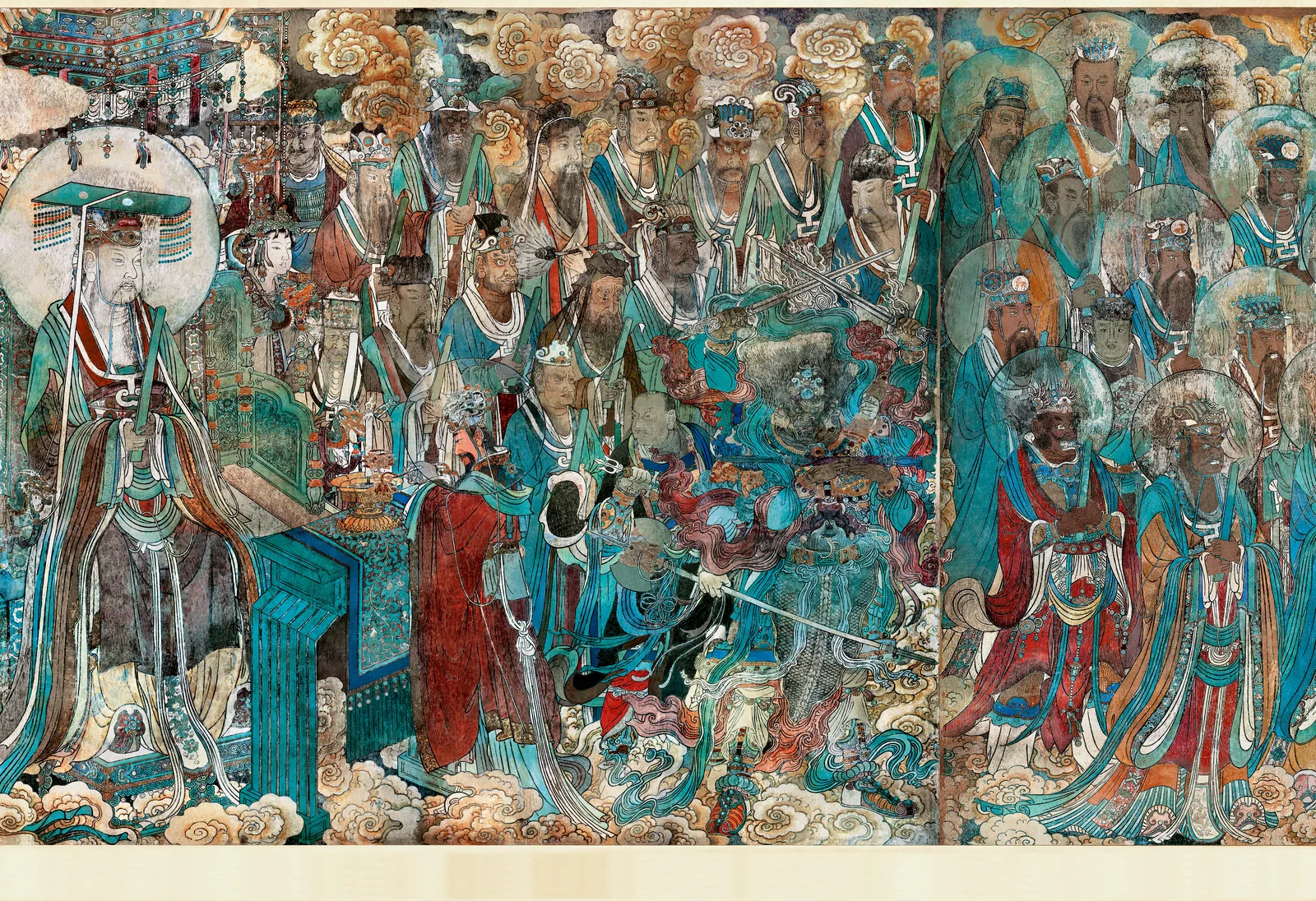
Begin with the frame, not a name
Before interpreting a religious subject, note what the crop includes and excludes. The left edge cuts through an architectural-looking arrangement: a broad turquoise canopy projects over a pale, rounded area, and patterned bands hang from its edge. Below it, a tall, stepped turquoise form rises from the lower margin. To the right, figures overlap one another in layered robes, with faces, headwear, sleeves, and long objects partly obscured. Clouds fill gaps between bodies and continue across the upper field.
This is an observation, not an identification. The crop does not show enough of the surrounding wall, inscriptions, or complete object to tell whether the foreground form is a throne, altar, platform, furnishing, or another painted element. Even “canopy” is a visual description of its shape, not a claim about its ritual use. Keeping that distinction explicit protects the record from turning plausible interpretation into false certainty.
How the turquoise structure anchors the composition
The bright green-blue foreground interrupts the warm reds, browns, and pale garments behind it. Its straight edges and stacked horizontal levels contrast with the softer curves of clouds and clothing. That contrast creates a visual anchor: the eye first registers a stable, block-like form, then moves upward to the canopy and outward to the animated group of figures.
The canopy adds another layer. Its projecting roofline forms a sheltered zone at the left, while hanging ornaments create narrow verticals beneath it. The structure therefore works compositionally even when its identity is unknown. It separates a partially enclosed area from the open field of cloud and figures, giving the viewer a point from which to read the procession rather than presenting every figure as an equally weighted detail.
Notice the crop boundary carefully. The canopy is cut off at the left and top, and the lower structure meets the bottom edge. The full painting may reveal supports, a larger building, or a relationship to figures outside this frame. Since those elements are not visible here, do not reconstruct them from expectation. Record the boundary as part of the evidence.
Cloud bands and overlapping figures create movement
At center and right, heads and shoulders overlap at several depths. Repeated faces and robe contours make the group feel continuous, while cloud bands weave between figures and lead the eye across the panel. Long objects held by some figures add directional lines, but the reproduction does not resolve every attribute clearly enough to name it. Describing them as staffs or elongated objects is safer than assigning a specific ritual or military function.
The result is a useful contrast between stillness and movement. The turquoise forms are geometric and visually stable; the clouds and bodies are irregular and crowded. The structure does not merely decorate the scene. It establishes a calm foreground against which the procession’s density becomes more legible. This reading concerns the crop’s visual design and does not establish narrative sequence or the status of any individual figure.
Color, pattern, and visible condition
The turquoise area contains darker outlines and patterned accents, while nearby garments combine pale blue-green, red, and cream. These colors help distinguish planes and overlapping forms at a glance. Small decorative details should be described only when they remain clear at the source image’s scale. A pattern that blurs in a web reproduction should not be transcribed as a precise motif.
Some portions of the crop appear mottled or worn, especially where pale patches interrupt darker contours. A digital image cannot establish whether a pale area reflects pigment loss, plaster, restoration, lighting, image processing, or compression. Use location-based language—such as “irregular pale patches beside the canopy”—and leave the cause undetermined unless conservation records or examination of the wall support a diagnosis. Also keep the condition of the mural distinct from the condition of this particular digital file.
Use museum context without overclaiming
The Guangdong Museum’s exhibition overview describes the Chaoyuan Tu in the Hall of the Three Purities at Yongle Palace and notes that the palace’s construction began in 1247 under the Quanzhen School of Daoism. Its exhibition included a 3D recreation of the monumental mural. This is useful context for understanding why a crowded celestial procession and architectural forms belong to a wider Daoist mural program. It does not independently prove that this exact digital crop is complete, accurately aligned, or catalogued to a specific place within the hall. Read the Guangdong Museum’s exhibition overview for the institutional account.
The local archive groups TK0676 with images labelled as segments of a Yongle Palace mural. Treat that folder label as collection metadata and a lead for research, not as standalone proof of date, authorship, restoration history, or provenance for this individual file. A full-wall photograph, published catalogue, or conservation record would be needed to verify more specific claims.
Compare details, not assumptions
A nearby article, TK0679: Reading an Armored Figure in a Yongle Palace Mural, studies a different crop in the same archive grouping. Comparing the two can help readers notice recurring visual devices—cloud bands, layered figures, saturated blue-green passages, and directional attributes—without assuming that the crops meet or depict a single continuous episode. Comparison is strongest when each image is first described on its own terms.
For a disciplined record, the site’s visual condition-report checklist offers a useful observation-first method: separate what is seen from what is inferred, note image limitations, and record uncertainty explicitly. Adapt the fields to mural imagery rather than treating a thangka checklist as a substitute for architectural or conservation documentation.
A visual checklist for TK0676
- Describe the canopy by shape, color, position, and visible decoration before assigning a function.
- Record the stepped turquoise form as an architectural-looking structure; leave its object identity open.
- Mark which figures and structural details are cut by the crop edges.
- Separate geometric foreground forms from cloud bands and overlapping bodies.
- Describe long held objects only to the level of detail the image supports.
- Locate pale or mottled areas; do not diagnose their cause from a reproduction.
- Keep archive labels, museum context, and direct visual evidence in separate notes.
- Revisit all identifications when a full mural image or authoritative catalogue becomes available.
Conclusion: let the structure guide the eye
TK0676 shows how a strong foreground form can organize a crowded mural crop. The turquoise canopy and stepped structure create a stable left-side anchor; clouds and overlapping figures carry movement across the rest of the image. That is a substantial reading without naming an object or deity the evidence cannot securely identify. For researchers, collectors, and viewers, the method is simple: describe first, compare second, and keep uncertainty visible.
Download the full Thangka image collection
Continue browsing and download the complete TANGKAWORLD image collection from the free downloads page. Explore the images side by side, and preserve clear distinctions between visual evidence, archive metadata, and interpretations that still need verification.