
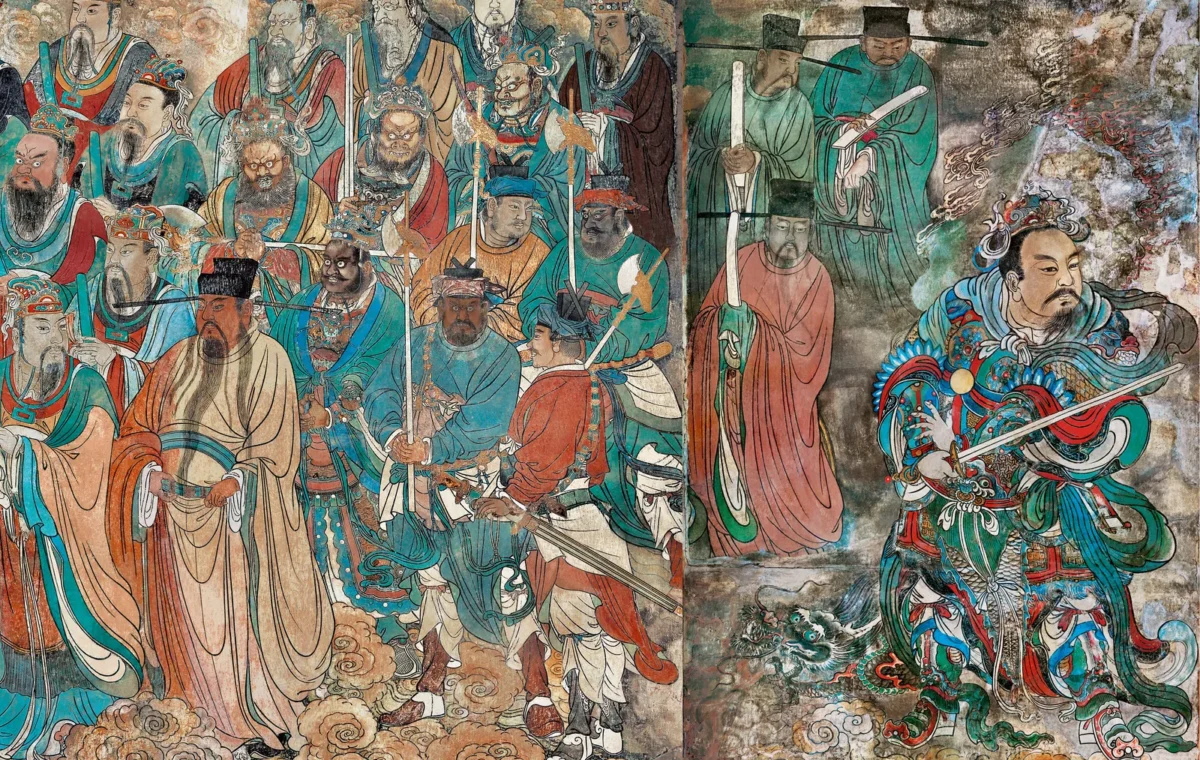
TK0679 is a cropped mural image filed in the local archive under a group associated with the Chaoyuan Tu at Yongle Palace. The reproduction shows a dense procession of robed figures at left, a smaller cluster of attendants near the center, and a large blue-and-red armored figure among clouds at right. This makes the crop a useful case study in how to read scale, grouping, costume, and surface condition together. The file label is a research clue, not independent proof of the figure’s identity, the exact location of this crop within the mural, or its full object history.
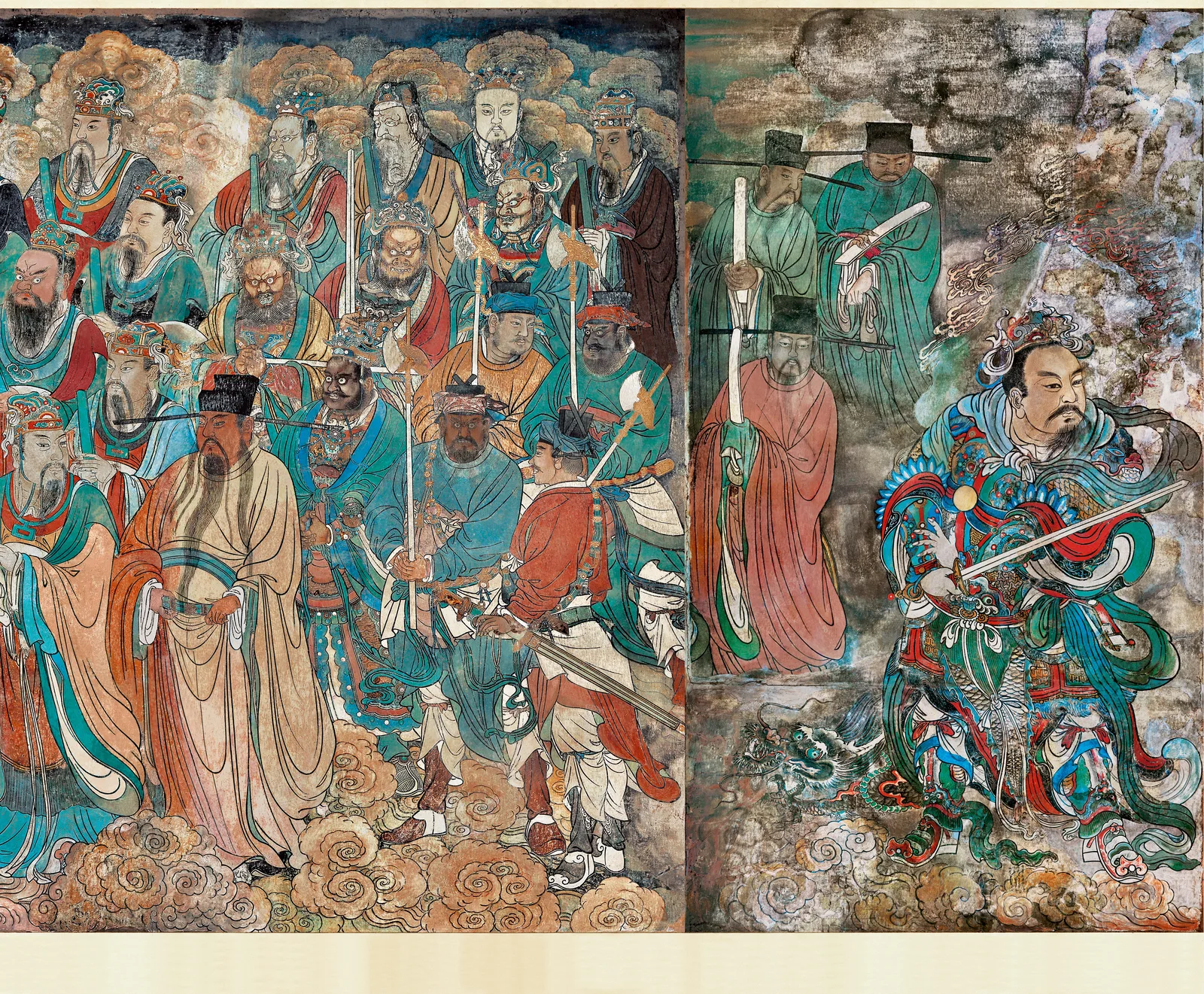
Start with what the crop actually shows
Before naming a deity or interpreting a narrative, divide the image into observable zones. The left half contains many figures in layered robes, several with dark headwear and some with visible facial hair. Near the middle, a smaller group stands in a more open patch of cloud and mottled background; pale elongated objects are held upright or across the body. At right, the largest figure wears patterned blue and red armor and carries a long, pale object diagonally across the torso. Cloud forms bridge the groups and fill the lower edge.
This description is intentionally literal. The small objects and facial details are difficult to resolve in the available reproduction. A line that looks like a sword, baton, banner, or other implement at screen size should be recorded as an elongated object until a better image or a reliable catalog supports a more precise name. Likewise, visual scale tells us which figure dominates this crop; it does not by itself establish rank, identity, or the original composition’s complete hierarchy.
How grouping creates movement
The left cluster feels crowded because heads, shoulders, sleeves, and staffs overlap. Repeated vertical bodies create a procession-like rhythm, while variations in robe color and headwear keep the group from reading as a uniform block. The smaller central group introduces a pause: more background is visible around the figures, and their spacing is easier to distinguish. The armored figure then draws attention through scale, saturated color, and a more elaborate silhouette.
These contrasts help explain the crop’s visual organization without requiring a fixed story. One can observe a transition from many similarly scaled attendants to a smaller, more open group and then to a dominant figure. But the source image is only a segment. We cannot infer what preceded it, what followed it, or whether the original mural’s full procession was read from this crop’s left-to-right order.
Costume and attributes: clues, not instant identifications
The armored figure
The right-hand figure is visually distinctive: a strong frontal presence, richly patterned armor, blue and red ornament, and an object extending diagonally across the body. These elements support a description such as “armored celestial figure” or “armored figure in a Daoist mural context.” They do not prove a personal name. Similar costume conventions can recur across divinities, generals, guardians, and attendants; the figure’s role should be checked against inscriptions, a full mural program, or a scholarly catalog before it is stated as fact.
The attendants
Several figures near the center wear pale green, blue, and red robes and appear to hold long objects. In a close-up, note the hand positions, object ends, garment folds, and whether an object touches the ground or crosses another figure. Those small observations can help distinguish a staff from a scroll or another implement. In this image, the available resolution does not settle every attribute, so their identities and exact roles remain uncertain.
What museum context can—and cannot—tell us
The Guangdong Museum’s exhibition overview, describing a program co-organized with the Yongle Palace Mural Art Museum, identifies the Chaoyuan Tu as a monumental mural from the Hall of the Three Purities and places Yongle Palace within the Quanzhen Daoist tradition; its overview dates the palace’s founding to 1247. A separate Grand Canal Museum exhibition account discusses Yongle Palace murals’ Yuan-period context, line-based painting, color decoration, and religious architectural setting. These sources help explain why the archive’s grouping is plausible and why costume, cloud, and procession deserve attention. They do not establish that this specific digital crop is complete, correctly aligned, or independently proven to belong to a particular bay of the hall.
The source folder also uses “Yuan Dynasty” and “Shanxi Museum” in its catalog path. Preserve those labels as supplied collection metadata, but do not turn them into a verified attribution for TK0679 without checking the underlying record. The full mural’s dating and history belong to the documented palace context; the crop’s exact capture source, restoration state, and chain of custody may require separate confirmation.
Surface condition in a digital reproduction
The upper-right area appears mottled and pale compared with the more legible figures below it. That is a visible condition in this reproduction, but a compressed or color-adjusted file cannot reveal whether the appearance comes from pigment loss, plaster exposure, lighting, restoration, photographic processing, or a combination. Avoid describing a cause unless conservation documentation confirms it. Record location and appearance instead: “irregular pale mottling in upper-right background; cause undetermined.”
For collection notes, separate the original surface from the digital file. Record the source filename, dimensions, crop boundaries, and any resizing or color changes. A useful starting point is the site’s visual condition-report checklist; adapt its observation-first approach, while noting that mural documentation may require different material and architectural fields.
A short reading checklist for TK0679
- Mark the left procession, central attendant cluster, and large right-hand figure as separate zones.
- Describe costumes, postures, and visible objects before assigning names or functions.
- Note cloud bands and the crop edges; do not infer the original full sequence from this segment alone.
- Transcribe no small inscription or object detail that cannot be read clearly; mark it uncertain.
- Record visible mottling separately from hypotheses about its cause.
- Keep the archive grouping, museum context, and direct visual evidence in separate fields in your notes.
Conclusion: read the hierarchy, keep the identity open
TK0679 rewards close looking because its crowded robed group, more open attendants, cloud bands, and large armored figure create a clear shift in visual emphasis. The image supports a careful account of composition and observable surface features. It does not, on its own, settle the armored figure’s name, the precise function of every object, or the crop’s complete provenance. Treat the archive label as a guide for further research, then test it against full-scale imagery and authoritative documentation.
Download the full Thangka image collection
Continue browsing and download the complete TANGKAWORLD image collection through the free downloads page. Use the collection to compare figures, attributes, and composition while keeping uncertain identifications clearly marked.