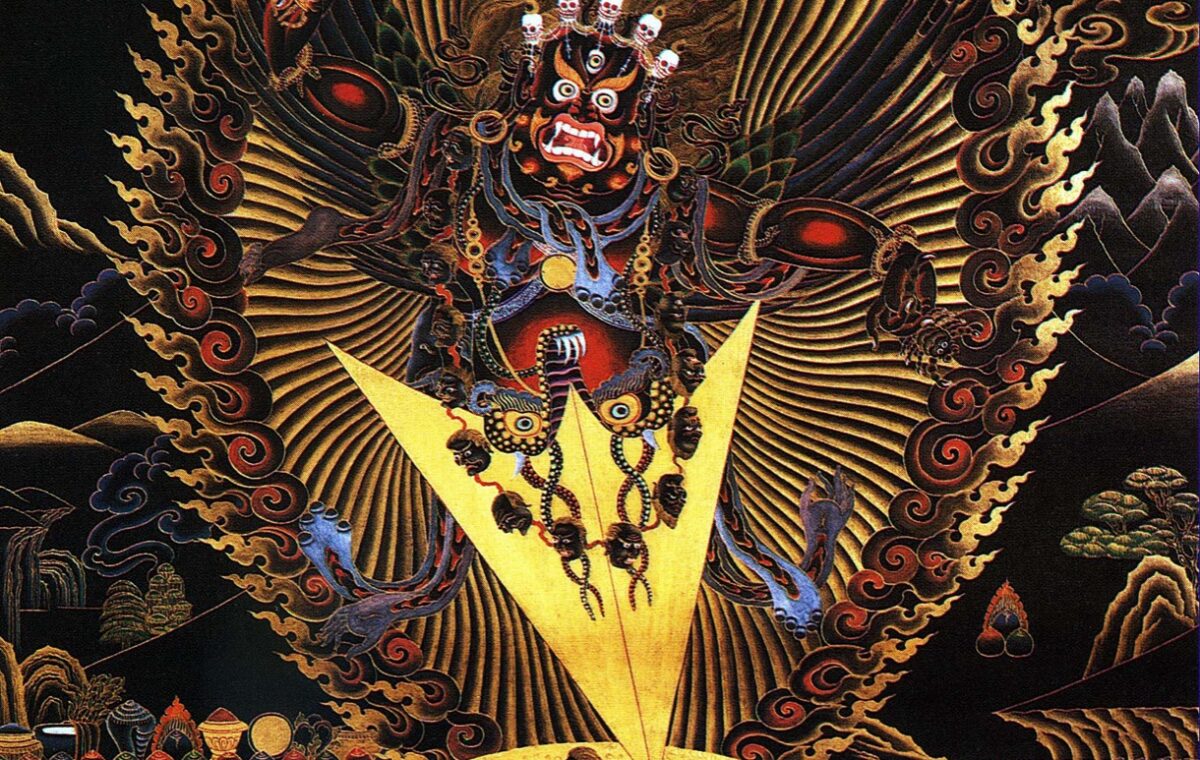
A Vajrakilaya thangka is organized around a striking visual axis: a wrathful deity grips a three-sided ritual dagger, or phurba, pointing downward through the center of the composition. Flames, wings, skull ornaments, multiple arms, and a blue-black body intensify the image, but the dagger is the most distinctive clue. Without it, the figure can easily be confused with another wrathful meditational deity or protector.
Vajrakilaya is also called Vajrakila or Vajrakumara in different sources. The name refers to a complex body of Vajrayana traditions rather than one uniform painting type. This article provides a visual identification method, not ritual instruction, and keeps the specific lineage and subtype of TK0558 uncertain.
The phurba as the central identifying feature
The phurba is a ritual peg or dagger with a triangular or three-sided blade. In many Vajrakilaya images, the principal hands hold it at the heart or torso, directing the point downward. Artists may enlarge the dagger so that it dominates the entire lower body, as in TK0558. This exaggeration makes the iconographic identity immediately legible.
A knife, sword, chopper, spear, or trident is not the same object. Look for the straight tapered triangular form and its central placement. The phurba may incorporate faces, knots, vajra forms, or a highly stylized handle. Because ritual objects vary in design, identification should combine shape, grip, and deity context.
Typical Vajrakilaya iconography
Blue-black wrathful body
Vajrakilaya is commonly dark blue or blue-black. The body appears massive and active, with a fierce face, bared fangs, and a third eye. Hair rises upward, and a crown of skulls may encircle the heads. Body color can shift in scans, so it should support rather than decide the attribution.
Multiple faces, arms, and legs
A widely represented form has three faces, six hands, and four legs. The side faces may be red and white, while the central face is blue. Wings spread behind the body. In a frontal painting, overlapping faces and limbs can be hard to separate, especially when the image is dark or heavily stylized.
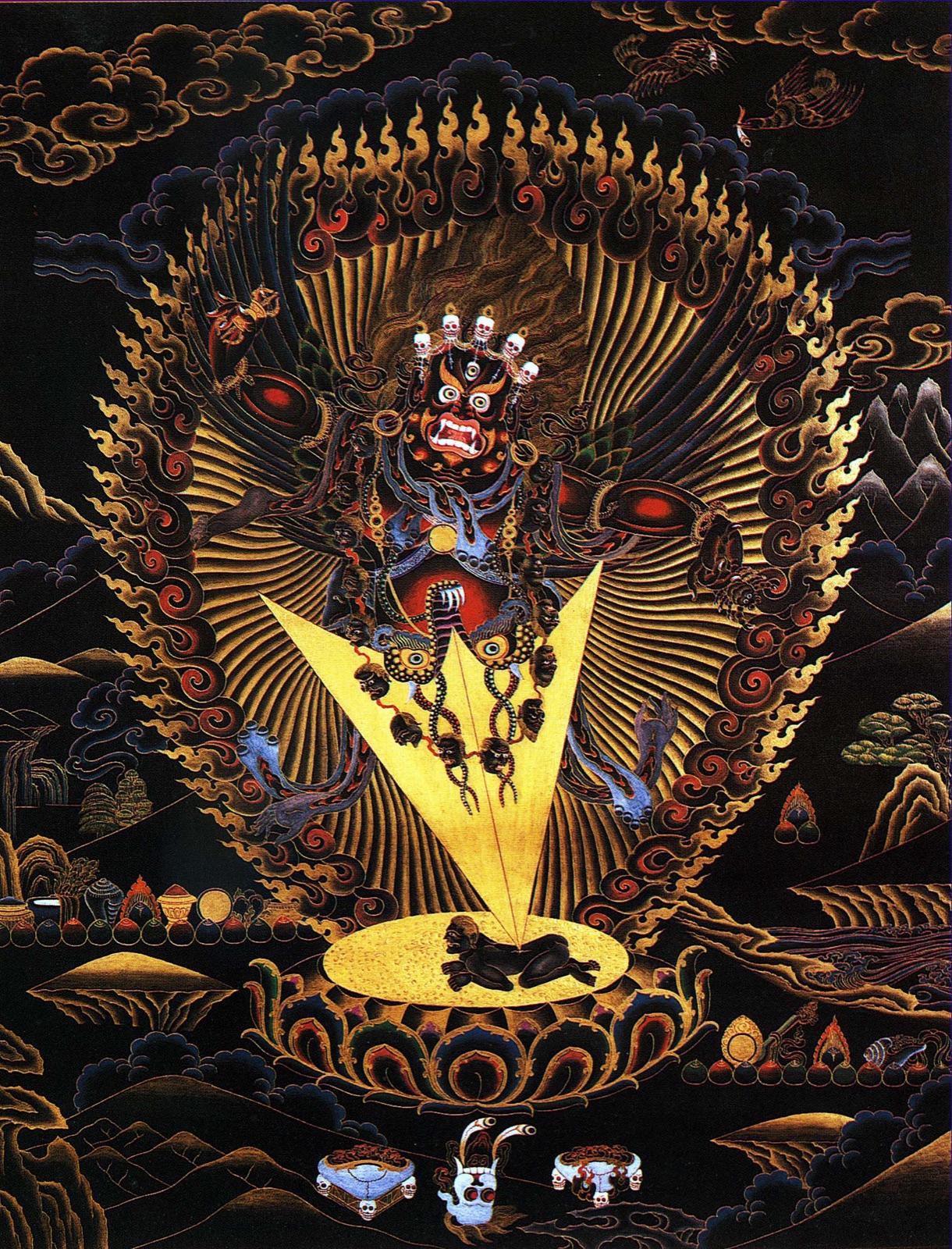
TK0558 clearly shows six arms, a wrathful central face, wings, and the large phurba. The side faces and full leg arrangement are not equally legible in this reproduction. The general identification is strong, but the exact iconographic subtype should remain uncertain.
Wings and flame aureole
Broad wings often form a radiating background behind Vajrakilaya. A ring of flames surrounds the figure, visually merging movement, heat, and sacred wrath. Do not mistake the wings for a separate bird or Garuda without checking how they attach to the central body.
Skull crown and wrathful ornaments
Skulls, severed-head garlands, snakes, bone ornaments, animal skins, and trampled figures are common in wrathful tantric iconography. These elements are not unique to Vajrakilaya. They confirm a wrathful class of image but cannot replace the phurba as the specific identifier.
Why wrathful does not mean demonic
The fierce appearance represents forceful enlightened activity within a Buddhist ritual framework. Flames and weapons visualize the overcoming of obstacles, ignorance, and destructive forces. Describing Vajrakilaya simply as a “demon” strips the image of context and can mislead readers about both subject and function.
The same caution applies when reading wrathful Vajrapani or Six-Armed Mahakala. Similar visual intensity can serve different iconographic and ritual identities.
Vajrakilaya versus similar wrathful deities
Vajrakilaya and Vajrapani
Wrathful Vajrapani commonly raises a vajra in one hand and stands within flames. He does not normally center the composition on a large downward-pointing phurba. Check the main hand object before using body color or flames as evidence.
Vajrakilaya and Mahakala
Mahakala forms can be black or blue, skull-crowned, multi-armed, and flame-surrounded. Their implements vary, but the characteristic Vajrakilaya dagger-body axis is absent. Mahakala is generally classified as a protector, while Vajrakilaya is a wrathful meditational deity; visual and functional categories should not be collapsed.
Vajrakilaya and other phurba-bearing figures
Some related deities and attendants also hold ritual daggers. A small phurba in one hand is weaker evidence than the principal pair of hands rolling or gripping a central dagger. Multiple faces, six arms, wings, and the characteristic body arrangement make the identification more secure.
Reading TK0558 carefully
The gold-colored triangular phurba dominates TK0558, extending from the central hands to the lotus base. A dark wrathful figure rises behind it with six outstretched arms, a skull crown, fierce eyes, fangs, and a mass of upward-moving hair. Wings create a ribbed halo, while a border of flames encloses the body.
Offerings line the lower sides, and three skull-cup-like forms appear beneath the lotus. Birds and mountains occupy the dark sky and landscape. These details establish a fully developed sacred environment, but they do not document the painting’s origin. The source filename supplies the Vajrakilaya label; it does not supply a verified date, artist, monastery, or lineage.
Practical identification checklist
- Is a large three-sided phurba central to the composition?
- Do the principal hands grip or roll the dagger near the torso?
- Is the body dark blue or blue-black and wrathful?
- Are multiple faces and six arms visible or strongly suggested?
- Do broad wings spread behind the body?
- Does a flame aureole enclose the figure?
- Are skull ornaments, snakes, skins, or trampled figures present?
- Could the image instead show Vajrapani, Mahakala, or another phurba-bearing figure?
- Are the subtype, lineage, date, artist, and provenance documented or uncertain?
Using digital images responsibly
Dark backgrounds and black pigments are especially vulnerable to crushed shadows in scans. Compression can merge side faces, hands, weapons, and wings into one mass. Increasing screen brightness may reveal details, but aggressive editing can also invent edges that are not present in the original object.
For cataloguing, record the file identifier, visible attributes, image dimensions, and source path. Keep iconographic identification separate from claims about age or authenticity. A high-resolution file can support close visual study, yet it cannot reveal the reverse inscription, textile support, pigment layers, repairs, or ownership history.
Conclusion
The defining clue in a Vajrakilaya thangka is the phurba: a three-sided ritual dagger held at the center and directed downward. The blue-black wrathful body, multiple faces and arms, wings, skull ornaments, and flames strengthen that identification. When the dagger is absent or peripheral, compare other wrathful forms before deciding.
Vajrakilaya traditions are closely associated with Padmasambhava in Tibetan Buddhist history and practice. For a separate visual guide to the master’s lotus hat, vajra, skull cup, and khatvanga, see Padmasambhava Thangka iconography.
Sources and further reading
- Himalayan Art Resources: comparative records for Vajrakilaya
- Rubin Museum of Himalayan Art: Vajrakilaya of the Eight Pronouncements (object record)
These references support comparative iconographic study. The TANGKAWORLD TK number is an internal catalogue identifier; artist, date, collection history, and provenance remain uncertain unless separately documented.
Download the full Thangka image collection
Continue browsing and download the complete TANGKAWORLD image library on the Downloads page.