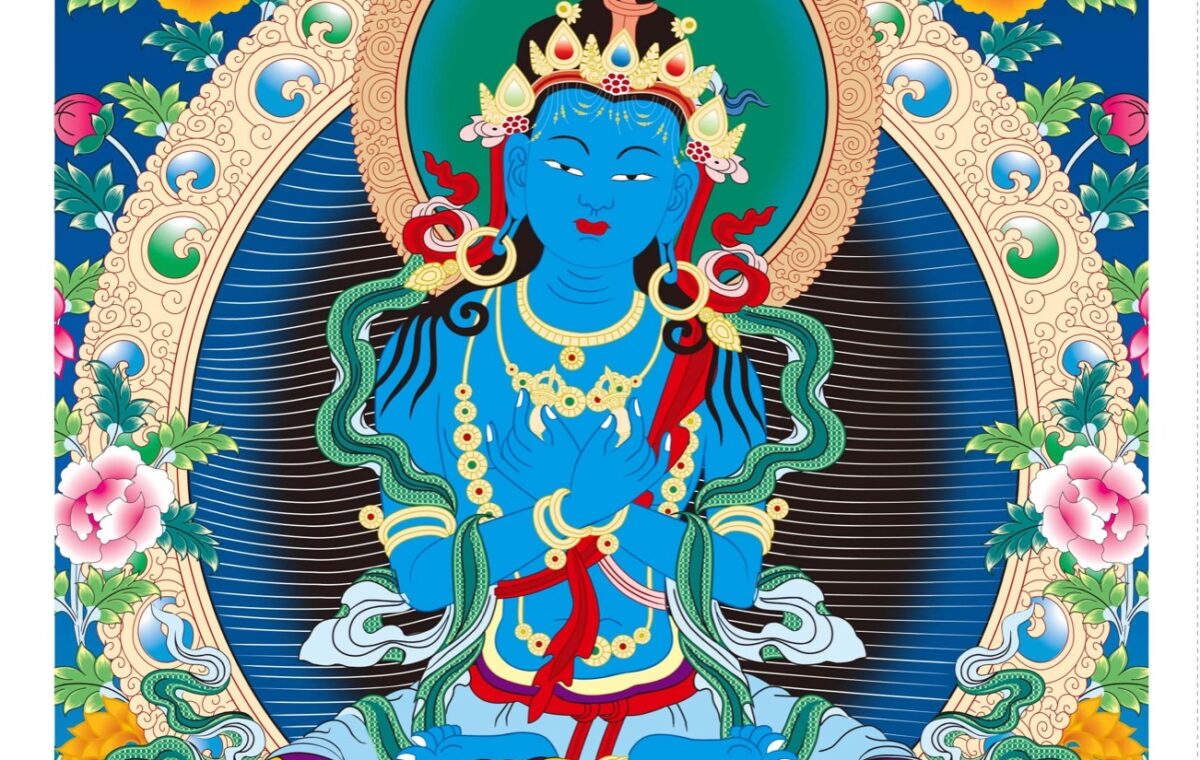
A Vajradhara thangka is often recognized in a single decisive area: the hands crossed before the heart, one holding a vajra and the other a bell. That compact gesture unites two ritual objects that are frequently shown separately elsewhere in Buddhist art. It also gives the figure a composed, inward quality. Yet the gesture should never be used alone. Body color, ornaments, posture, crown, surrounding figures, inscriptions, and the work’s regional context all help determine whether Vajradhara is truly the intended subject.
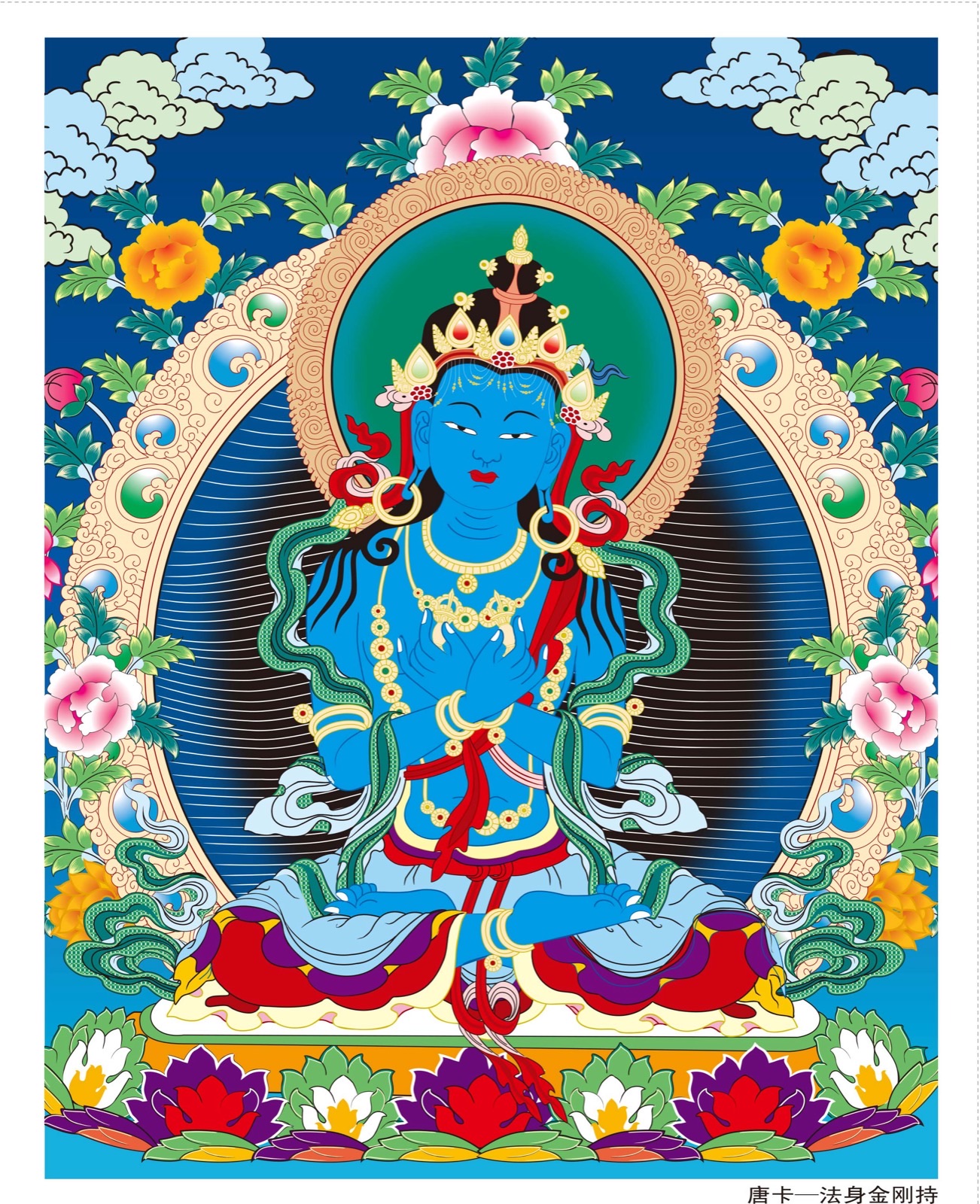
The image illustrated here, TK1266, is catalogued as Vajradhara. It shows a blue, crowned figure seated in meditation, with the forearms crossed at the chest. The catalogue file does not establish the artist, date, workshop, lineage, or original ritual setting, so those details remain uncertain. This guide explains what can be read from the visual evidence without turning a plausible identification into an unsupported attribution.
Vajradhara thangka identification at a glance
Begin with the whole figure, then move to the hands and ritual implements. A typical identification rests on several features appearing together:
- A deep blue body, although color can vary with condition, school, and artistic convention.
- A peaceful face rather than the exposed fangs and blazing hair of a wrathful protector.
- A jeweled crown, earrings, necklaces, armlets, and silken garments.
- Both hands crossed at the heart in the vajra-humkara gesture.
- A vajra held in one hand and a ritual bell held in the other.
- A stable meditation posture on a lotus and moon seat.
- A luminous halo or aureole and a composition organized around centered stillness.
No single item is conclusive. A blue figure holding a vajra might instead be Vajrapani, and a peaceful white figure with vajra and bell may be Vajrasattva. The crossed placement, peaceful bodhisattva-like ornaments, and complete compositional context are what make the reading persuasive.
Who is Vajradhara in Buddhist art?
Vajradhara, whose name can be translated as “Vajra Holder,” has a central role in several Tibetan Buddhist traditions. In art he represents awakened reality in an esoteric, timeless form rather than a historical teacher shown in ordinary monastic dress. This is why he is commonly depicted with the ornaments and silks of a celestial Buddha. His blue body evokes the unbounded quality of space and the depth of awakened mind, but viewers should treat such color symbolism as part of a larger visual language rather than a universal code.
Lineage paintings sometimes place Vajradhara above teachers as the primordial source of a transmission. In other compositions he appears as the main figure, surrounded by masters, meditational deities, protectors, or offering goddesses. If a thangka includes a vertical sequence of teachers, the identities and order of that lineage may be more important than decorative details. Names should remain uncertain unless an inscription, reliable catalogue, or lineage record confirms them.
How to read the crossed vajra and bell
The vajra
The vajra is a compact ritual implement with symmetrical prongs around a central grip. In visual and ritual interpretation it is associated with indestructibility, stability, and method or compassionate action. In a Vajradhara thangka it is usually held close to the heart rather than raised as a weapon. That placement separates the image from many wrathful forms in which the vajra is brandished dynamically.
The bell
The ritual bell, or ghanta, is associated with wisdom and the insight that phenomena do not possess independent, fixed existence. Its handle may be visible above or beside the crossed hand, while the bell’s flared body can be partly hidden by the forearm, jewelry, or paint loss. Do not assume a missing bell if the relevant area is damaged or cropped. Look for the outline of the handle and the metal body before deciding.
The crossed gesture
Crossing the vajra and bell at the heart visually brings method and wisdom together. The gesture is sometimes called vajra-humkara. It is one of the most reliable features for recognizing Vajradhara, but it also appears in closely related tantric imagery. A careful reader therefore checks whether the face is peaceful, the body is blue, the figure is crowned, and the pose is meditative.
Crown, jewelry, and meditation posture
Vajradhara is usually not dressed like a historical Buddha in plain monastic robes. A five-leaf crown may refer to the five Buddha families, while earrings, necklaces, armlets, anklets, scarves, and a jeweled belt establish a celestial mode of representation. These details can be highly stylized. A contemporary line drawing, a nineteenth-century painted thangka, and a mural may express the same iconography with very different surface treatment.
The legs are generally crossed in a stable meditation posture. A lotus seat separates the awakened figure from the ordinary ground, and a moon disc may appear above the petals. Symmetry reinforces the central stillness. If the figure lunges in a wide stance, wears a skull crown, or stands within violent flames, Vajradhara is unlikely unless the work presents an unusual form confirmed by documentation.
Vajradhara compared with similar figures
Vajradhara and Vajrasattva
Vajrasattva is commonly white and often holds a vajra upright at the heart while a bell rests near the hip. Vajradhara is commonly blue and crosses both hands at the heart. These are strong working differences, not substitutes for context. See our detailed Vajrasattva thangka identification guide for the contrasting hand positions.
Vajradhara and Vajrapani
Wrathful Vajrapani is usually blue, but he often has a fierce expression, a powerful standing pose, and a vajra lifted in one hand amid flames. Vajradhara is peaceful, seated, jeweled, and inwardly composed. Our guide to Vajrapani thangka iconography shows why body color alone is never enough.
Vajradhara and Akshobhya
Akshobhya may also be blue. His most recognizable gesture is typically the earth-touching mudra, with one hand reaching toward the knee, rather than two hands crossed over the heart. A monastic robe may further distinguish a Buddha-family image from the jeweled tantric form of Vajradhara.
A practical Vajradhara visual checklist
- Confirm that the central figure is peaceful rather than wrathful.
- Check whether the body is blue and the figure wears a crown and jewelry.
- Locate both ritual objects; do not infer them from color alone.
- Verify that the vajra and bell are held in crossed hands at the heart.
- Look for a meditation posture, lotus seat, and centered composition.
- Compare the hand positions with Vajrasattva and the pose with Vajrapani.
- Read inscriptions, labels, and lineage figures before naming a tradition.
- Record the artist, date, region, and provenance as uncertain if the source does not supply them.
How to describe an uncertain Vajradhara image
A responsible catalogue note separates observation from interpretation. Start with visible facts: “Blue crowned figure seated on a lotus, holding a vajra and bell in crossed hands at the heart.” Then add the identification with its evidentiary basis: “The crossed implements and peaceful jeweled form support identification as Vajradhara.” Finally state the limits: “Artist, date, school, and provenance are uncertain.” This format is more useful than a confident label built from assumptions.
Digital reproductions create further complications. Color balance may shift, details can disappear in compression, and cropping may remove lineage figures or inscriptions. When possible, compare a full image with detail views. TK1266 clearly preserves the central gesture, but the file alone does not prove the work’s age, material, or ritual history.
Conclusion
The most dependable way to identify a Vajradhara thangka is to read a cluster of features: blue peaceful body, celestial ornaments, crossed hands, vajra, bell, meditation posture, and centered composition. The crossed implements provide the strongest clue, while comparison with Vajrasattva, Vajrapani, and Akshobhya prevents common mistakes. For a broader method, continue with How to Read a Thangka.
Sources and further reading
- Himalayan Art Resources: comparative records for Vajradhara
- Rubin Museum of Himalayan Art: Vajradhara with vajra and bell (object record)
These references support comparative iconographic study. The TANGKAWORLD TK number is an internal catalogue identifier; artist, date, collection history, and provenance remain uncertain unless separately documented.
Download the full Thangka image collection
Continue exploring and download the complete TANGKAWORLD image library from our downloads page.