
A black thangka painting transforms the usual relationship between color and line. Instead of building a bright landscape from broad fields of mineral color, the artist establishes a dark ground and lets pale or gold-colored contours carry much of the image. Flames, clouds, ornaments, bodies, textiles, and sacred attributes emerge through precise linear rhythms. Small accents of red, blue, white, or green may then guide the eye toward faces, ritual objects, and important points in the composition.
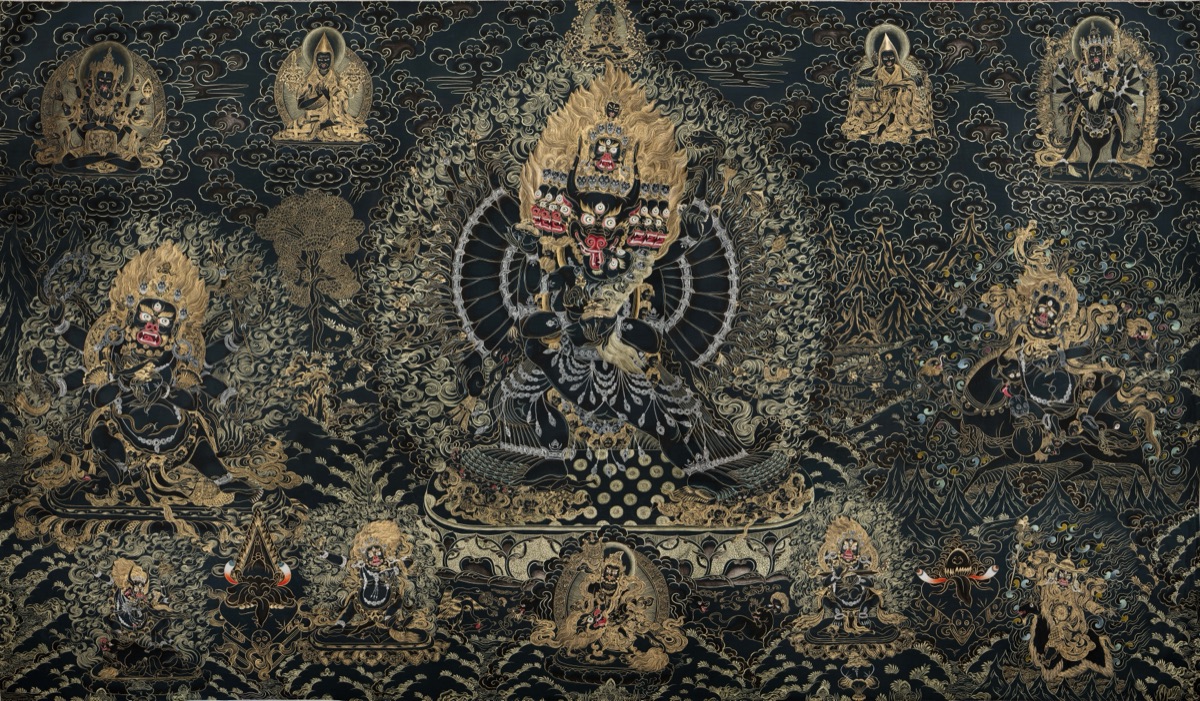
TANGKAWORLD image TK1241 offers a striking case study. It shows a large wrathful central figure, flanking protectors, teachers or lineage figures above, and smaller attendants below, all set against a dense black field. Gold-colored lines dominate the landscape and halos, while red, blue, and white accents sharpen selected details. The catalogue title supports identification of the format as a black-gold Thangka. However, the central deity, every attendant, the date, artist, school, region, materials, ritual lineage, collection history, and provenance are uncertain. Without inscriptions or technical examination, the gold-colored passages should not automatically be described as actual gold.
What defines a black thangka painting?
A black-ground Thangka is defined first by its visual system, not by one particular deity. The Rubin Museum’s historical exhibition Red, Black, and Gold describes solid-ground paintings in which line takes precedence over large modeled color fields. On black or red grounds, outlines are generally rendered in gold, although variations occur. The result can be intensely dramatic because a luminous contour appears to advance from the darkness.
This genre is often associated with protective or wrathful subjects, but black is not proof of identity. A correct reading still begins with posture, faces, arms, attributes, attendants, inscriptions, and documented context. Our beginner’s guide to reading a Thangka provides that evidence-first sequence. Ground color is one clue among many, never a substitute for iconography.
How the dark ground changes the painting process
Prepared cloth still matters
Traditional painted Thangkas are usually made on prepared cloth. Project Himalayan Art’s process of Thangka painting explains how canvas may be stretched, sized, coated with a smooth ground, polished, drawn, painted, shaded, outlined, and finally mounted in textile. A black-ground work belongs to this broader craft tradition even though its finished appearance emphasizes darkness and line.
The visible surface does not reveal the exact recipe used in TK1241. The support might be cotton or another cloth; the dark layer might involve one or more pigments and binders; the bright lines might contain metallic material or a nonmetallic gold-colored paint. Those questions require documentation, microscopy, or other conservation analysis. A digital image can show appearance, but it cannot establish chemical composition.
Line becomes structure, volume, and movement
On a conventional multicolored Thangka, adjacent color zones help separate skin, robes, clouds, rocks, flames, and architecture. In a black thangka painting, contour and hatching may perform several of those jobs at once. Thin parallel strokes can model folds. Repeated curls can build clouds. Dense hooked lines can turn a flame halo into an energetic boundary. Changes in line weight help distinguish a principal figure from a more distant retinue.
TK1241 demonstrates this economy clearly. The central figure is not isolated by a simple empty field. It is surrounded by radiating shapes, layered flames, circular forms, jewelry, hair, and garments. Gold-colored lines make these zones legible while allowing the black ground to remain visually dominant.
Gold-colored outlines and limited accents
The phrase “gold-line Buddhist art” describes what the eye sees, but material claims need caution. Traditional painters could use gold in selected passages, and the Rubin’s painting-process account notes that gold ornament might be selectively polished for luminosity. Yet photographs cannot tell us whether every bright line is gold, another metallic pigment, or a later material. For TK1241, “gold-colored line” is the responsible description until testing or a reliable catalogue says more.
Limited color is equally important. Red appears around mouths, eyes, flames, or ritual details; blue and white mark selected faces, ornaments, and bodies. These accents interrupt the otherwise restricted palette and create a hierarchy of attention. They also prevent the image from becoming a flat two-tone design. The viewer reads the work through an alternation of black mass, luminous contour, and concentrated color.
How to read the hierarchy in TK1241
Start with scale. The central wrathful figure is substantially larger than every surrounding figure and occupies the dominant vertical axis. A pair or assembly appears around the center, with secondary wrathful figures to left and right. Teachers or peaceful sacred figures occupy the upper register, while smaller attendants and offerings extend along the bottom. This arrangement establishes ritual hierarchy even when individual names remain uncertain.
Next, follow the directional energy. Curving flames, cloud bands, hair, scarves, and limbs turn inward toward the center. The dense linework around the principal figure creates a visual pressure that contrasts with the more open cloud fields near the top. The painting therefore controls attention through both iconometric scale and line density.
Finally, separate secure observations from possible identification. The central figure appears wrathful and multi-armed, and the composition includes a substantial retinue. These facts are visible. It may invite comparison with complex protector or meditational-deity images, including our guides to Vajrakilaya iconography and Six-Armed Mahakala. Comparison is useful, but it does not justify naming TK1241 without clearly readable attributes or documentation.
Why wrathful imagery suits the black-ground format
Wrathful Buddhist figures use flames, dynamic posture, bared teeth, skull imagery, weapons, and forceful movement to express protective or transformative activity. A dark ground can intensify those features. Luminous flame contours seem to move across the surface, and restricted color makes eyes and mouths unusually prominent. The visual effect can feel severe, but wrathful imagery should not be reduced to evil or violence.
Compare the different evidence sets in the Palden Lhamo protector guide and the Metropolitan Museum of Art’s documented black-ground Mahakala painting. The museum object can be named because its attributes, related figures, and catalogue history support the identification. TK1241 currently lacks equivalent documentation, so its broader wrathful assembly is more secure than a specific name.
Black-ground Thangka identification checklist
- Confirm the ground: Look for an intentionally continuous dark field rather than darkening caused by poor photography, soot, or age.
- Study the line system: Gold-colored or pale contours should organize bodies, robes, clouds, flames, landscape, and ornaments.
- Map limited colors: Note where red, blue, white, or green accents direct attention.
- Read the hierarchy: Compare the scale and position of the central figure, upper teachers, side figures, and lower attendants.
- Check attributes: Count faces and arms, identify posture and implements, and compare documented examples.
- Do not infer materials: A gold appearance is not proof of elemental gold, and a black appearance does not reveal the pigment recipe.
- Separate genre from identity: “Black-ground Thangka” can be accurate even when the deity remains uncertain.
- Record missing evidence: Mark date, artist, school, region, provenance, and unclear figures as uncertain.
Care and storage checklist for black Thangkas
Black-ground paintings can be visually unforgiving: abrasion, pigment loss, creases, and surface grime may interrupt the bright line network. Smithsonian conservation guidance notes that handling, light, humidity and temperature fluctuations, pollution, and unsuitable display materials can damage collection objects. Thangkas are also composite works in which a painted cloth may be joined to silk borders, cords, rods, or coverings, so painting and textile problems must be considered together.
- Limit direct light: Avoid sunlight and strong, prolonged illumination that can fade colorants and weaken textiles.
- Keep the environment stable: Avoid damp walls, heaters, vents, kitchens, and rapid temperature or humidity changes.
- Handle the mount, not the paint: Clean, dry hands and adequate support reduce pressure on fragile pigment.
- Never rub the surface: Dusting, wiping, adhesive tape, household cleaners, and amateur inpainting can remove or alter original material.
- Do not force a tight roll: If paint is flaking, creased, or stiff, rolling can worsen losses.
- Document condition: Photograph the front, back, mount, edges, inscriptions, and damaged areas under consistent light.
- Consult a qualified conservator: Flaking paint, tears, unstable mounts, water exposure, mold, or past repairs require professional assessment.
The Smithsonian Museum Conservation Institute’s record on conservation of Tibetan Thangka paintings emphasizes stabilizing flaking pigment while retaining the integrity and flexibility of the complete object. That balance is important: treatment should not make the painting look merely newer at the cost of original material, inscriptions, textile structure, or ritual function.
Conclusion
A black thangka painting is best understood as a disciplined interaction of ground, line, limited color, iconometric hierarchy, and sacred subject. TK1241 shows how luminous contours can build flames, clouds, ornaments, landscape, and a complex wrathful assembly from a predominantly dark field. Its format is clear, but its precise deity identities and historical data remain uncertain. Reading those limits honestly allows the image to support both visual education and future collection research.
Download the full Thangka image collection
Continue comparing black-ground paintings, protectors, Buddhas, bodhisattvas, Mandalas, and other Buddhist artworks throughout the complete TANGKAWORLD gallery. Browse and download the full Thangka image collection for further visual study.