
Maitreya in Buddhist art cannot be recognized from one universal pose. As the Buddha of the future, Maitreya may appear as a jeweled bodhisattva awaiting buddhahood, as a monastically robed Buddha, or through regionally specific forms such as Budai in Chinese art. The most reliable identification therefore combines attributes, dress, posture, inscriptions, and a documented object record.
This guide explains the recurring clues without treating them as rigid rules. It also shows why a title can be useful evidence but not a substitute for looking closely at the image itself.
Who is Maitreya?
Maitreya is understood as the future Buddha: a bodhisattva now awaiting the next Buddhist age and destined to teach after becoming a Buddha. That future role explains an important visual fact. Artists can represent him before enlightenment in princely bodhisattva dress or after enlightenment in the simpler robes of a Buddha. The Metropolitan Museum of Art describes both modes in its overview of Buddhism and Buddhist art.
The two modes are not contradictory. They present different moments or aspects of the same identity. For a researcher, however, they create a practical challenge: a crown and jewelry may support a Maitreya Bodhisattva identification, while their absence does not exclude a Buddha-form Maitreya.
The two principal visual forms of Maitreya
Maitreya as a bodhisattva
In bodhisattva form, Maitreya is often youthful, crowned, and adorned with necklaces, earrings, armlets, scarves, and fine garments. A small stupa may appear in the headdress or on a lotus beside him. A water flask is another recurring attribute. The Met identifies the flask in several Maitreya sculptures as a decisive clue, including an eleventh-century Nepalese Maitreya and a seventh-century bronze from the Kashmir or Swat region.
Posture varies. Maitreya can stand, sit in a meditative position, or occupy a chair-like pose with the legs lowered or crossed at the ankles. The seated posture may be memorable, but it should never be used alone. A figure’s crown, flask, stupa, gesture, retinue, and inscription collectively provide stronger evidence.
Maitreya as a Buddha
In Buddha form, Maitreya wears monastic robes and lacks the elaborate jewelry of a bodhisattva. The figure may resemble Shakyamuni or another Buddha when seen without context. A dedicatory inscription can resolve the identity even where visual attributes remain general. The Met’s gilt-bronze Buddha Maitreya dated 486, for example, is identified through the inscription on its base.
This is a useful reminder for digital cataloguing: iconography is strongest when visual clues and documentary evidence agree. If a Buddha image has no distinctive emblem and no readable inscription, the responsible label may be “Buddha, possibly Maitreya” rather than a confident name.
Four clues for identifying Maitreya in Buddhist art
1. A stupa in the headdress or on a lotus
A small stupa is one of the most valuable Maitreya clues. It may sit within the crown, rise above the hair, or rest on a lotus near the shoulder. Scale matters: in a small photograph the shape can resemble a jewel, flame, or finial. Zoom in before recording it, and compare the detail with a securely identified museum object.
The stupa also helps separate Maitreya from other crowned bodhisattvas. Avalokiteshvara may display a small image of Amitabha in the crown, while Manjushri is frequently associated with a sword and a book supported by a lotus. Our guides to Four-Armed Avalokiteshvara and Manjushri show how several clues work together.
2. A water flask
The flask, often called a kamandalu in South Asian contexts, is another recurring identifier. It may be held in a lowered hand or supported by a lotus. Its shape varies across regions and periods, so “small vessel” is a safer first observation than a premature ritual name. Once the object is visible, compare its position and form with documented examples.
Do not confuse this vessel with the longevity vase associated with Amitayus. Amitayus is usually shown in meditation holding a vase in both hands at the lap, while Maitreya’s flask belongs to a different iconographic pattern. The distinction is explained in our Amitayus identification guide.
3. Teaching gestures and seated posture
Maitreya can make a teaching or exposition gesture. Hands may be raised near the chest, and some compositions emphasize his role as the teacher of a future age. Yet gestures are shared across Buddhist art. A teaching gesture without a stupa, flask, inscription, or supporting context is not enough for a secure identification.
Likewise, a chair-seated or ankles-crossed figure may suggest Maitreya in certain traditions, but posture alone remains insufficient. Describe exactly what is visible: the direction of the palms, the placement of the feet, the seat, and any objects beside the shoulders.
4. Inscriptions, companions, and setting
Inscriptions can name the deity, donor, date, or purpose of an image. A paradise scene, assembly, or sequence of Buddhas may also establish identity through context. The British Museum’s Paradise of Maitreya painting demonstrates that Maitreya imagery can extend beyond a single central figure into an architectural and narrative environment.
Transcription and translation require expertise. If the writing is unreadable or the photograph is too soft, record “inscription present; content uncertain.” A guessed translation can create a chain of false catalogue data.
Maitreya, Shakyamuni, and other Buddha images
A monastically robed Maitreya may look much like Shakyamuni. Shakyamuni is often recognized by the earth-touching gesture, meditation bowl, and a composition connected with his awakening. Maitreya may instead be identified by a future-Buddha context, a teaching gesture, a stupa, or an inscription. See the Shakyamuni Buddha guide for the earth-touching pattern.
Other seated Buddhas also overlap visually. Color is not a dependable shortcut because pigments fade, photographs shift hues, and traditions vary. Do not rename an image Maitreya merely because it appears golden, calm, or monumental. Begin with visible facts, then test the proposed identity against specific records.
Budai and the “Laughing Buddha” question
In Chinese art, the smiling, round-bellied monk Budai became associated with Maitreya. He is typically bald, loosely robed, and accompanied by the cloth sack that gives him his name. The Met’s record for a seventeenth- or eighteenth-century porcelain Budai explains this relationship.
Budai should still be described precisely. A crowned bodhisattva with a stupa, a robed Buddha named by an inscription, and a laughing monk with a cloth sack are three different visual types. They may all connect to Maitreya traditions, but collapsing them into one generic appearance erases their historical and regional distinctions.
How to read TK0216 responsibly
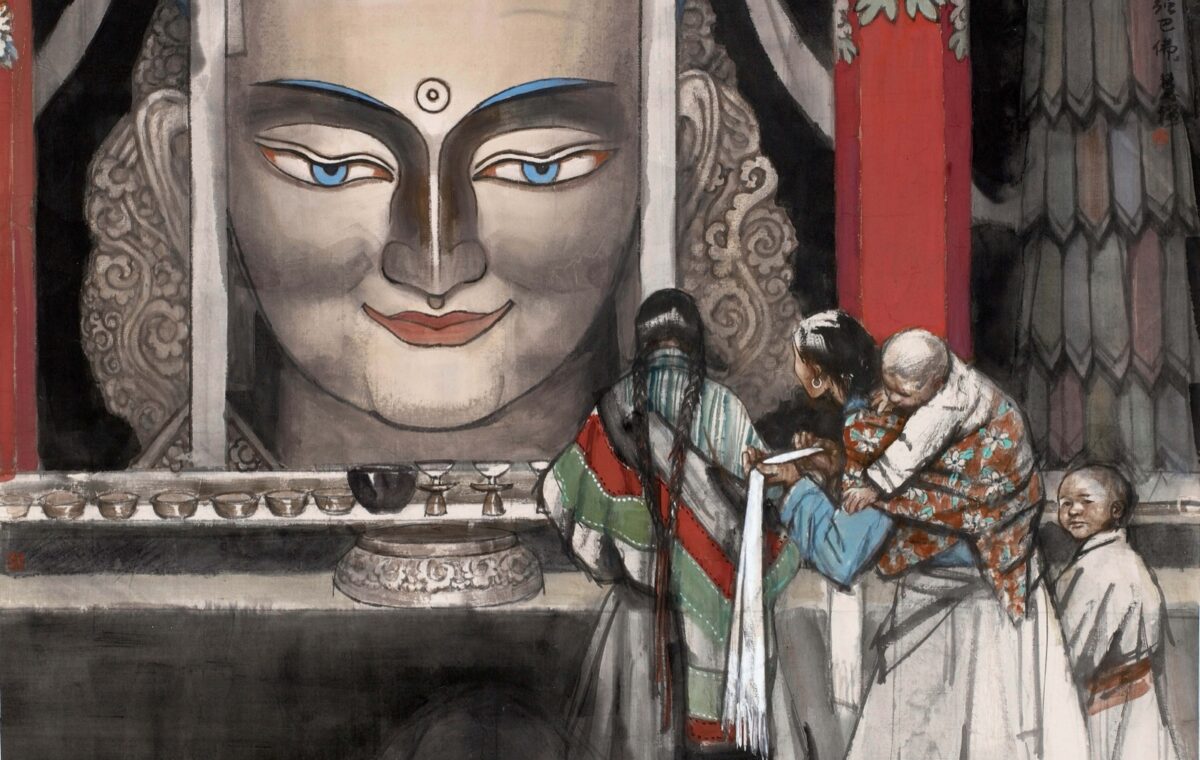
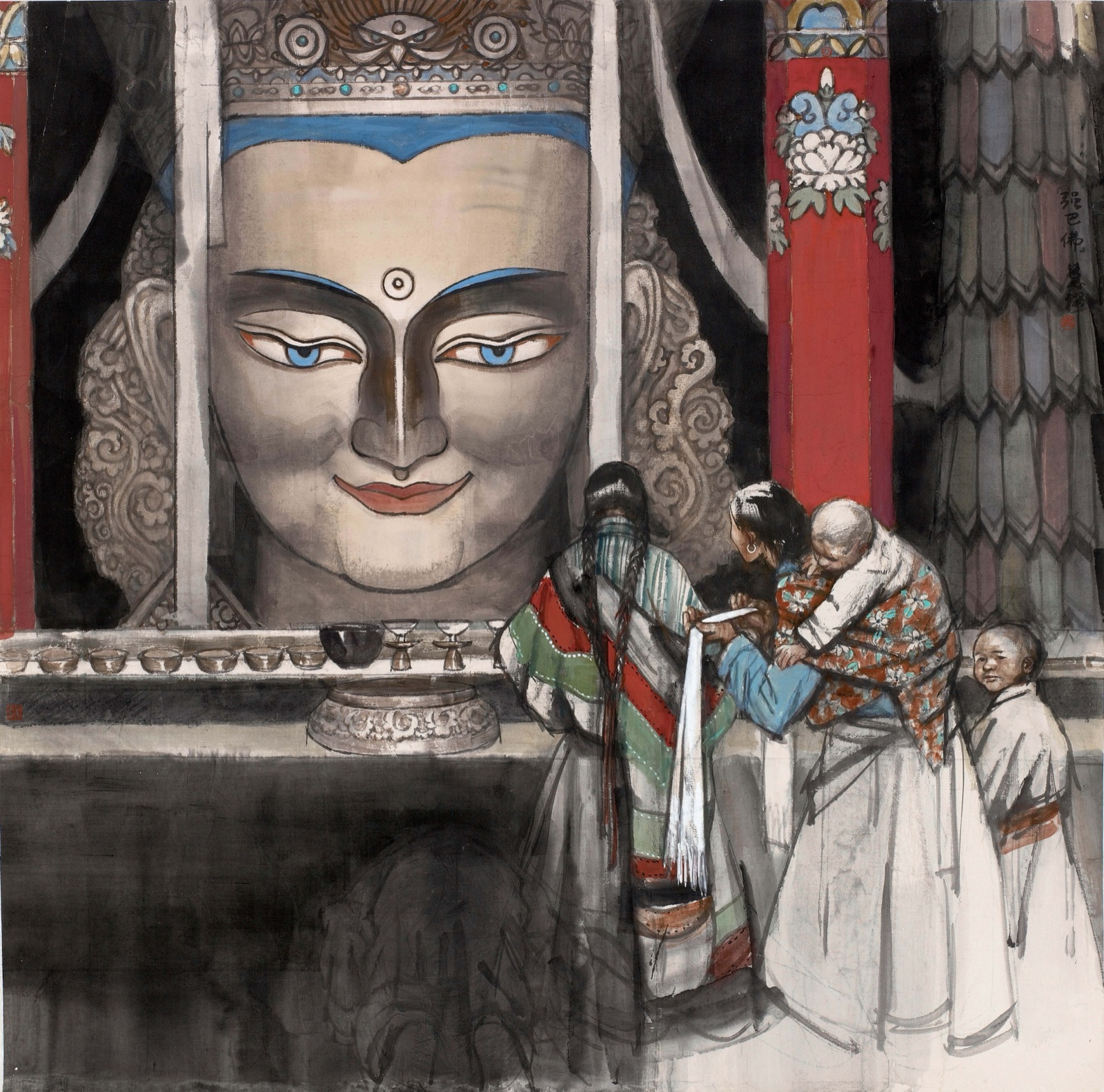
TK0216 presents a monumental, serene Buddha face above a group of Tibetan people or pilgrims. The scale contrast directs attention from lived human presence to an immense sacred image. The work is catalogued locally as Maitreya, by Shi Guoliang, and that supplied title supports the subject identification.
The visible composition does not display the conventional stupa and water flask clearly enough to use them as independent confirmation. For that reason, TK0216 should not be presented as a standard iconographic template for identifying every Maitreya image. It is better understood as a modern interpretation in which title, human encounter, and monumental presence carry much of the meaning.
The file does not establish an exact date, medium, dimensions, provenance, collection history, or exhibition record. Those details remain uncertain. “By Shi Guoliang” is retained from the English catalogue title rather than expanded into an unsupported biography or chronology.
A practical Maitreya identification checklist
- Is the figure dressed as a jeweled bodhisattva or as a monastically robed Buddha?
- Is a small stupa visible in the headdress or on a lotus?
- Does the figure hold or accompany a water flask?
- Are the hands teaching, meditating, or making another clearly visible gesture?
- Does the seated posture match a documented regional Maitreya type?
- Do an inscription, caption, donor record, or museum catalogue name Maitreya?
- Could the figure instead be Shakyamuni, Avalokiteshvara, Manjushri, Amitayus, or another Buddha or bodhisattva?
- If it is Budai, are the cloth sack, laughing expression, and monk’s body type present?
- Which observations are visible, and which claims come only from the supplied title?
- Are date, artist, school, and provenance documented—or should they be marked uncertain?
A reliable research sequence
Start by viewing the entire composition. Next, describe the central figure without naming it: dress, crown, hands, held objects, seat, halo, and companions. Then inspect inscriptions and compare the work with exact museum object pages rather than image-search thumbnails. Finally, assign a confidence level such as confirmed, probable, possible, or uncertain, and record the reason.
This sequence reduces confirmation bias. It also makes your notes reusable when a better photograph or catalogue appears. For a broader method covering central figures, registers, attributes, and evidence, use our beginner’s guide to reading a Thangka.
Conclusion
Maitreya in Buddhist art is best identified through converging evidence. A stupa, water flask, bodhisattva dress, Buddha robes, teaching gesture, posture, inscription, and regional context can each contribute, but no single clue works in every image. Budai represents a related Chinese tradition with its own recognizable form. TK0216 adds a modern interpretation whose catalogue title supports the identification while its exact date and provenance remain uncertain.
Download the full Thangka image collection
Continue browsing and download the complete TANGKAWORLD image library at Free Downloads. The full collection supports side-by-side study of Maitreya, Buddhist iconography, regional styles, and modern sacred art.