
High-quality thangka images are available from several kinds of online source, but the best place to download them depends on what you need to do. Museum open-access portals are strongest when you need a documented object record and clearly stated reuse terms. Specialist databases are useful for comparing iconography across many collections. A curated image archive is more convenient when you want a large group of files in one organized download. Before choosing any source, check the image dimensions, file format, object information and reuse statement rather than judging quality from the thumbnail alone.
Start with the purpose of your download
A single image can be “high quality” in one context and unsuitable in another. A compressed JPG may be ideal for screen study, presentations and quick comparison. A substantially larger TIF can be more useful when you need to inspect paint boundaries, inscriptions, textile details or signs of restoration at high magnification. Neither format can supply historical information that was not recorded by the source.
- For identification: prioritize a clear image plus a reliable title and object record.
- For art-historical research: look for date, region, medium, dimensions, accession number, provenance and bibliography.
- For printing: check pixel dimensions, color profile and the required output size before downloading.
- For long-term reference: preserve the original filename, source URL and access date alongside the image.
1. Museum open-access collections
Museum collection portals should be the first stop when documentation matters. The Metropolitan Museum of Art, for example, marks many collection images as Public Domain and provides object-level details such as culture, date, material, dimensions and accession number. Its record for a nineteenth-century Thangka with Buddha includes a downloadable image and a specific catalogue record rather than a generic search page.
The Smithsonian Open Access portal also provides downloadable collection media with reusable metadata. Open-access status should still be checked on the individual object. A museum may hold both public-domain works and media with restrictions, so the institution-wide name alone is not a license.
2. Specialist Himalayan art databases
Specialist databases can reveal visual relationships that are difficult to see in a general museum search. They may group works by deity, lineage, composition or iconographic attribute. This is especially useful when a figure has many forms or when a mandala contains several courts and attendant deities. Use these databases as research indexes, then follow links to the most specific object record available.
A specialist record is valuable because it gives you a comparison set. If you are trying to identify White Tara, for example, compare the number and placement of eyes, the lotus flowers, hand gestures, seated posture and accompanying figures across several documented examples. Do not infer a date, artist or school merely because two images look similar.
3. Curated downloadable archives
A curated archive is useful when you want many images available locally for side-by-side study. It reduces the time spent opening individual records and can support offline browsing, visual reference boards and repeated comparison. The tradeoff is that documentation may vary from image to image. Keep internal filenames separate from confirmed museum accession numbers, and treat undocumented artist, date, school, collection history and provenance as uncertain.
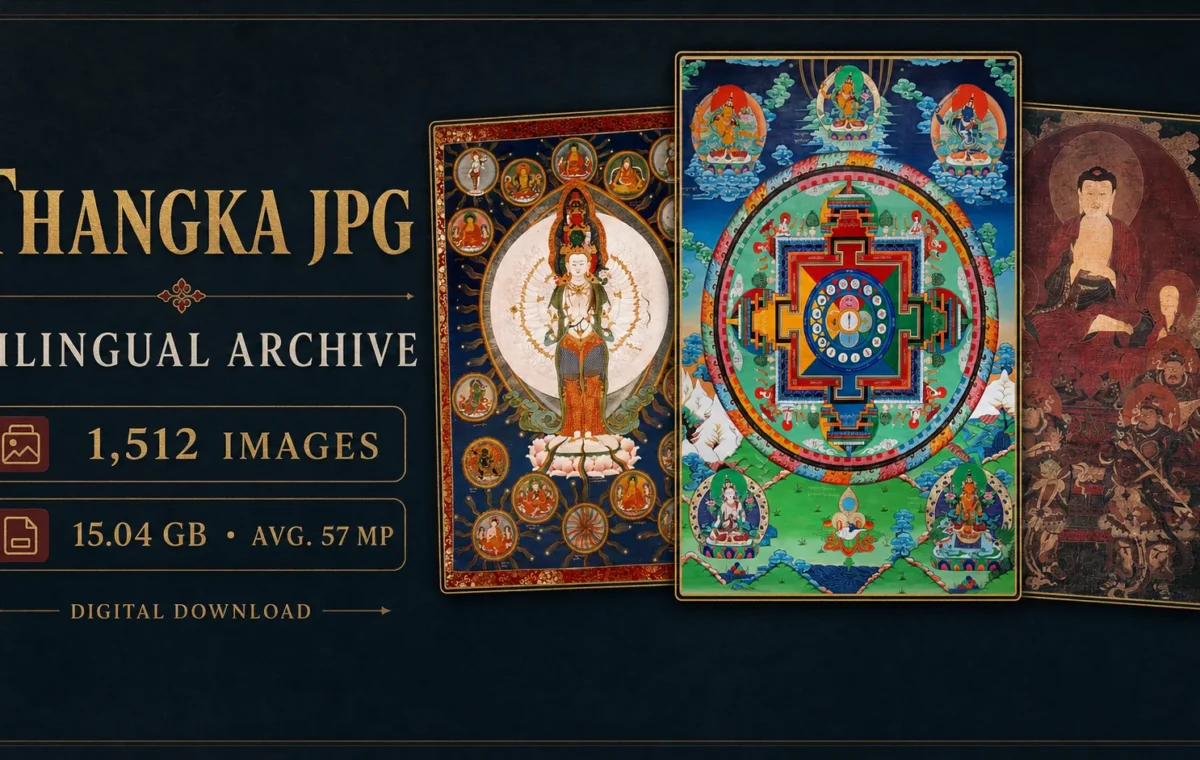
TANGKAWORLD offers the same complete set of 1,512 images in two formats. The 15.04 GB JPG collection is available as a free direct PikPak download for convenient browsing and everyday reference. The 331.5 GB high-resolution TIF archive is a separate $49.99 product for closer visual inspection, professional reference and long-term storage. You can compare the JPG and high-resolution TIF archive before choosing a format.
How to evaluate a thangka image before downloading
| Check | Why it matters | What to look for |
|---|---|---|
| Pixel dimensions | Determines how far you can enlarge the image | Actual width and height in pixels, not only “HD” or “high resolution” |
| File format | Affects size, compatibility and compression | JPG for convenience; TIF when larger source files are needed |
| Object record | Supports identification and citation | Title, date, region, medium, dimensions and accession number |
| Reuse statement | Defines what you may do with the file | Public-domain mark, Creative Commons license or institution-specific terms |
| Image condition | Digital defects can be mistaken for features of the artwork | Cropping, color cast, glare, stitching artifacts, sharpening and compression blocks |
Download is not the same as permission
The technical ability to save an image does not automatically establish permission to republish, sell or redistribute it. Read the rights statement on the source page and preserve it with your notes. Public-domain status may apply to the underlying historical artwork while a website imposes separate conditions on its photography, metadata or interface. Laws and institutional policies can vary by jurisdiction and source.
For academic or editorial work, cite the specific object page whenever possible. A useful citation record includes the institution, object title, accession number, page URL and the date you accessed it. This makes your research traceable even if a local filename later changes.
A practical download workflow
- Open the specific object record rather than downloading from an image-search result.
- Record the title, institution, accession number, source URL and stated rights.
- Download the largest appropriate file; avoid unnecessary enlargement of a small source.
- Keep the original unchanged and create working copies for crops, color correction or annotations.
- Use consistent filenames and a spreadsheet or catalogue file for your research notes.
- Compare several documented works before making an iconographic identification.
Common download traps to avoid
Search results often lead to copies that have been separated from their original record. A visually impressive file may have been enlarged, sharpened, colorized or cropped without disclosure. Reverse-image search can help locate an earlier version, but the strongest evidence is still a specific institutional or collection page that identifies the object.
- Thumbnail presented as a master: open the file itself and check the actual pixel dimensions before saving it.
- “High resolution” without numbers: treat the phrase as marketing unless width, height or file size is disclosed.
- Upscaled detail: artificial enlargement can make a file larger while inventing edges and textures that were not captured.
- Missing mount or border: a tight crop may remove inscriptions, seals, textile construction or other evidence needed for interpretation.
- Unverified title: reposted images frequently inherit confident deity names that are not supported by attributes or a catalogue.
- Rights detached from the object: a social-media caption is not a substitute for the rights statement on the source record.
Build a source record beside every image
A useful research archive contains more than pictures. Create a text file, spreadsheet or catalogue record that travels with each download. The record should distinguish information supplied by the institution from your own visual observations. If a later source corrects the title or date, keep the earlier note and record the update rather than silently overwriting the research trail.
| Field | Example of what to record | Why to keep it |
|---|---|---|
| Source | Institution and specific object URL | Lets another reader verify the record |
| Object identity | Title and accession or catalogue number | Separates the work from similar images |
| Documented facts | Date, culture, medium and dimensions | Preserves the source’s catalogue information |
| Rights | Public Domain, CC license or stated restrictions | Supports responsible later use |
| File data | Filename, format and pixel dimensions | Helps detect conversions or substitutions |
| Observation | Visible attributes and uncertainty notes | Separates your analysis from supplied metadata |
When a larger download is not automatically better
File size can increase because an image uses less compression, contains more pixels, stores additional color information or includes embedded metadata. It can also increase because a smaller source was merely enlarged. Compare the same region in both files at 100 percent. Genuine additional detail should reveal clearer source information rather than only smoother pixels or stronger sharpening halos.
Color accuracy is another separate question. A large image photographed under uneven light may be less useful than a smaller, carefully managed museum capture. Likewise, a complete view with the textile mount can be more informative than a larger crop of the painted center. Evaluate resolution, capture quality, completeness and documentation together.
Organize downloads for long-term use
Keep an untouched original folder and a separate working folder. Add version labels to crops and annotated copies. Back up the catalogue and source notes together with the images; otherwise the visual files can survive while their context is lost. For a large collection, generate checksums or use backup software that verifies copied files. Periodically test a sample rather than assuming that a completed transfer remains readable forever.
This discipline also makes comparison faster. Searchable notes let you retrieve every image described as White Tara, every work with a vajra and bell, or every mandala with a specific palace structure without changing the original filenames.
Review the source record again before publication, because institutional titles, rights statements and catalogue notes can change as research advances.
Use the JPG versus TIF format guide to match the file type to your workflow, and follow the high-resolution iconography study method when building comparison notes.
Sources and further reading
- The Metropolitan Museum of Art — Thangka with Buddha, object record
- The Metropolitan Museum of Art — Open Access policy
- Smithsonian Institution — Open Access
- Project Himalayan Art — educational resources
Continue your research
For the visual-reading method, start with What is a thangka? and the beginner’s guide to reading a thangka. When you need a larger offline comparison set, view the complete thangka collection.