
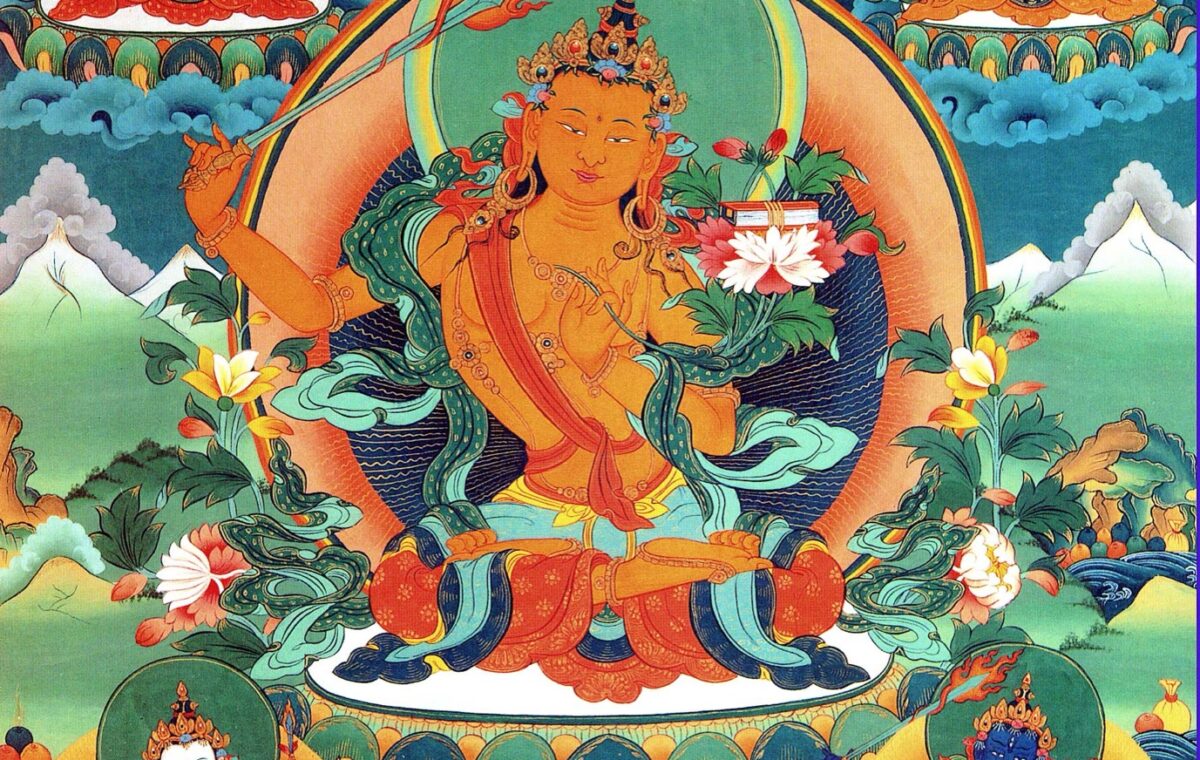
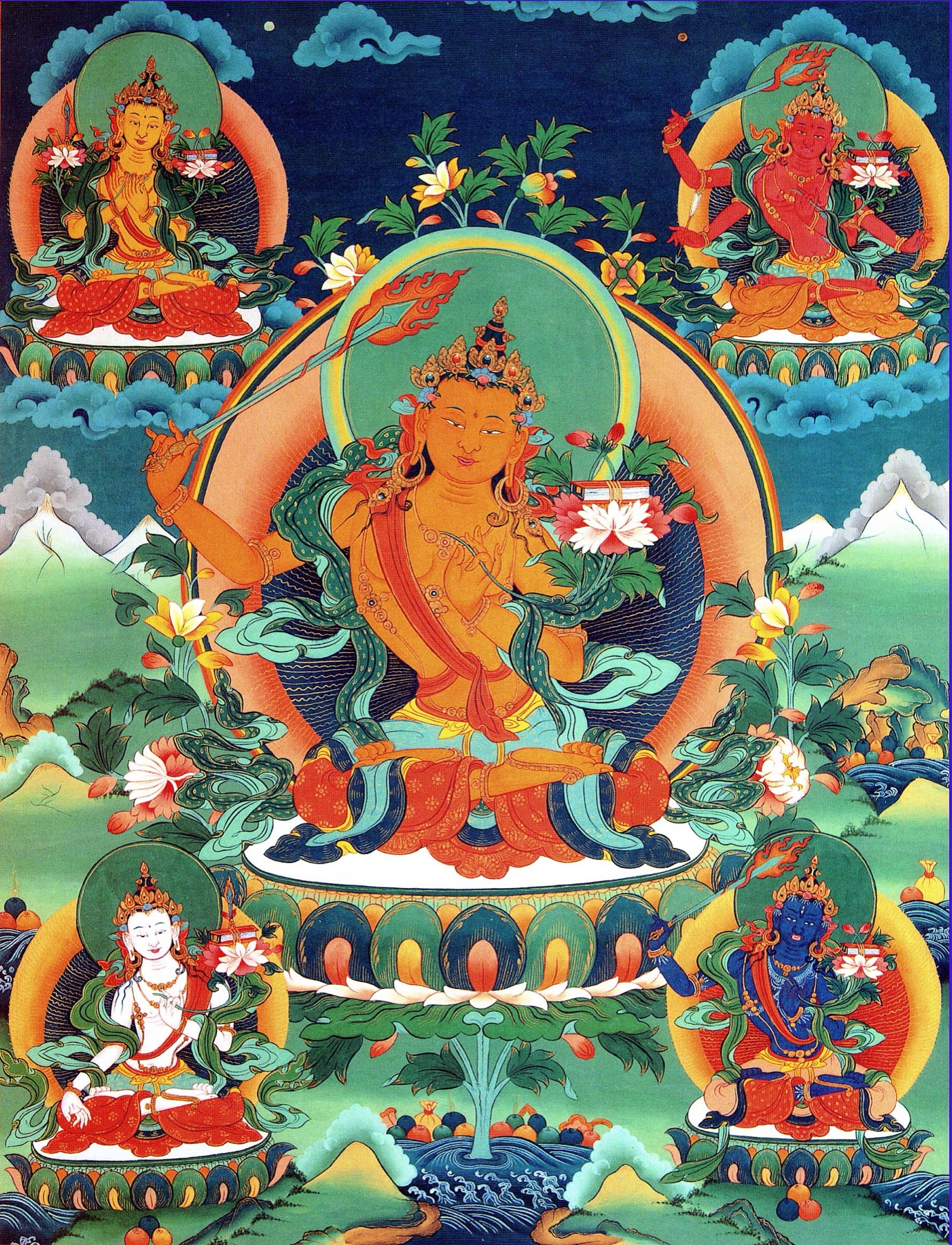
The phrase Five Forms of Manjushri describes more than five portraits of the same bodhisattva. In a grouped Thangka, repetition can turn a single figure into a visual study of differentiated wisdom: one central presence anchors the composition while four related forms create a balanced field around it. The TANGKAWORLD archive labels TK0385 “Five Forms of Manjushri.” This guide reads what is visible in that image, explains how to compare its figures, and separates observation from details that remain unverified.
Five Forms of Manjushri at a glance
Begin with the overall arrangement rather than naming each deity. TK0385 presents one large orange figure in the center and four smaller figures placed around it. All five sit on lotus supports amid clouds, water, and stylized landscape. Their repeated crowns, halos, ornaments, and princely dress connect them visually, while differences in color, gesture, and attributes make each figure distinct. The central figure’s raised sword and lotus-supported book are especially clear; some details in the smaller figures are less certain at this image scale.
The composition is not simply a row of five independent icons. The central figure dominates through scale and position, while the four surrounding forms create a cross-like balance. A viewer’s eye returns to the center after moving between the corners. That hierarchy is useful when studying any multi-deity Thangka: first establish the visual center, then read the supporting figures as a group.
How to read the central Manjushri
Manjushri is associated with wisdom in Buddhist art. One familiar iconographic form holds a sword and a text associated with the Perfection of Wisdom. In TK0385, the central figure’s orange body, upright sword, and lotus carrying a book make that visual vocabulary accessible. The sword is a strong identifying attribute, but it should be read alongside the figure’s posture, hand positions, seat, and relationship to the other four forms—not in isolation.
Notice how the sword rises beyond the figure’s shoulder and crosses the surrounding halo. The book rests on a lotus stem near the opposite side of the body. This paired arrangement gives the central image a clear diagonal rhythm: the sword points upward, while the flower and text extend outward. For a closer introduction to these familiar symbols, see our guide to Manjushri’s sword, lotus, and book.
Do not assume every Manjushri must repeat this exact pose. Museum and collection records show multiple forms, and the same broad symbol may appear with different hand gestures, body colors, seats, or numbers of arms. The Metropolitan Museum’s record for a Japanese Monju painting, for example, describes a sword and Prajnaparamita text but a different composition and cultural setting. It is a useful comparison, not evidence that TK0385 belongs to the same period or tradition.
What the four surrounding forms contribute
The four smaller figures echo the central figure without becoming identical copies. In the available reproduction, their body colors appear yellow, red, white, and blue. Some hold or gesture toward objects; others have attributes that are difficult to read confidently at this scale. Record the visible color and posture first. Do not assign a specific Sanskrit or Tibetan name to each one unless an inscription, catalog record, or authoritative iconographic source confirms it.
This caution matters because color is not a universal name tag. Himalayan Art Resources documents five-Manjushri compositions in which color arrangements vary between examples; its comparative notes treat directional color associations as a possible explanation, not a rule that can identify every figure. TK0385 should therefore be described through its own visible evidence. The archive’s title supports the five-form subject, but it does not provide a verified list of each manifestation, a date, an artist, or a lineage.
Look also at how each figure occupies a separate lotus and halo. These repeated supports establish equivalence: each is a sacred form worthy of attention. The central figure is larger, but the four attendants are not ordinary human donors. Their shared dress and visual attributes keep them within the same iconographic family. The surrounding landscape—clouds, water, and mountain-like shapes—helps separate the figures while binding them into one painted world.
Why a five-figure arrangement is different from a single-deity image
A single-deity Thangka often concentrates attention on one principal figure, with attendants, lineage teachers, or offering deities arranged around it. A Five Forms composition adds a different question: how does one visual identity appear in several distinguishable forms at once? The answer is carried by repetition and variation. Similar crowns, lotus seats, halos, and bodily proportions indicate kinship; differing colors and attributes keep the forms legible as separate manifestations.
This is why counting figures alone is not enough. A painting with five bodhisattvas could depict a retinue, a lineage, or a different group altogether. In TK0385, the archive title supplies the broad identification, while the central sword-and-book figure and the four visually related forms make the grouping plausible. For a reusable method—center first, then posture, hands, attributes, and surrounding figures—see How to Read a Thangka: A Beginner’s Guide.
A practical checklist for identifying Five Forms of Manjushri
- Count the principal figures. Distinguish five large, haloed forms from smaller decorative or landscape elements.
- Find the visual center. Compare figure size, placement, halo, and the direction of the main gestures.
- Record attributes without guessing. Note the central sword and lotus-supported book; describe unclear objects as uncertain.
- Compare the four surrounding forms. Log color, posture, number of arms, hand gestures, and seat separately for each position.
- Check the composition as a whole. Observe how lotus supports, halos, clouds, and landscape create a balanced group.
- Look for inscriptions and collection records. These can confirm individual names, date, region, or ritual context.
- Keep attribution limits visible. If the available file does not document artist, school, provenance, or date, mark those fields uncertain.
High-resolution viewing helps with fine details, but it does not replace catalog evidence. Our high-resolution iconography study guide explains how to inspect attributes while avoiding overconfident identification. When preparing collection notes, separate “visible in the image” from “recorded by a source.” That small distinction makes a description more useful to researchers and readers alike.
What remains uncertain about TK0385
The local archive filename and image support the title “Five Forms of Manjushri,” and the visible composition supports a central figure with four surrounding forms. The available record does not establish the painting’s precise date, artist, school, place of production, ritual use, or provenance. Nor does it independently name each of the four surrounding manifestations. Those details should remain uncertain until a reliable inscription or collection record is available.
Condition also affects interpretation. Fine lines, small attributes, and inscription details can disappear in a compressed image or be softened by age and reproduction. Avoid “completing” a damaged object from memory of another painting. A responsible reading can still be rich: describe the five-part structure, the color contrasts, the central sword and book, and the visual movement through the composition while clearly stating the limits.
Conclusion
TK0385 makes the Five Forms of Manjushri easier to approach by placing one prominent central figure among four related forms. Read it from center to edge: establish the main Manjushri, observe the sword and lotus-supported text, compare the four surrounding figures, and then study how halos, lotuses, color, and landscape organize the group. Treat the archive title as a useful starting point, not permission to invent undocumented names or dates.
Sources and further reading
- Himalayan Art Resources: Five Manjushri (comparative examples and notes on varying color arrangements)
- Himalayan Art Resources: Manjushri, with descriptions of differing forms and attributes
- The Metropolitan Museum of Art: The Bodhisattva Five-Topknot Monju
Download the full Thangka image collection
Continue browsing and download the complete TANGKAWORLD image collection from our free downloads page. Explore more Thangka, Buddhist deities, Manjushri imagery, and visual guides for comparative study.