
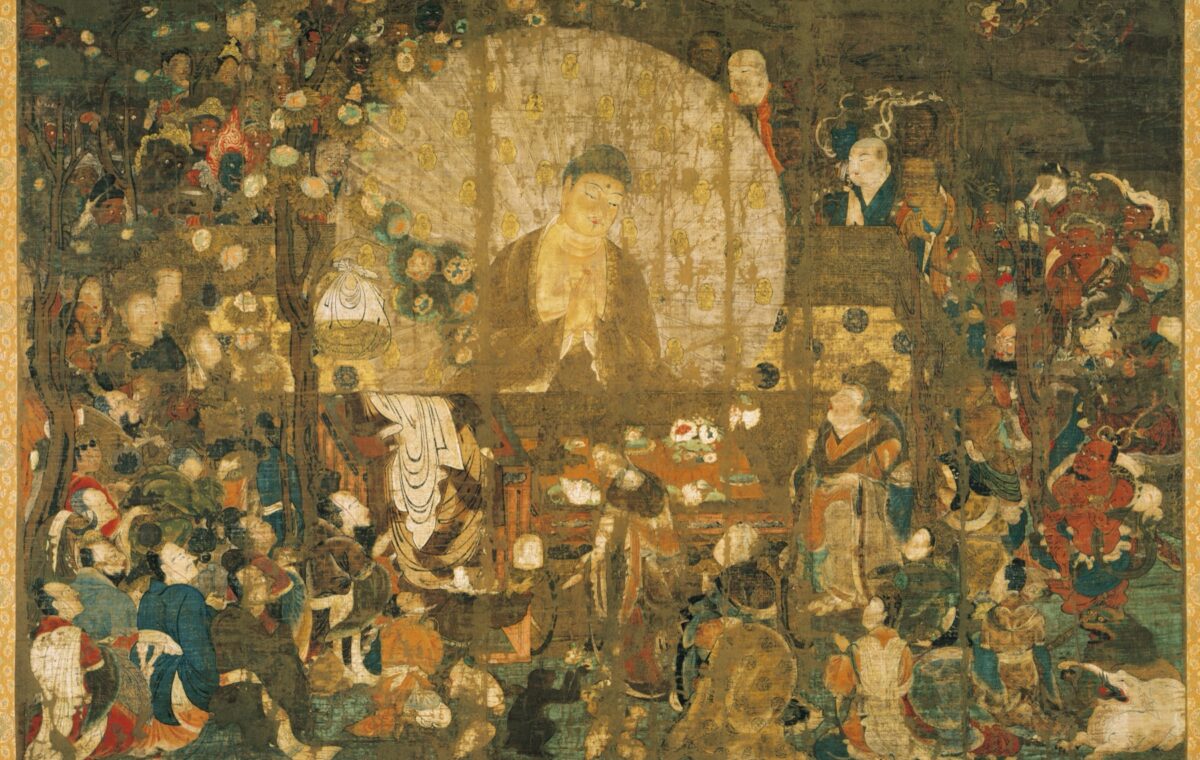
Shakyamuni rising from the gold coffin is an unusual Buddhist narrative image: after the Buddha has entered Nirvana, his mother Queen Maya arrives too late to see him alive, and he rises from the coffin to teach her once more. TANGKAWORLD image TK0274 appears to show this dramatic encounter, with a central Buddha, a radiating field of smaller Buddhas, attendants, and ritual objects. Its archive filename proposes the subject, but the digital image alone cannot prove the exact object, date, maker, or provenance. This guide explains the story and offers a careful visual method for reading the composition without turning a proposed label into a certainty.
What does “Shakyamuni rising from the gold coffin” depict?
The scene is associated with a narrative about Queen Maya, the Buddha’s mother. In the account summarized by the Kyoto National Museum, Maya descends from the Trāyastriṃśa heaven after hearing of her son’s death. Shakyamuni opens the coffin, rises, and teaches her about impermanence before lying down again and closing the coffin. The episode makes an image of death into a moment of teaching: grief, reunion, and the Buddha’s continuing capacity to teach are held together.
Museum records use English phrases such as “resurrection” or “rising from the gold coffin” for this episode. Those are useful catalog titles, but readers should not automatically import meanings from other religious traditions. The most grounded interpretation is the one supported by the image and the relevant Buddhist narrative: Maya arrives after the Buddha’s passing, and the coffin becomes the setting for a final lesson.
The Kyoto National Museum identifies its celebrated hanging scroll as Shaka (Sakyamuni) Rising from the Gold Coffin, dates it to Japan’s late Heian period in the 11th century, and records it as color on silk. Tokyo National Museum’s 2018 exhibition page describes the same named subject as a National Treasure lent by Kyoto National Museum. These records offer a strong comparison for TK0274, not automatic proof that the digital archive image is that specific object.
Read the composition from the central figure outward
1. Begin with the Buddha and the coffin
In TK0274, the central Buddha rises above a horizontal coffin-like structure. His upright torso contrasts with the horizontal format and the crowd arranged around him. That contrast is the clearest narrative clue: this is not simply a conventional image of a seated Buddha or a standard Buddha’s Parinirvana scene. The title’s proposed “rising” episode is consistent with the unusual posture, although the precise identity of every nearby figure still requires evidence beyond a web-sized reproduction.
Record posture before naming it. Is the figure fully seated, kneeling, or lifting his body from the coffin? Which parts of the coffin remain visible? Does the figure look toward someone or toward the viewer? A description such as “central haloed figure upright above a horizontal coffin” preserves what can be seen even if the subject label later changes.
2. Look for the mother and the exchange of attention
Queen Maya is essential to the story, but a viewer should not identify her solely by gender, robe color, or position. In the traditional narrative she descends from heaven and meets the Buddha at the coffin; the visual relationship between the main figure and a grieving or reverent woman may therefore be significant. In TK0274, multiple attendants and figures make individual identifications difficult. Map their positions and gestures first, and call a figure “Maya” only when the archive title, inscription, or a reliable object record supports that reading.
Notice whether the central Buddha turns toward a specific attendant, whether anyone holds a bowl or staff, and whether an offering table separates the figures. The Kyoto National Museum’s account mentions Maya holding the Buddha’s bowl and cane. Such objects can help test an interpretation, but a low-resolution image may not show them clearly enough for confident naming.
3. Follow the rays and miniature Buddhas
A broad radiating field fills much of the space behind the central figure. Small Buddha forms appear within the rays, multiplying the central image rather than leaving the halo as empty decoration. The Kyoto National Museum notes thousands of rays, each containing thousands of Buddhas, in its own scroll. In a close-looking exercise, describe the repeated figures and their direction before deciding whether the digital reproduction preserves every detail of the museum description.
The rays also guide the eye inward. They connect the central figure to the surrounding crowd and make the miracle visible as an event that affects the whole composition. This is a useful distinction from a simple aureole: the field seems to contain repeated figures, so record it as a populated radiance rather than just a halo.
4. Treat attendants and ritual objects as evidence, not decoration
Groups at the sides and lower edge give the scene witnesses. Some appear to watch, bow, or respond; others may represent celestial beings or members of the Buddha’s community. The archive image includes richly varied faces, clothing, and objects. These details can suggest a narrative sequence, but neither the number of figures nor a single costume is enough to identify a named attendant.
Make a simple inventory: coffin, central figure, possible mother, bowls or staff, offering stand, rays, miniature Buddhas, attendants, trees or architectural cues, and border. Then mark each item as visible, probable, or uncertain. This method follows the broader practice in our guide to reading the main icon and embedded scenes: separate observation from interpretation and use the surrounding episode to test the proposed story.
How this differs from a Buddha’s Parinirvana painting
A Buddha’s Parinirvana painting usually centers on Shakyamuni reclining on his right side as disciples, celestial beings, and other witnesses gather around him. TK0274’s proposed subject is a later moment in the narrative: Maya arrives after the death, and the Buddha rises from the coffin to teach. These scenes are related, but they are not interchangeable. Our Buddha’s Parinirvana visual guide focuses on the reclining composition and its mourners; this page focuses on the coffin episode and the encounter with Maya.
The distinction matters for cataloguing and search. “Nirvana painting” may describe a broad deathbed theme, while “rising from the gold coffin” points to a specific narrative episode. If the source label is uncertain, retain it as a supplied title and add a cautious descriptive note rather than silently rewriting the work’s identity.
What can and cannot be said about TK0274
- Visible in the digital image: a large central Buddha-like figure rising above a coffin-like form; a fan of rays with many small Buddha figures; surrounding attendants; and a decorated border.
- Proposed by the gallery filename: Shakyamuni emerging from a coffin, with a Tokyo National Museum reference.
- Supported comparison: Kyoto National Museum and Tokyo National Museum records document a closely related “Sakyamuni Rising from the Gold Coffin” subject and describe the Maya episode.
- Still uncertain for this exact file: whether TK0274 reproduces that particular National Treasure; the current holding institution, accession number, exact date, artist, workshop, provenance, and restoration history.
A filename can preserve useful research clues, including a museum or exhibition association, but it is not equivalent to an accession record. If a museum number, old mount, inscription, or collection catalogue becomes available, the match can be revisited. Until then, use the Kyoto and Tokyo records as documented comparanda, not as proof of TK0274’s ownership history.
A practical checklist for identifying the scene
- Describe the central figure’s posture and the coffin before assigning a narrative title.
- Look for a woman or mother figure and record her gesture, direction of gaze, and position.
- Check for bowls, a staff, an offering table, or other objects named in the Maya story.
- Describe rays and repeated Buddha figures separately from the main halo.
- Map attendants by location; avoid naming them from costume or color alone.
- Compare the composition with museum records for “Sakyamuni Rising from the Gold Coffin” and the Maya episode.
- Keep the exact archive filename, TK number, proposed identification, and verified collection data in separate fields.
- Use “uncertain” where the digital image or documentation does not settle a claim.
Conclusion
Shakyamuni rising from the gold coffin turns a dramatic reunion with Queen Maya into a teaching image. The coffin, upright Buddha, radiating miniature Buddhas, and gathered witnesses provide a practical route through the composition. TK0274 appears consistent with that subject, while its exact relationship to a named museum object remains tentative. Museum records sharpen the comparison; they do not replace an object-specific catalogue entry. For another way to distinguish narrative imagery from attribution, see our beginner’s guide to reading a Thangka.
Download the full Thangka image collection
Continue browsing and download the complete TANGKAWORLD image collection to compare Buddhist paintings, stories, deities, and visual details across the archive. Visit the full Thangka image collection to explore and download more images.
Collection references: Compare the Kyoto National Museum record for Shaka Rising from the Gold Coffin, the Tokyo National Museum’s 2018 exhibition entry, and the Hyogo Prefectural Museum of History’s Maya narrative study. Each supports historical comparison; none by itself confirms TK0274’s provenance.