
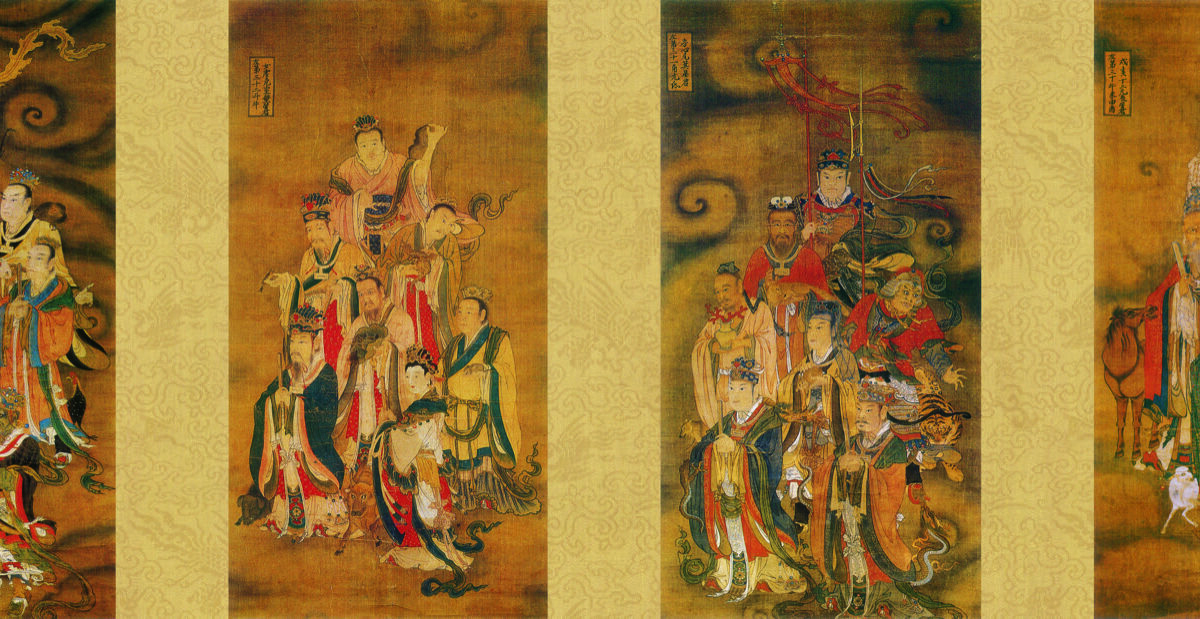
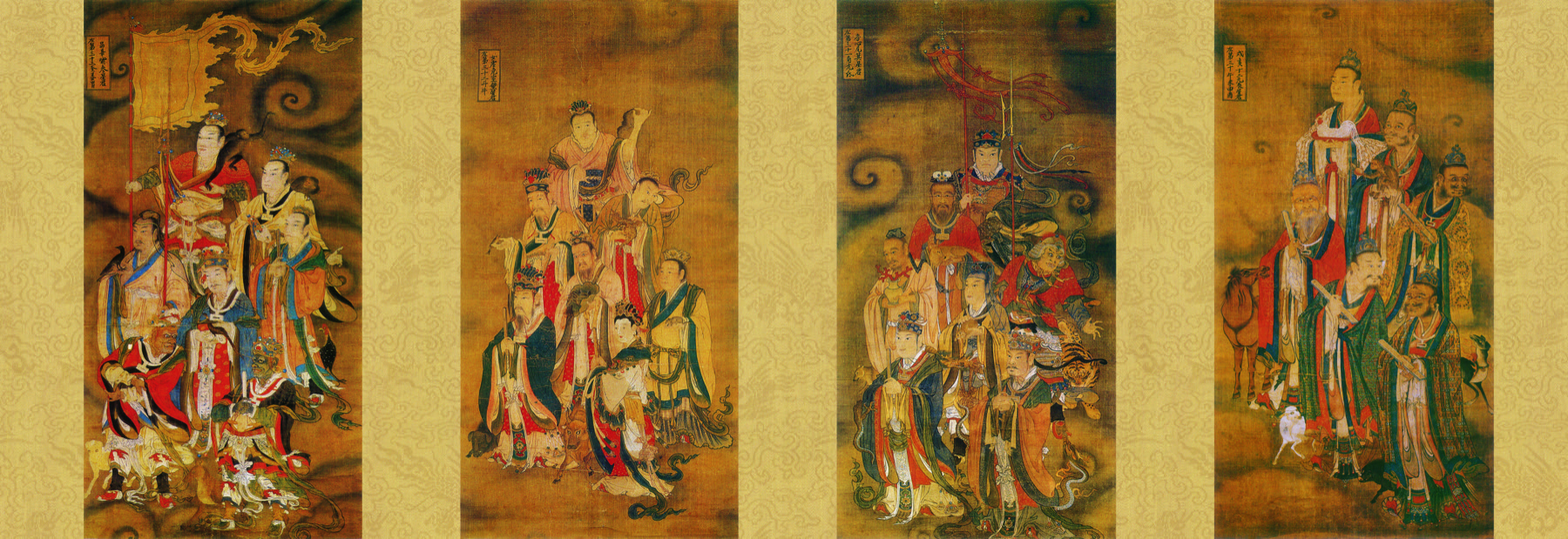
Water-and-Land handscroll dividers offer a useful way to read TK0180 before trying to name its figures. In this wide archive image, pale patterned bands separate four visible clusters of people. The bands create pauses across the composition, but they do not by themselves prove that each cluster represents a named ritual chapter, a separate painting, or a specific historical episode. This guide describes what can be seen, explains how the dividers shape the viewing sequence, and keeps the archive’s object history appropriately uncertain.
Quick answer: what do the bands do?
The pale bands work as visual dividers. They interrupt the darker painted field, provide breathing room between groups, and make a long horizontal image easier to scan. In TK0180, the eye can move from one assembly to the next without treating all the figures as a single crowd. The repeated pattern also gives the sections a visual relationship: each group is distinct, yet the shared background, color range, and aligned scale hold the image together.
That is a formal observation, not a full interpretation. The bands may separate subjects, help organise a long composition, or reflect how an image was assembled or recorded. Without a complete object record, inscriptions that can be read in context, or examination of the original, their precise historical purpose remains uncertain.
What is visible in TK0180
The archive image presents four vertical groupings across a long horizontal field. Each contains several standing or seated figures in layered robes. Small inscription-like panels appear near some groups, while curling cloud forms and dark painted areas occupy the spaces around them. The pale divider bands carry a repeated, low-contrast pattern that differs from the figurative sections. These details can be recorded directly from the image without assigning names to the figures.
The groups are not identical. Their silhouettes, number of figures, banners or carried objects, and internal spacing vary. That variation gives the eye a reason to pause at each band and compare what follows. It is safer to describe “a cluster with a tall standard” or “a group with several figures at different heights” than to identify a deity, official, or ritual role from a small digital view. The narrow labels are also visible, but their characters are not reliably legible at this scale.
Because TK0180 is a digital reproduction, it may flatten, crop, or join material that would be experienced differently in person. The archive filename places it within a group of four Shanxi Water-and-Land handscroll images; that catalog context is useful for retrieval, but it is not independent proof of the scroll’s original mounting, date, maker, or use. Keep the archive label and direct visual evidence in separate notes.
Why pale dividers matter in a handscroll composition
A handscroll is not normally viewed all at once. The Metropolitan Museum of Art explains that Chinese handscroll viewing is gradual: the viewer unrolls the work and encounters it section by section. A wide digital image changes that experience: it shows multiple sections simultaneously and can make a sequence appear like a static panorama. When reading TK0180, imagine the image as a sequence of encounters, but do not assume the current crop preserves the original order or complete extent.
Within the visible image, the pale bands serve as punctuation. They make a transition perceptible without using a modern frame or a heavy border. Their repeated pattern gives continuity, while their light value separates one darker figure group from the next. A viewer can follow the horizontal rhythm—figures, pause, figures, pause—before understanding every symbol or inscription. This is especially helpful when many small figures make the image seem visually dense.
The bands also affect comparison. Look at one group, note its scale and arrangement, then compare the next group after crossing the divider. Does the group become taller, more compact, or more varied? Are the figures facing in a similar direction? Does a banner, animal, or cloud motif recur? These are useful questions because they rely on visible structure. They do not require the viewer to guess a narrative or identify a figure prematurely.
Keep the Water-and-Land label in context
Water-and-Land ritual painting is a broad category, not a single fixed layout. The Guangdong Museum notes that related paintings can appear as scrolls, murals, or panels and bring together Buddhist, Daoist, and other figures in its Water-and-Land exhibition overview. The Smithsonian’s record for a Chinese ritual image, for example, identifies it as belonging to a larger set used for the Water-Land Prayer Rite. Those records help explain why groupings and diverse figures may matter in this tradition; they do not establish that TK0180 shares the same date, function, or provenance as any museum object.
For a wider introduction to the genre’s visual hierarchy, see our Buddhist Water-and-Land ritual painting guide, which studies a separate archive image, TK0187. Compare the two works as visual examples, not as proven parts of one original set. For a practical way to document ambiguous labels and marks, our guide to seals and collector marks in Buddhist painting offers a useful evidence-first checklist.
A close-looking checklist for handscroll dividers
- Record the image reference. Note TK0180, the file version, and whether you are viewing the full image or a crop.
- Count only visible sections. Describe the four groupings shown in this reproduction; do not infer the total number in the original scroll.
- Describe each divider. Record its width, color, repeated pattern, and position between adjacent groups.
- Compare groups without naming them. Note figure count, height, posture, direction, clothing, banners, and visible animals or objects.
- Separate text from interpretation. Mark the narrow panels as visible but unreadable unless you can inspect a clear image or a transcription.
- Track the source of every claim. Distinguish the archive filename, direct image observation, museum comparison, inscription reading, and conservation examination.
- Leave uncertain facts open. Do not supply a dynasty, workshop, ritual chapter, artist, original owner, or provenance without supporting documentation.
Conclusion: read the pauses before the people
TK0180 shows how visual section dividers can make a crowded handscroll image easier to follow. The pale patterned bands separate four visible figure groups, create pauses, and establish a repeated horizontal rhythm. That formal reading is already informative; it does not require unsupported identities or a guessed history. Start with the boundaries, compare the groups on either side, and then add interpretation only when inscriptions, object records, or direct examination provide stronger evidence.
Download the full Thangka image collection
Continue browsing and download the complete TANGKAWORLD image collection from the free Thangka downloads page.