
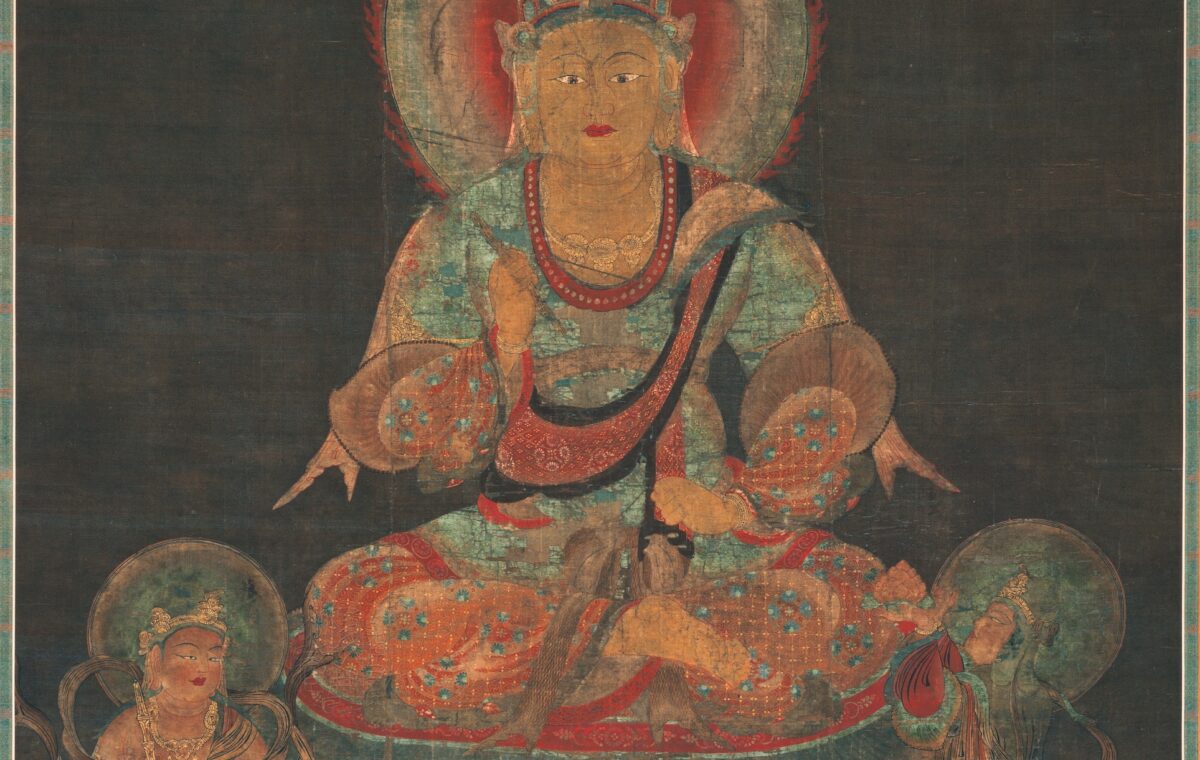
Taishakuten (Indra) in Japanese Buddhist art is best understood through both identity and placement. Taishakuten is the Japanese name for Indra, a guardian associated with the east in the Twelve Devas. When a single figure is separated from its original set, however, a label alone is not enough to establish every detail of its identity, date, maker, or ritual history. This visual guide shows how to read the directional context, compare reliable museum records, and mark uncertain evidence honestly.
Quick answer: who is Taishakuten?
Taishakuten is the Japanese Buddhist name for the deity known in Sanskrit as Indra. In Japanese Esoteric Buddhist iconography, he belongs to the Twelve Devas and guards the eastern quarter. The set as a whole protects a ritual space through a coordinated arrangement of directional and cosmic guardians. That role is more dependable as a starting point than trying to identify Taishakuten from one crown, hand gesture, or isolated object.
The National Institutes for Cultural Heritage’s e-Museum record for Taishakuten describes a documented 12th-century painting in the Twelve Devas set, produced in 1127 for an annual New Year esoteric prayer ceremony at the Imperial Palace. That particular scroll is held by Kyoto National Museum. These facts explain the ritual role of the figure, but they do not date or authenticate TK0623.
Why Indra appears among the Twelve Devas
The Twelve Devas are not simply a group of twelve unrelated gods. They map protection around a sacred or ritual environment. Eight figures correspond to the cardinal and intermediate directions; four additional figures represent heaven, earth, the sun, and the moon. Taishakuten, identified with Indra, occupies the east. Other names and spellings vary across Sanskrit, Japanese, Chinese, and English catalogues, so keep the terminology of each cited record visible rather than silently normalizing every label.
These deities have roots in earlier Indian religious traditions and were incorporated into Buddhist ritual systems. Their roles were reframed as guardianship within Buddhism, especially in Esoteric Buddhist practice. The official e-Museum overview of the Twelve Devas outlines the directional arrangement and notes that the group appeared in Japanese ritual paintings and ceremonies. For a broader introduction to the group and its visual logic, see our Twelve Devas guide.
How to read the TK0623 figure without overclaiming
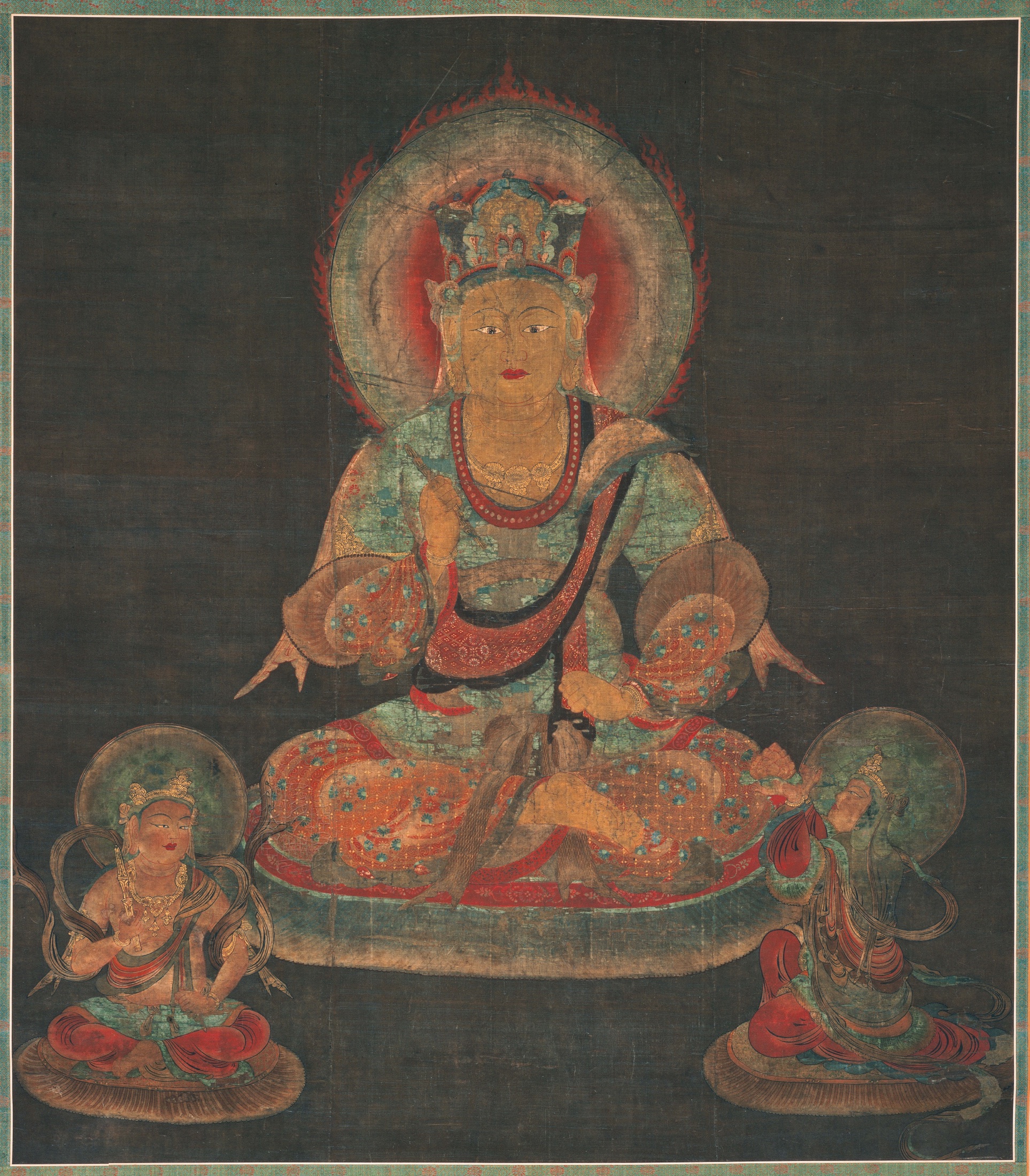
The TANGKAWORLD archive filename records TK0623 as an image of Taishakuten. In the image itself, a large crowned figure sits centrally, with two smaller figures near the lower corners. The central figure’s scale establishes visual hierarchy, while the attendants frame the main body. A large halo, patterned garments, and a dark ground make the principal silhouette easy to follow even where surface detail is subdued.
Those observations describe what is visible; they do not independently prove the name. At this image resolution, I cannot confidently identify a vehicle or a specific object in the central figure’s hands. It would be tempting to use a familiar attribute from another Taishakuten painting to fill that gap, but doing so would confuse comparison with direct evidence. The careful wording is: “the archive identifies the figure as Taishakuten; the attribute is unclear in this image.”
That distinction matters because iconographic images are often transmitted through sets, ritual manuals, sketches, and later copies. The Met’s collection record for a Kamakura-period Zuzōshō scroll of deva iconography explains that written names, Sanskrit equivalents, seed syllables, and attributes accompanied images to help transmit complex Buddhist iconography. A name in a filename is useful metadata, but a connected object record or a complete series provides stronger evidence.
Compare the role, not just the costume
Taishakuten’s directional role gives a practical comparison test. In a documented Twelve Devas set, ask whether the candidate image belongs to a series whose other members occupy the remaining directions and cosmic positions. Check inscriptions, seed syllables, labels, mounting sequence, or catalogue references. If the image has been detached from its companions, mark the missing context as a limitation rather than treating the figure as a self-contained portrait.
Costume and gesture can still help, but they should be read alongside position and format. Kyoto National Museum’s documented Taishakuten scroll is a useful comparison because the museum identifies its ritual context and its place within a larger set. It notes fine cut-gold patterns, vivid color, and distinctive flowing lines on the attendants’ robes. Those characteristics belong to that documented scroll; they should not be projected onto every image catalogued as Taishakuten.
Do not confuse the Twelve Devas with the Four Heavenly Kings. Both groups have protective functions, but they organize figures differently. Vaishravana, for example, can appear as an independent guardian and as Bishamonten, the northern member of the Twelve Devas. Our Four Heavenly Kings visual guide explains the four-guardian system. Similar roles do not make the groups interchangeable.
Taishakuten identification checklist
- Record the source label. Preserve “Taishakuten” and “Indra” as the archive’s identification, and note where that label came from.
- Describe the image before interpreting it. Write down posture, number of figures, crown, clothing, halo, hand positions, visible attributes, and background.
- Look for directional context. Check whether the work belongs to a Twelve Devas set and whether the east position is supported by inscriptions or sequence.
- Compare like with like. Use a museum record of a documented Taishakuten image as a comparison, not proof of shared date, workshop, or provenance.
- Separate what is visible from what is inferred. If an attribute is faint, damaged, or hidden, label it “unclear” rather than naming it from expectation.
- Keep object history open. Without a reliable catalogue record, treat the date, artist, school, original location, ritual use, and provenance of TK0623 as uncertain.
This evidence-first approach also helps with other Buddhist images. Our beginner’s guide to reading a Thangka offers a related method for distinguishing observation from interpretation when names, symbols, and object histories are incomplete.
What a single image cannot establish
A digital image can support visual comparison, but it cannot by itself establish the original support, pigment composition, repairs, dimensions, or conservation history. TK0623 visibly has a subdued surface and areas where fine detail is difficult to read. That description should not be converted into a claim about age, damage, or restoration without a physical examination or a reliable conservation record.
The same caution applies to date and authorship. The 1127 date, Kyoto ownership, and Imperial Palace ritual context in the e-Museum record refer to a separate, documented Taishakuten scroll. The TANGKAWORLD archive image has not been tied here to that object. Keeping these records separate protects readers from false certainty and makes later research easier: a future catalogue link can add evidence without requiring the article to retract invented details.
Conclusion
Taishakuten (Indra) in Japanese Buddhist art is a directional guardian whose eastward role is clearest when the image is read as part of the Twelve Devas. TK0623 is recorded by the local archive as Taishakuten and visibly presents a crowned central figure with two attendants. The group context supports a useful study, while the specific attribute, date, maker, and provenance remain uncertain. Start with the label, test it against the set and trusted records, then state only what the image allows you to see.
Download the full Thangka image collection
Continue exploring Buddhist art and iconography, and browse and download the full TANGKAWORLD image collection.