
Buddhist attendant figures in Thangka are often the key to reading an image as a structured assembly rather than a single portrait. They direct attention toward a central Buddha or Bodhisattva, establish vertical and horizontal zones, and connect a principal figure with donors, monks, protectors, lineage holders, or other participants. Their presence does not automatically identify a specific ritual, school, or historical event. A careful reading begins with placement, scale, posture, and relationship before assigning names.
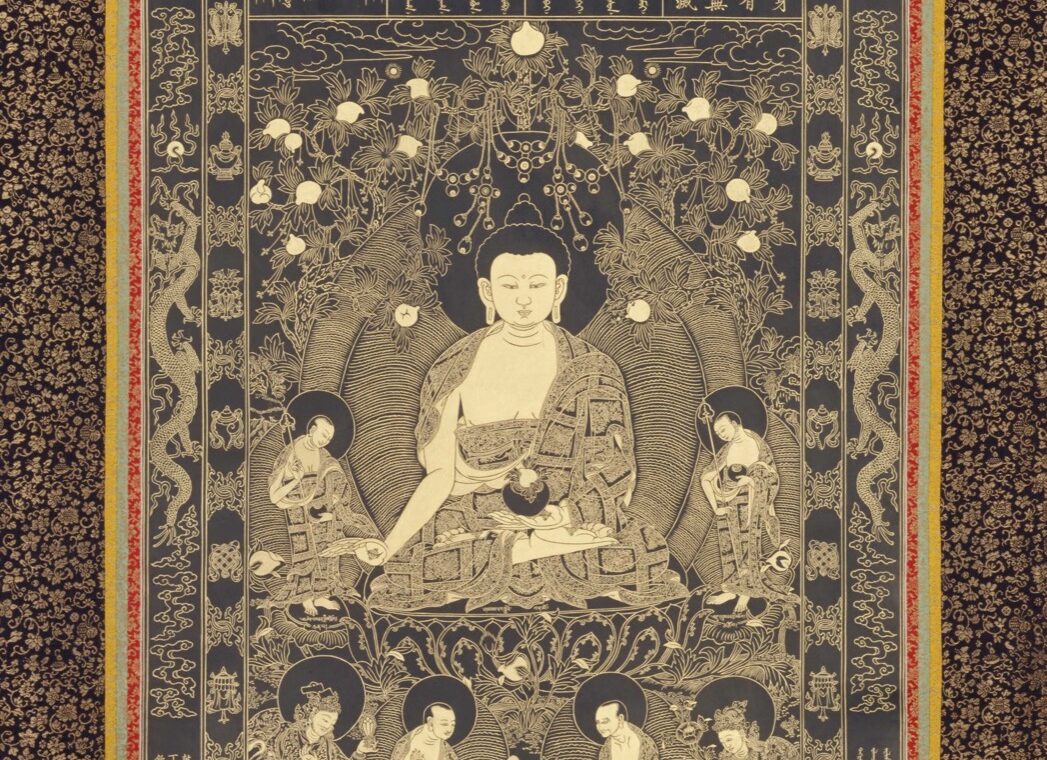
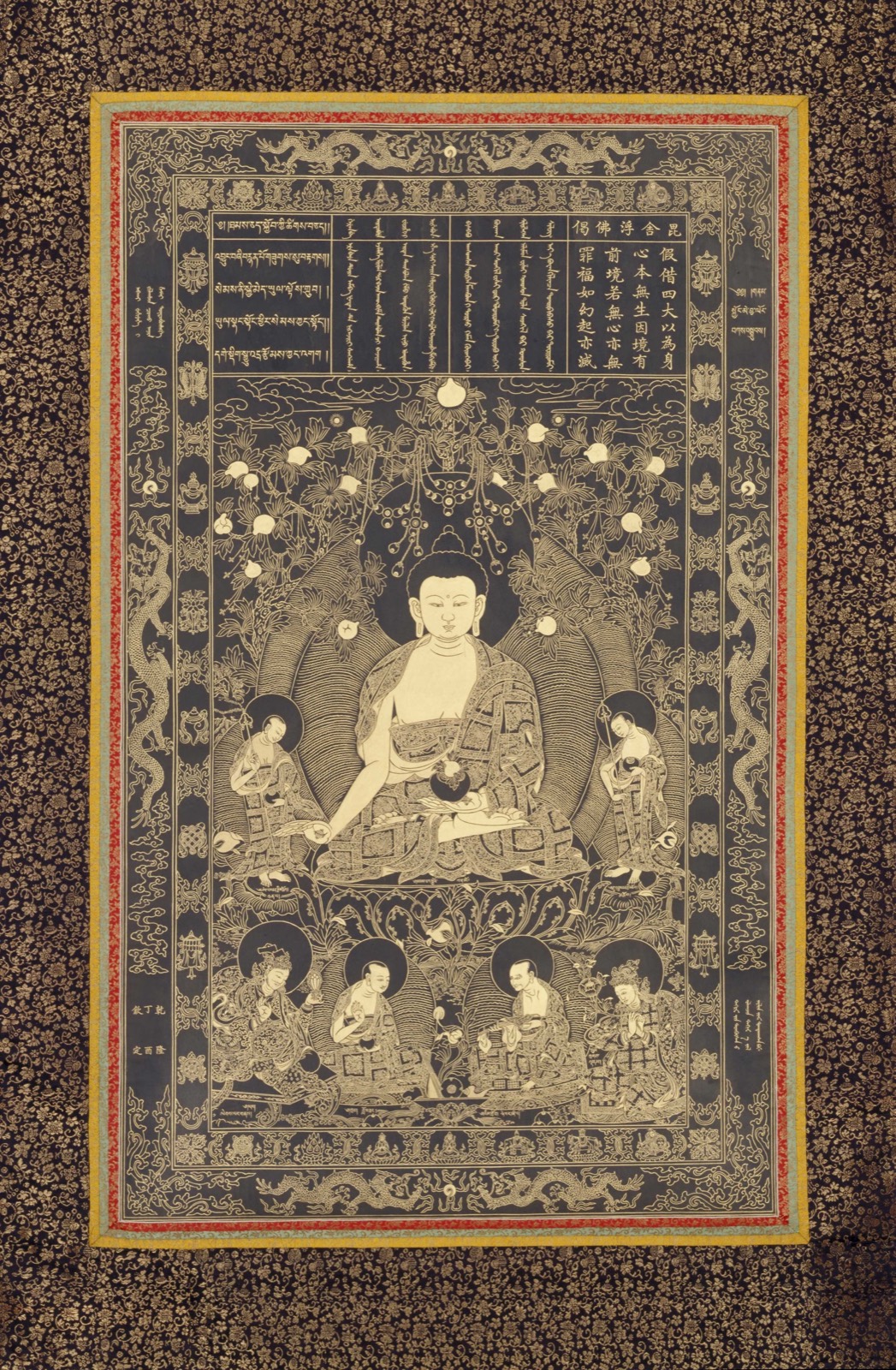
TK1146 provides a useful case. A central seated Buddha occupies the main field, flanked by two standing haloed figures. Four additional haloed figures sit in a lower register, while a multiscript panel, dragons, floral framing, and patterned textile surround create further zones. The archive filename associates the work with Viśvabhū Buddha, but the visible image alone cannot confirm every figure, date, workshop, or original purpose. Those points should remain uncertain without a reliable inscription study or catalogue record.
Start with the central relationship
First identify the largest figure and ask how the surrounding people relate to it. In many Thangka paintings, size and central position indicate visual priority, but they do not by themselves provide a name. In TK1146, the seated central Buddha has a larger scale than the nearby figures and sits above the lower group. That is a sound compositional observation. It is less secure to label every surrounding figure as a particular disciple, donor, or deity from position alone.
Notice where each attendant looks, gestures, or offers an object. A standing figure can face inward, outward, or toward the viewer; a lower figure may hold a book, flower, bowl, or other attribute. When the image quality permits, record the visible item and hand position separately from the proposed identity. This leaves a useful record even if a later reading of an inscription changes the identification.
How to read Buddhist attendant figures in Thangka
Map the registers
Divide the painting into visual registers before counting people. TK1146 has an upper text zone, a central field with the primary seated figure and two attendants, and a lower field with four haloed figures. Borders and textiles frame these zones but are not the same as the figure group. A simple map avoids the common problem of describing every small form in a dense painting as if it occupied the same narrative space.
Compare scale and spacing
Attendants may be nearly equal in size, deliberately smaller, or compressed into a lower band. Equal scale can signal a balanced pair; it does not prove equal ritual rank. Wide spacing can make two side figures read as a formal escort, while tight clustering can create an assembly. In TK1146, the two flanking figures and the lower group occupy different parts of the composition. Describe those differences before deciding whether they belong to a single lineage, an offering scene, or another iconographic program.
Separate halos, backgrounds, and figures
Gold-line paintings often make halos, clouds, floral scrolls, garments, and background patterns appear equally active. Trace a figure’s outline before naming it. A halo establishes a field around a head or body; it is not itself an attendant. Similarly, a dragon, vase, cloud, or border ornament may frame the assembly without being part of its human or divine hierarchy.
What counts as reliable evidence?
Reliable identification usually combines several kinds of evidence: a legible inscription, characteristic attributes, a stable comparison with documented works, and an understanding of the painting’s full composition. A filename is helpful for locating an image in an archive, but it is not an independent scholarly confirmation. In TK1146, the gold-line image, central Buddha, surrounding figures, and text panels deserve close attention; they do not authorize a complete transcription or a definitive named roster without further sources.
This evidence-based approach is especially important when images have been cropped, retouched, photographed under uneven light, or distributed at reduced resolution. Record what is visible—such as a haloed standing figure at the left or four seated figures below—then record separately what is uncertain. That distinction improves catalogue notes, condition reports, and later comparisons.
A practical documentation checklist
- Photograph the complete Thangka before isolating individual figures.
- Mark the central figure, side figures, lower figures, and text panels as separate zones.
- Record each figure’s position, scale, orientation, halo, gesture, and visible attribute.
- Describe any object without converting it into a name unless the evidence supports it.
- Note whether a figure overlaps landscape, clouds, textiles, or a border.
- Keep inscriptions, seals, and labels separate from visual descriptions until they are legibly read.
- Mark deity names, dates, school, maker, ownership, and provenance uncertain where no source confirms them.
For broader practice, compare this method with our guide to reading a Thangka and the Thangka condition report checklist. An assembly can also be studied as a teaching scene; see how to read a Buddha preaching assembly.
Text panels and figure groups
Text panels can be closely connected to an assembly, yet they should not be used as instant figure labels. TK1146 includes a large multiscript area above the figures, but a photographed panel may be incomplete, stylized, or too small for reliable transcription. Begin by recording its location, scripts as visually observed, line arrangement, and relationship to the central field. Then seek qualified reading and independent cataloguing before linking particular lines to particular figures. Our study of the Sikhin Buddha Thangka and its four-language inscriptions explains why this separation matters.
From figure count to visual structure
Reading Buddhist attendant figures in Thangka is not a matter of memorising a fixed cast. It is a way of seeing structure: a central focus, flanking presence, lower registers, text zones, and frames that guide attention. In TK1146, the seated Buddha, two standing attendants, four lower haloed figures, dragons, floral motifs, and textual field create a layered assembly. Start with that observable order, compare it with documented examples, and let uncertain details remain uncertain until better evidence is available.
Download the full Thangka image collection
Continue browsing and downloading the complete TANGKAWORLD image collection for close comparison of Buddhist figure groups, inscriptions, borders, and painting details.