
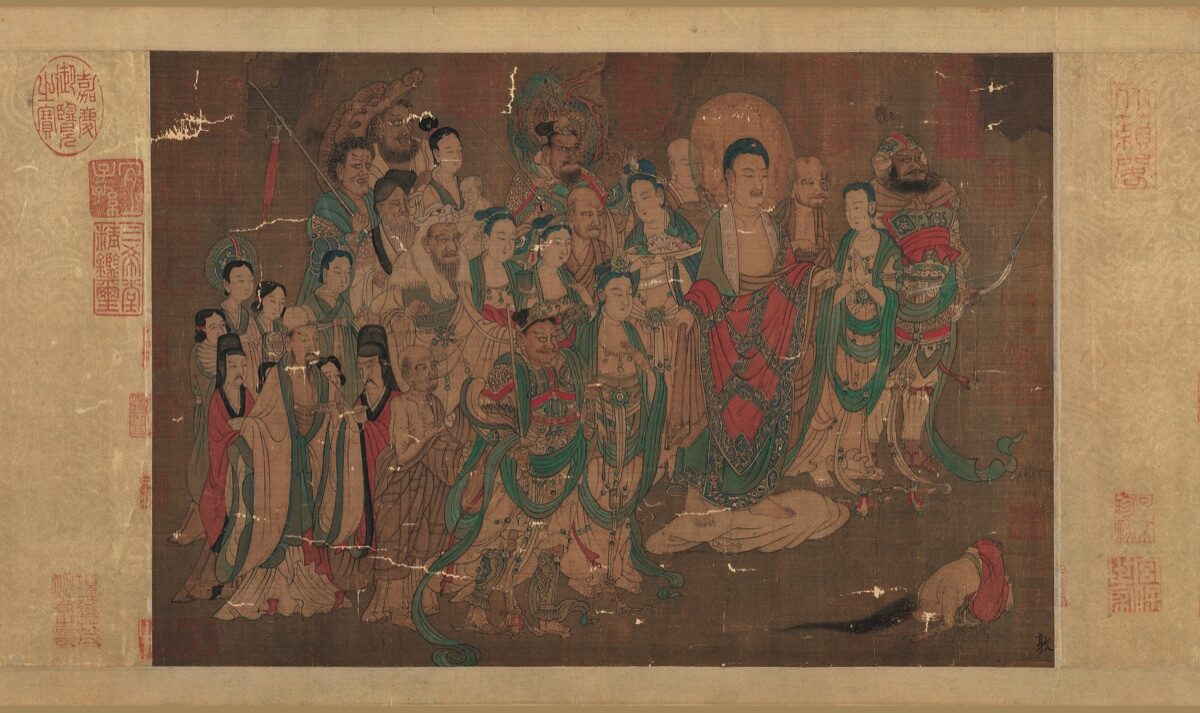
Dipankara Buddha in art is often recognized through a meeting between a past Buddha and the ascetic who will eventually become Shakyamuni. In TANGKAWORLD archive image TK0210, a tall haloed Buddha stands within a dense assembly while a small kneeling figure occupies the open space to the right. The horizontal handscroll format, grouped witnesses, scale differences, mounting, and numerous red seals all help us read the image—but they do not prove every identity or historical label by themselves.
This guide explains how to separate what is visibly present from what the archive title proposes. TK0210 is not a conventional Tibetan hanging Thangka. It belongs to the broader field of Buddhist narrative painting, making it especially useful for comparing story, hierarchy, format, and later collection history.
Who is Dipankara Buddha?
Dipankara is a Buddha of the distant past in Buddhist tradition. His importance to the life story of Shakyamuni comes from a prediction: an ascetic—called Megha or Sumedha in different traditions—meets Dipankara, makes an offering, and receives confirmation that he will become a Buddha in a future life. The future Buddha is therefore represented before his final enlightenment, not as the historical teacher already known as Shakyamuni.
The Metropolitan Museum of Art’s Dipankara Jataka relief shows how one narrative can present the ascetic several times: offering flowers, prostrating and spreading his hair over muddy ground, and appearing again in veneration. That object is an ancient Gandharan stone relief, not the same painting as TK0210, but it provides a reliable comparison for the story’s central relationship.
A separate Metropolitan Museum Dipankara sculpture explains that Shakyamuni, in a past birth, vowed before Dipankara to follow the path to Buddhahood. These museum records support the narrative framework. They should not be used to assign TK0210 the same date, region, medium, or provenance.
How to read the Dipankara prophecy scene
1. Begin with the dominant standing Buddha
The largest sacred figure stands slightly right of center and is framed by a circular halo. Scale establishes hierarchy: the Buddha is not simply another person in the crowd. The upright posture also creates a vertical anchor inside an otherwise strongly horizontal composition.
A standing Buddha alone is not enough to identify Dipankara. Many Buddhas share robes, halos, bodily marks, and calm expressions. The archive title and the narrative relationship between the large Buddha and the kneeling figure provide the stronger combined clue.
2. Locate the kneeling or prostrate figure
At the far right of the painted scene, a small figure bends low near the Buddha’s path. This separation matters. The surrounding assembly forms a compact wall of witnesses, while the kneeling figure occupies a quieter patch of ground. That visual gap turns the encounter into the narrative focus.
The figure is consistent with the ascetic in the Dipankara prophecy story, but the exact gesture and identity should still be described cautiously. The digital image does not provide a verified inscription that names the person, and some details may be obscured by wear, scale, or later treatment.
3. Read the assembly as witnesses, not decoration
Monastic-looking figures, richly dressed attendants, guardians, and other sacred participants gather around the standing Buddha. Their varied faces, clothing, poses, and scale create a structured audience. The group makes the prediction public and consequential: this is not a private portrait but a scene of recognition witnessed by a community.
Individual members should not be named without stronger evidence. A crown, staff, halo, or robe can narrow possibilities, but it rarely confirms a specific bodhisattva, Arhat, guardian, donor, or historical person on its own. This is the same evidence-first method used in our Buddha preaching assembly guide.
4. Follow the handscroll from mounting to image
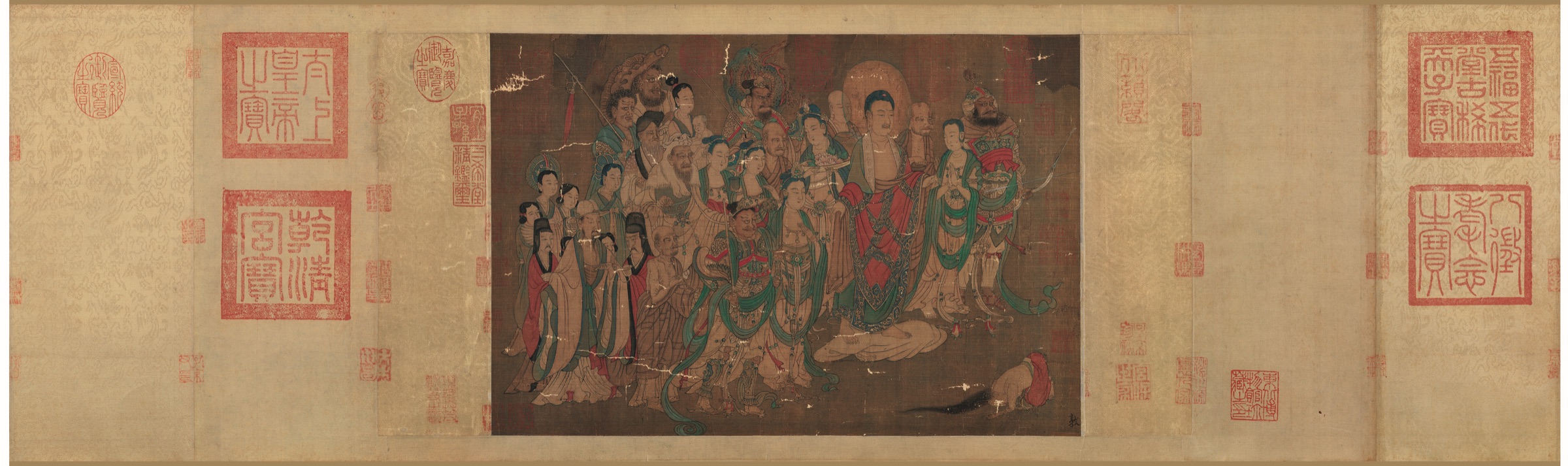
A hanging Thangka is usually designed for a largely vertical encounter. A handscroll is viewed progressively across its width. TK0210’s long mounting, central painted section, open margins, and repeated seals create several zones rather than one self-contained icon.
When studying a digital reproduction, zoom out first to understand the full sequence. Then move inward: mounting, inscriptions or seals, main assembly, kneeling figure, and damaged or repaired areas. This prevents a close-up detail from being mistaken for the whole subject.
What the red collector seals can and cannot tell us
TK0210 carries many red impressions across the mounting and painted field. Their placement shows that the work acquired a long record of viewing, ownership, authentication, or appreciation. Large seals on the outer mounting and smaller impressions over the image belong to different visual layers of the object’s history.
A red seal is not automatic proof of age, authenticity, imperial ownership, or an unbroken provenance. A responsible study records shape, size, script, color, location, overlap, and impression quality before attempting to read or identify it. See our practical guide to Buddhist painting seals and collector marks for that workflow.
The archive filename proposes a Southern Song date, and a Tsinghua University library catalog lists a work with the Chinese title Dipankara Buddha Giving the Prediction to Shakyamuni among paintings associated with the Liaoning Provincial Museum. However, the current TANGKAWORLD file alone does not verify that TK0210 is an exact, complete, or authoritative reproduction of that cataloged object. The date, artist, accession history, later mounting, and provenance should therefore remain uncertain until checked against a current official object record.
Dipankara Buddha identification checklist
- Dominant Buddha: Look for a Buddha larger than the surrounding figures, often standing in narrative depictions.
- Future Shakyamuni: Look for a smaller ascetic offering flowers, kneeling, bowing, or spreading hair or cloth along the path.
- Witness assembly: Note monks, bodhisattva-like attendants, guardians, donors, or celestial witnesses, without naming uncertain figures.
- Narrative spacing: Check whether open ground isolates the encounter from the crowd.
- Multiple episodes: Some works repeat the ascetic in several moments; do not assume a painting must use only one continuous scene.
- Inscription and catalog evidence: Treat a title, seal, or later label as evidence to verify, not as a substitute for verification.
- Format: Distinguish a horizontal handscroll, mural, relief, manuscript leaf, and vertical Thangka before comparing compositions.
Observed, proposed, and uncertain details in TK0210
Observed: a horizontal mounted work; a large standing haloed Buddha; a crowded sacred assembly; a kneeling figure on open ground; numerous red seals; surface losses and abrasion; and a very wide viewing path.
Proposed by the archive record: Dipankara Buddha, the prediction concerning the future Shakyamuni, a scroll-painting format, and a Southern Song association.
Uncertain without a verified current object record: the exact identities of most attendants; precise date; artist; workshop; original support and pigments; present collection; accession number; sequence and owners of the seals; restoration history; mounting date; provenance; and whether the digital file reproduces the entire physical scroll at a consistent scale.
Why condition and format change interpretation
Surface loss crosses faces, garments, halos, and background areas. A missing line can alter a hand gesture; a darkened passage can hide an attribute; and a cropped digital image can remove inscriptions or colophons. Identification should therefore include a basic condition-report checklist, especially when the argument depends on a small object or gesture.
Format matters just as much. Compare this progressive handscroll encounter with the centered vertical drama of Buddha’s Parinirvana in art. Both are Buddhist narrative images, yet one directs the eye laterally through an encounter and accumulated seals, while the other usually organizes mourners around a reclining Buddha.
Conclusion
Reading Dipankara Buddha in art requires more than spotting a haloed Buddha. The decisive structure is relational: a past Buddha, a future Buddha in ascetic form, a witnessed prediction, and a composition that gives the encounter visual priority. TK0210 supports that reading through its large standing figure, kneeling participant, dense assembly, and horizontal narrative space. Its many seals and areas of wear also remind us to separate the depicted story from the object’s later history—and to keep unsupported date, artist, and provenance claims uncertain.
Download the full Thangka image collection
Continue exploring Buddhist narrative paintings, deities, Mandalas, and comparative archive images in the complete TANGKAWORLD collection. Browse and download the full Thangka image collection for close visual study.