
Kshitigarbha in Buddhist art is often immediately recognizable because this bodhisattva looks like a monk rather than a jeweled prince. A shaved head, layered monastic robes, a ringed staff, and a luminous jewel form a compact set of visual clues. These attributes appear across Chinese, Korean, Japanese, and Himalayan contexts, although pose, costume, attendants, and name forms vary by region.
Kshitigarbha is known as Dizang in Chinese and Jizo in Japanese. English-language sources may spell the Sanskrit name Kshitigarbha or Ksitigarbha. These spellings refer to the same broad figure, but a specific painting may belong to a local tradition with its own visual conventions. This guide concentrates on what can be seen rather than assuming that every regional image follows a single template.
Why Kshitigarbha looks different from many bodhisattvas
Many bodhisattvas appear crowned and jeweled, dressed in the garments of an idealized prince. Kshitigarbha often adopts the outward form of an ordained monk. The contrast is useful for identification: the plain shaved head and monastic robe separate him from figures such as Manjushri, whose sword, lotus, book, crown, and ornaments create a markedly different silhouette.
The monastic form also shapes the mood of the image. Rather than projecting royal splendor, Kshitigarbha is frequently shown standing calmly and ready to travel. The staff suggests movement through the worlds of rebirth, while the jewel provides a concentrated point of radiance and beneficent power.
Key features of Kshitigarbha iconography
The shaved head
A smooth, shaved head is one of the most consistent clues. It signals monastic identity and should be read together with the robe. A bald figure alone is not enough: Arhats, disciples, monks, and teachers may share the same feature. Kshitigarbha becomes more securely identifiable when the staff and jewel are also present.
The ringed monk’s staff
The long staff commonly ends in a metal finial with loose rings. In East Asian art it is often called a khakkhara or shakujō. The rings may be difficult to count in a small reproduction, and regional artists can simplify the form. Focus first on the tall staff, open metal head, and hanging rings rather than requiring a fixed number in every painting.
The wish-fulfilling jewel
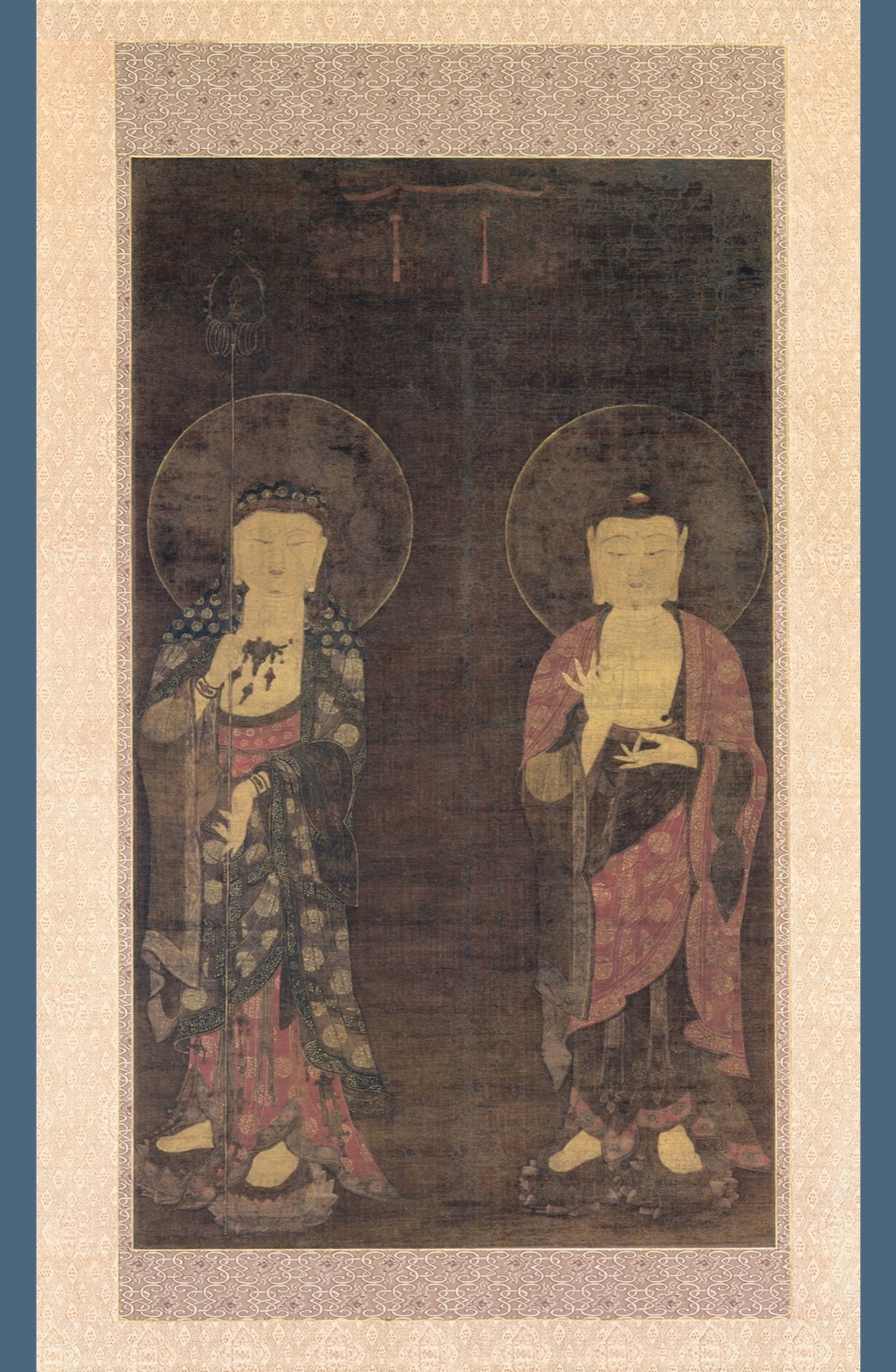
Kshitigarbha often holds a rounded jewel on an open palm. It may be shown as a glowing orb, a flaming jewel, or a translucent sphere. The object is commonly identified as a cintamani, a wish-fulfilling jewel. In TK0222, the ringed staff is much clearer than the jewel at this reproduction scale, so the paired figure and surrounding context become important supporting evidence.
Monastic robes and lotus support
The figure wears layered robes rather than the short lower garment and abundant jewelry common to princely bodhisattvas. Decorative textiles can still be extremely rich; “monastic” does not necessarily mean visually plain. Kshitigarbha may stand or sit on a lotus, clouds, or a pedestal. TK0222 presents two standing sacred figures with circular halos and textile-rich robes.
How Kshitigarbha varies across regions
In Chinese painting, Dizang may appear alone, with attendants, or within scenes related to the realms of rebirth. Korean Buddhist art can present richly patterned robes and luminous jewels. In Japan, Jizo images range from refined temple sculpture to accessible roadside figures. Himalayan examples may place Kshitigarbha among larger bodhisattva groups and can emphasize princely dress more than East Asian monastic forms.
Because these traditions are related but not identical, labels should stay specific. A Japanese Jizo sculpture should not automatically be described as a Tibetan Thangka, and a modern devotional painting should not be assigned a medieval date because it uses older symbols. Object type, material, mounting, inscription, and collection record all matter.
Common identification mistakes
Confusing Kshitigarbha with an Arhat or monk
Arhats and historical monks may have shaved heads and robes, but they usually lack the paired ringed staff and wish-fulfilling jewel. They may sit in landscape settings, hold books, fly whisks, begging bowls, or staffs of different forms, and display more individualized portrait features. Compare the museum-minded approach in How to Recognize Arhat Paintings.
Assuming every staff-bearing bodhisattva is Kshitigarbha
A staff is not exclusive to one figure. Check the shaved head, robe, jewel, and overall devotional context. If the object in the opposite hand is unclear, describe the figure as “possibly Kshitigarbha” until stronger evidence appears.
Treating a modern image as an ancient object
Traditional iconography continues across centuries of Buddhist art. A painting can follow an old visual formula without proving an old date. Digital files also remove information about the reverse, mounting, pigments, repairs, and inscriptions. TK0222 supports a visual study of Kshitigarbha, but its precise date and physical medium are uncertain from the archive image alone.
Practical identification checklist
- Does the figure have a shaved head?
- Are the garments recognizably monastic robes?
- Is there a tall staff with a ringed metal finial?
- Does the other hand support a round or flaming jewel?
- Is the figure standing or seated on a lotus, cloud, or sacred pedestal?
- Does a halo or nimbus mark the figure’s sacred status?
- Do attendants or surrounding scenes provide regional context?
- Are artist, date, and provenance documented, or should they remain uncertain?
Reading TK0222 carefully
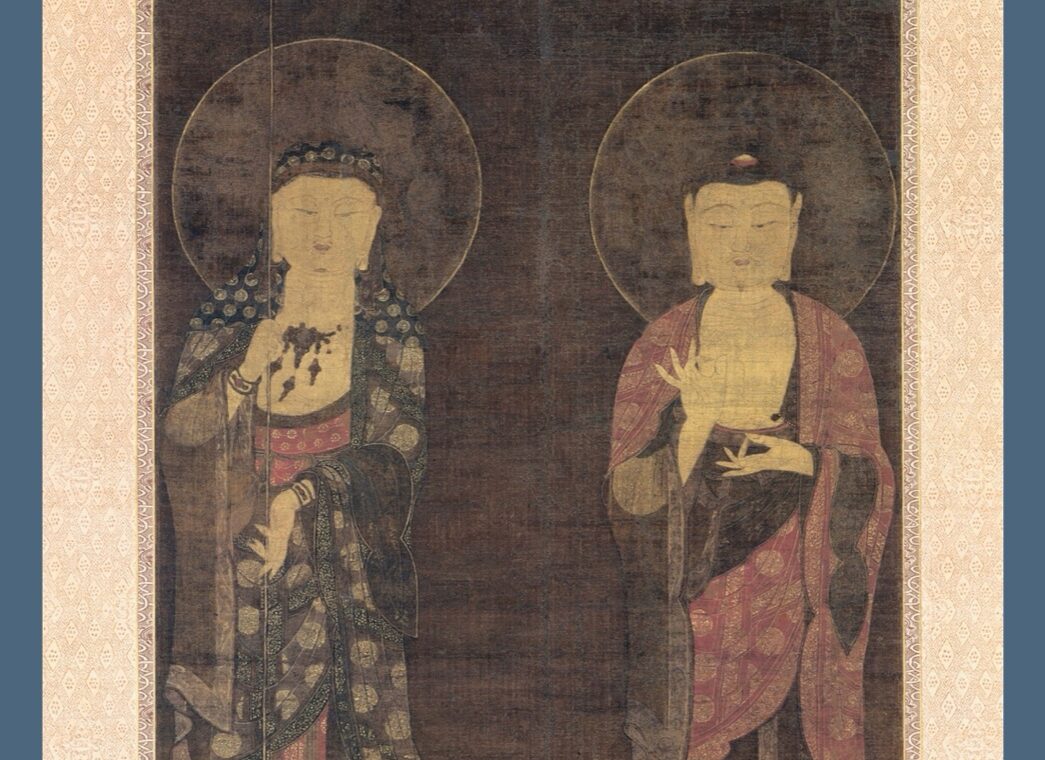
TK0222 places Kshitigarbha at the left beside Amitabha Buddha. The shaved head, long monastic robe, halo, and tall ringed staff support the Kshitigarbha identification. The neighboring Buddha has a cranial protuberance, monastic robe, and hand gestures rather than the bodhisattva’s staff. The pairing gives the painting a broader Pure Land context.
The decorative surface is important too. Patterned textiles and gold-toned halos show that monastic iconography can coexist with elaborate artistic treatment. Those choices should not be used to claim a specific school without comparative evidence. The file label identifies the paired subjects, but no signed inscription or collection catalogue is available here to establish authorship or date.
Conclusion
The most reliable way to recognize Kshitigarbha in Buddhist art is to read a combination rather than a single object: shaved head, monk’s robe, ringed staff, wish-fulfilling jewel, lotus or cloud support, and sacred halo. Regional versions may rearrange these elements, but the staff-and-jewel pairing remains especially useful. When the pair is missing or obscured, keep the identification provisional.
For another guide to reading a central sacred figure through posture, hand gesture, costume, and companions, see the Shakyamuni Buddha Thangka identification guide.
Sources and further reading
- Himalayan Art Resources: comparative records for Kshitigarbha
- The Metropolitan Museum of Art: Kshitigarbha with staff and wish-fulfilling jewel (object record)
These references support comparative iconographic study. The TANGKAWORLD TK number is an internal catalogue identifier; artist, date, collection history, and provenance remain uncertain unless separately documented.
Download the full Thangka image collection
Continue browsing and download the complete TANGKAWORLD image library on the Downloads page.