
A Vaishravana thangka combines kingship, protection, and abundance. The central figure is usually armored or richly dressed, holds a tall victory banner, and carries a mongoose that releases jewels. In one especially recognizable form he rides a white snow lion. Each clue matters because Buddhist art contains several wealth deities and guardian kings. The mongoose alone can also appear with Jambhala, while a lion mount can support other figures. Banner, animal, dress, and directional role must be read together.
Who is Vaishravana?
Vaishravana is the Guardian King of the North and the leader of the Four Direction Guardians in Buddhist cosmology. In Tibetan contexts he is also known as Namtose. He has a protective role connected with the Buddhist teachings and a benefactor role associated with wealth and resources. His regal appearance reflects both functions.
As one of the Four Kings, Vaishravana can appear in a set with Dhritarashtra, Virudhaka, and Virupaksha. He can also appear alone, surrounded by mounted attendants or wealth deities. A single figure may therefore be a devotional image, a protector painting, or part of a larger directional program.
The victory banner in the raised hand
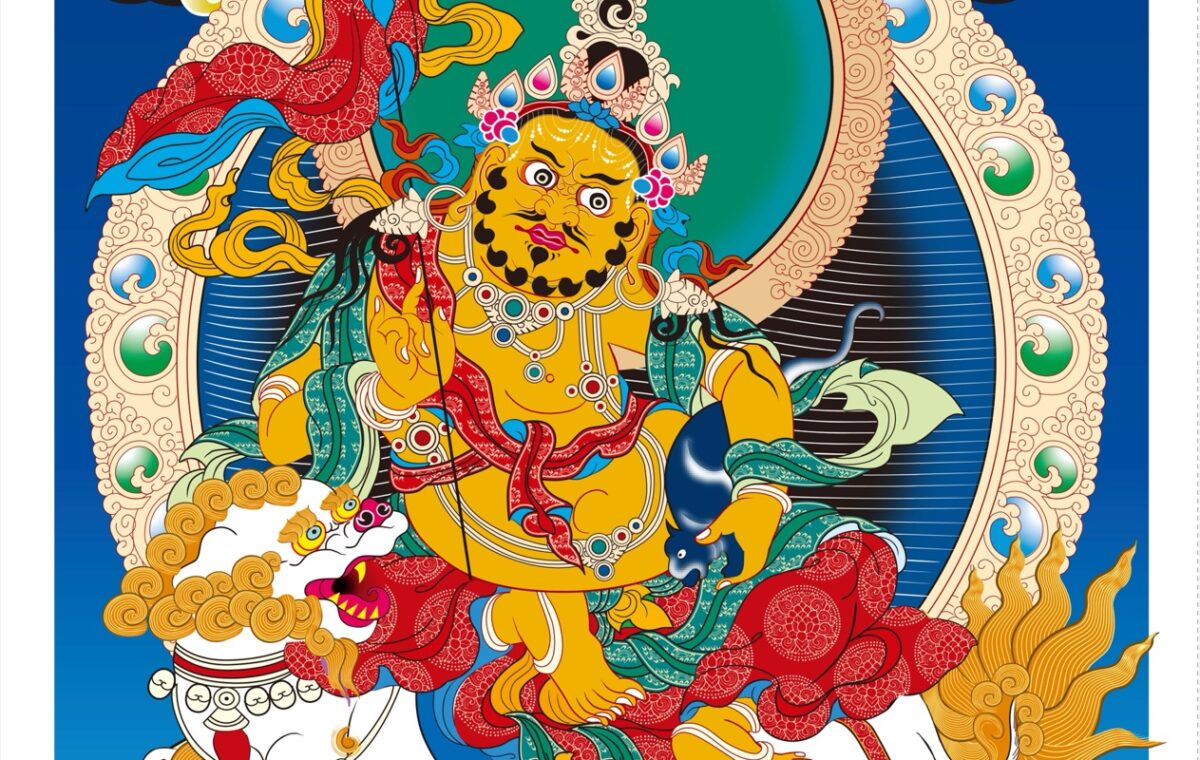
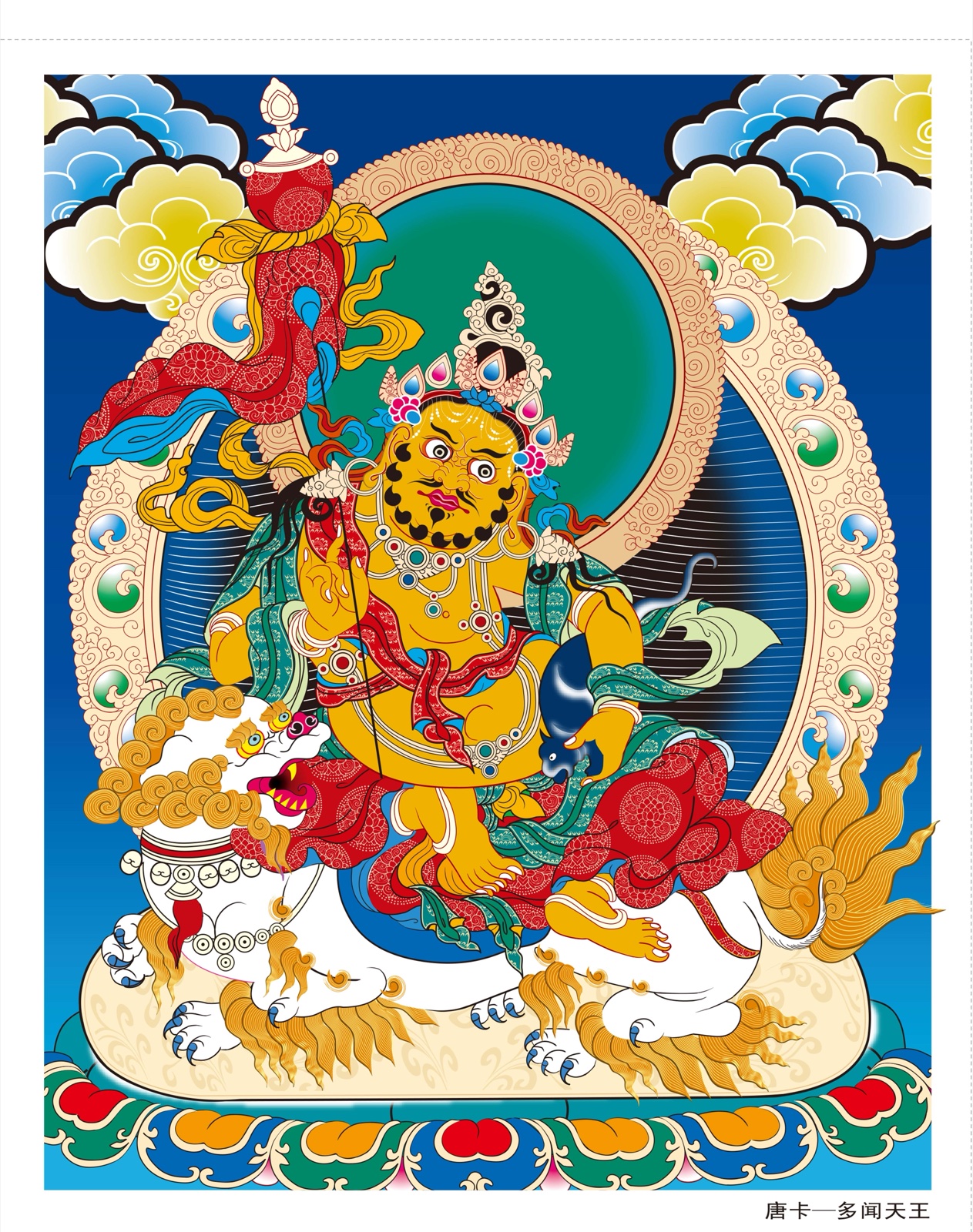
In TK0479 Vaishravana raises a tall staff topped by a decorated banner with streaming fabric. The object is vertical and emblematic, signaling victorious protection. It differs from a parasol, which opens into a broad canopy. This distinction is important when comparing Vaishravana with Sitatapatra, the White Parasol Goddess.
Banner details vary. Some paintings emphasize a cylindrical textile, others a jewel finial, ribbons, or a small canopy-like top. Rather than naming every decorative element, record the tall staff and banner silhouette first. Its position in the right hand is a reliable part of the riding-lion form.
The jewel-spitting mongoose
The left hand supports a dark mongoose. In many images the animal opens its mouth and releases jewels, representing resources made available rather than hoarded. At small scale the mongoose can resemble a bag, fruit, or rounded vessel. Look for the head, muzzle, curved body, and jewel forms near the mouth.
Jambhala also carries a mongoose, so this attribute does not identify Vaishravana by itself. Jambhala is often potbellied and seated or standing in a different posture, with a citron-like fruit or other attribute. Vaishravana’s armor, victory banner, royal dress, and guardian-king context provide the decisive combination.
The white snow lion mount
TK0479 shows the deity seated on a white snow lion with a colorful mane. The lion’s open mouth and strong paws create a dynamic base, while Vaishravana remains stable and commanding above it. In this form the mount is not a decorative throne support; it is a fully visible animal carrying the deity.
Snow lions appear elsewhere in Tibetan art, so the mount should confirm rather than determine the name. When banner and mongoose accompany the armored yellow king, the identification becomes much stronger. If either hand is damaged, the remaining attributes and overall composition may still support a qualified identification.
Armor, yellow body, and royal dress
The figure in TK0479 has a yellow-gold body, a crown, jewelry, boots, and layered garments that resemble royal or martial attire. He looks stern rather than furiously wrathful. The body is substantial, conveying authority and abundance. A dark halo and bright clouds surround the figure.
Color varies across forms and reproductions. Yellow is common, but it should not override the object evidence. Ratnasambhava and Yellow Jambhala can also be yellow. Vaishravana is identified through the complete royal-protector grammar: banner, mongoose, armor, and directional or lion-riding context.
Vaishravana versus common look-alikes
Versus Yellow Jambhala
Both can be yellow and hold a jewel-spitting mongoose. Jambhala is commonly potbellied and holds a fruit, while Vaishravana carries the victory banner and may ride a snow lion in armored royal dress.
Versus the other Heavenly Kings
The Four Kings share armor and royal bearing, but their objects differ. A lute, sword, serpent, stupa, or other directional attribute points to another king. The mongoose and banner mark Vaishravana.
Versus protector deities such as Mahakala
Mahakala is generally dark, fully wrathful, surrounded by flames, and equipped with skull cups, choppers, or other tantric objects. Vaishravana looks kingly and organized rather than charnel-ground wrathful. Compare our Mahakala guide.
Practical identification checklist
- Find a tall victory banner in the raised hand.
- Confirm a mongoose, often releasing jewels, in the other hand.
- Look for armor, boots, crown, and royal garments.
- Check whether the figure rides a white snow lion.
- Note a yellow-gold body and stern guardian expression without relying on color alone.
- Compare Yellow Jambhala and the other Four Kings.
- Use inscriptions or verified records before assigning a date, school, or provenance.
Protection and wealth in the same image
It is tempting to reduce Vaishravana to a “wealth god,” but the image holds protection and generosity together. The banner expresses victory and guardianship; the mongoose releases treasures; armor signals readiness; the lion conveys authority. Resources are shown within an ethical and protective framework rather than as private accumulation.
This broader reading places Vaishravana among Buddhist protectors without confusing him with fully wrathful figures. Palden Lhamo, for example, rides a mule through flames and displays a different ritual vocabulary. See the Palden Lhamo protector guide for comparison.
How to record TK0479
An evidence-based description could read: “Yellow Vaishravana in royal armor, seated on a white snow lion, holding a victory banner and dark mongoose.” The archive title and visible attributes strongly agree. The image file does not establish the artist, date, exact tradition, or provenance, so those details remain uncertain.
When catalogue evidence is incomplete, iconographic accuracy still has value. Readers can identify the subject securely while avoiding unsupported history. The method also makes future correction easy if an inscription or museum record becomes available.
Conclusion
Vaishravana becomes recognizable when four clues converge: victory banner, jewel-spitting mongoose, royal armor, and snow lion mount. His yellow body and stern expression support that cluster. By separating him from Jambhala, other Heavenly Kings, and wrathful protectors, readers can understand both his northern guardian role and his association with beneficial resources.
Sources and further reading
- Himalayan Art Resources: comparative records for Vaishravana
- Rubin Museum of Himalayan Art: Vaishravana and Virupaksha (object record)
These references support comparative iconographic study. The TANGKAWORLD TK number is an internal catalogue identifier; artist, date, collection history, and provenance remain uncertain unless separately documented.
Download the full Thangka image collection
Continue exploring and download the complete TANGKAWORLD image library through our Thangka image collection.