
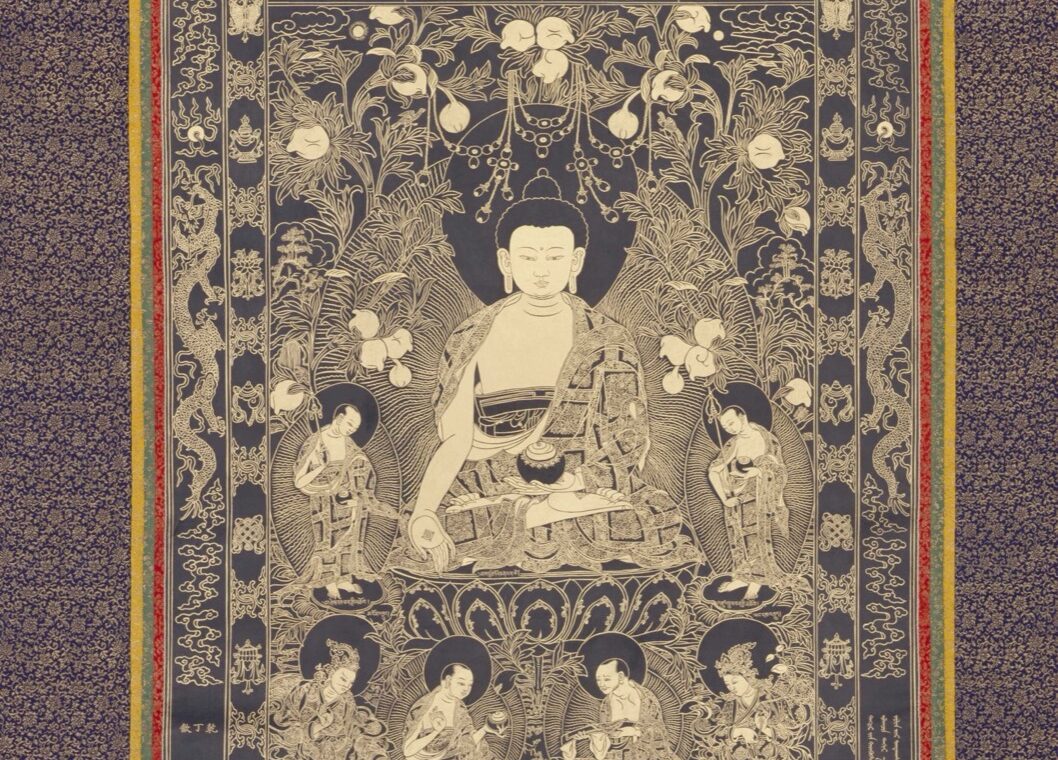
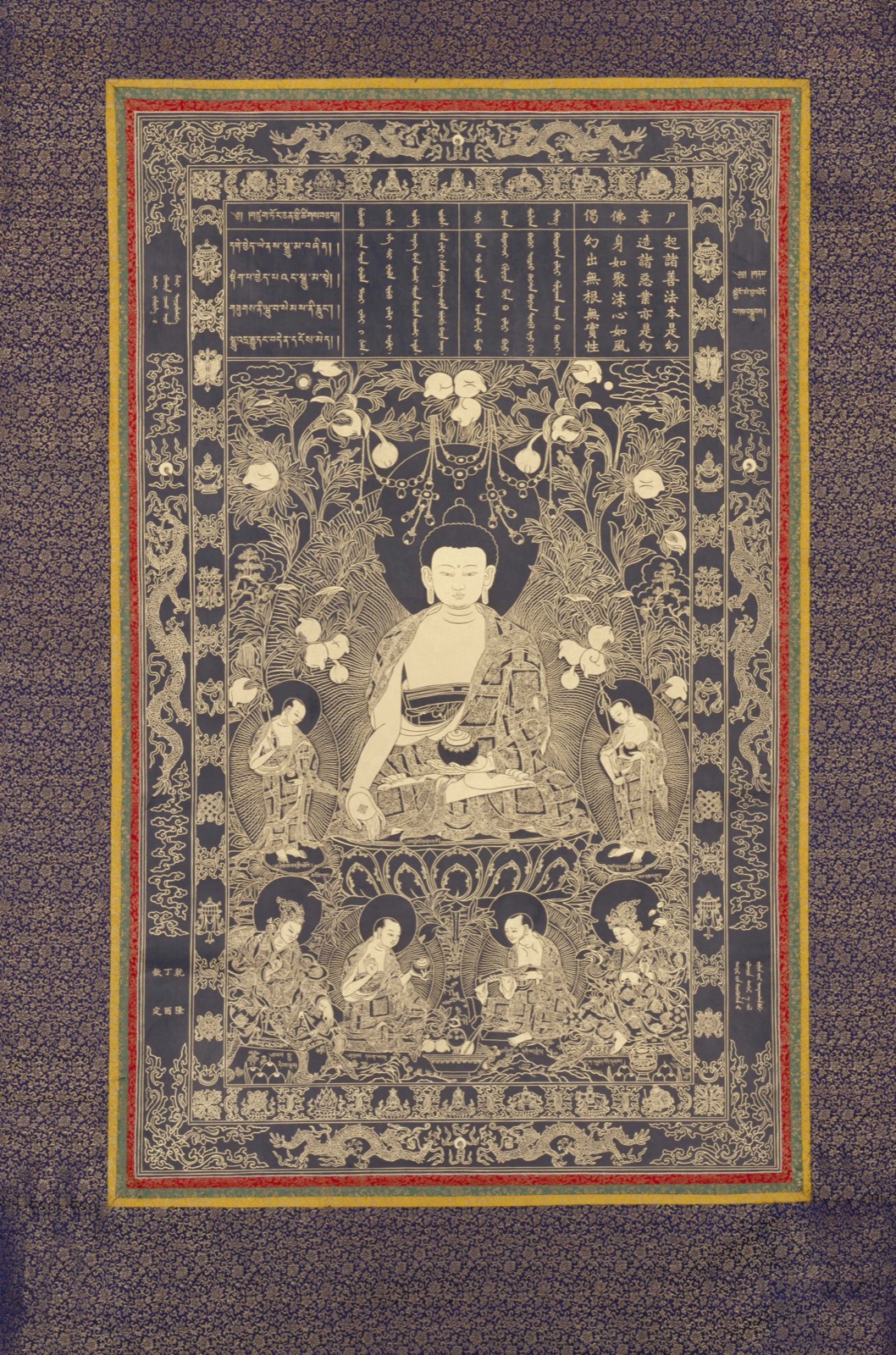
Sikhin Buddha thangka images are not identified by a single hand gesture or halo. In TANGKAWORLD archive image TK1142, the most decisive evidence sits above the figures: a carefully organized panel of Tibetan, Chinese, Manchu, and Mongolian writing. The text, central Buddha, six attendants, gold-line drawing, floral canopy, dragons, and dense ornamental borders work together as one visual system.
TK1142 closely corresponds in composition to a painting catalogued by The Metropolitan Museum of Art as Śikhin, one of the Buddhas of the past. The museum dates its object to 1777 and identifies the medium as gold on indigo-dyed paper. Because a digital archive file is not a substitute for examining the physical object or its accession history, this guide uses the museum record as a strong comparison while keeping the precise source and reproduction history of TK1142 uncertain.
What the museum record establishes
The Met’s object record identifies its painting as Śikhin, the second of the Seven Buddhas of the Past. It explains that a group of seven paintings was sent by the Panchen Lama to the Qianlong emperor in 1777. The images were then recreated in several formats, including polychrome paintings, stone carvings, rubbings, and gold-on-indigo paintings.
The museum also identifies the upper text as a hymn praising Śikhin in the four official languages of the Qing court: Chinese, Manchu, Mongolian, and Tibetan. This information is essential. The seated Buddha’s robes, halo, lotus throne, and downward-reaching right hand belong to a wider Buddhist visual vocabulary and do not independently prove that the figure is Śikhin. Here the inscription and documented set provide the identity.
Romanization varies across publications and search behavior. This article uses “Sikhin” in the primary keyword for accessibility, while “Śikhin” follows the spelling in The Met’s catalogue. Both refer to the same Buddha of the past in this context.
How four languages frame the Sikhin Buddha thangka
1. Read the text panel as part of the composition
The inscription is not a label added outside the image. It occupies a broad architectural band above the central scene. Horizontal Tibetan lines appear at the left, Chinese characters at the right, and two groups of vertical writing fill the middle. Borders divide the scripts into ordered fields, giving the multilingual hymn a visual hierarchy of its own.
For a researcher, the first task is mapping rather than translating. Record where each script begins and ends, the direction of writing, the number of lines or columns, changes in scale, and any damaged passages. Do not guess a word from visual resemblance. A reliable transcription should be completed or reviewed by specialists familiar with the relevant historical scripts.
2. Follow the central axis from canopy to Buddha
A pendant floral canopy hangs below the text panel and directly above the Buddha’s head. The vertical sequence—hymn, canopy, halo, face, torso, alms bowl, lotus throne—guides the eye through the center. The composition makes written praise and sacred image mutually reinforcing rather than treating them as separate forms of evidence.
The Buddha is much larger than the surrounding figures. Scale signals hierarchy, while the circular halo and broad lotus seat separate the central presence from the attendants. Two standing figures flank the throne at mid-level. Four seated figures occupy the lower register, creating a balanced group of six around the central Buddha.
3. Notice how the gold line changes visual reading
Gold outlines on a dark indigo ground suppress the usual contrast between colored bodies, robes, landscape, and flames. Instead, density and line weight become the main tools of emphasis. The Buddha’s pale body reads as a calm open area against tightly patterned robes and foliage. Repeated gold contours make the borders, dragons, flowers, ritual objects, and figures appear connected.
This appearance should not be described simply as a “black Thangka.” The Met record specifies indigo-dyed paper for its object. TK1142 is a digital reproduction, so its screen color cannot independently verify the original support, pigment, binder, metallic composition, or present condition. For a broader comparison of dark-ground technique, see our guide to black Thangka painting and gold-line practice.
4. Separate sacred figures from ornamental borders
Dragons appear in the upper and lower bands and along the sides. Floral scrolls, auspicious emblems, cloud forms, and repeating border units create a dense frame. These motifs establish a courtly visual environment, but they should not be used alone to date the work. Borders can be copied, revived, repaired, cropped, or remounted.
The safest sequence is to document the entire object first, then the image field, text panel, figure registers, borders, and individual details. This prevents a decorative fragment from being mistaken for an identifying attribute.
Why inscriptions matter in Buddhist painting
Inscriptions can name figures, identify donors, record dates, preserve vows, describe commissions, transmit prayers, or connect an image to a lineage. Their function varies with placement and context. Some appear prominently on the front; others occupy margins, mountings, or the reverse. A later label or collector note may belong to a different moment from the sacred text.
A useful comparison is The Met’s Shakyamuni and Jataka painting, where a Chinese inscription dates the work and Tibetan glosses identify narrative scenes. That example demonstrates why language, location, and purpose must be recorded separately. It does not mean every bilingual or multilingual painting has the same origin, audience, or date.
Inscriptions also differ from the ownership and authentication marks discussed in our guide to Buddhist painting seals and collector marks. Text and seals may overlap historically, but a red impression, a dedicatory verse, a figure label, and a modern inventory number are not interchangeable evidence.
Thangka inscription documentation checklist
- Photograph the whole object: Include the painted field, textile mounting, borders, top and bottom edges, and any visible reverse.
- Record orientation: Note whether writing runs horizontally or vertically and whether the image has been rotated or cropped.
- Map script zones: Assign neutral labels such as upper left, upper center, margin, reverse, or later mounting before identifying a language.
- Separate stages: Keep transcription, transliteration, translation, interpretation, and attribution in distinct fields.
- Preserve line breaks: Line and column structure can reveal how a hymn or dedication was designed to fit the image.
- Capture scale and color: Include a ruler and color target when documenting the physical work under controlled conditions.
- Note losses and repairs: Abrasion, folds, retouching, relining, and digital sharpening may change the apparent shape of a character.
- Verify against catalogues: Compare titles, object numbers, dimensions, medium, and images from current institutional records.
- State uncertainty: If a script, word, date, figure, artist, school, collection, or provenance is not verified, label it uncertain.
High-resolution files help researchers distinguish strokes and ornamental lines, but resolution alone does not guarantee accuracy. Compression, color correction, cropping, and resampling can all alter evidence. Our guide to studying Thangka iconography with high-resolution images explains how to compare the full composition with close details without losing context.
Observed, verified, and uncertain details in TK1142
Observed in the archive image: a central seated Buddha; two standing attendants; four lower seated figures; gold-colored line work on a dark ground; a large upper text panel; several visibly different scripts; a floral canopy; dragons; lotus imagery; and dense ornamental borders.
Verified for The Met’s closely corresponding object: the identity Śikhin; membership in a Seven Buddhas of the Past series; a 1777 date; gold on indigo-dyed paper; Chinese, Manchu, Mongolian, and Tibetan versions of a hymn; unidentified artists; and object number SL.17.2019.3.1.
Uncertain for TK1142 without a documented file-to-object chain: whether the archive file reproduces that exact physical object; the date and method of photography; color accuracy; cropping; present ownership; accession history; conservation treatment; inscriptions outside the visible front; and whether every visible mark is original.
Conclusion
The Sikhin Buddha thangka shows why inscriptions are not secondary decoration. The multilingual hymn establishes an identity that the central pose alone cannot prove, while its placement shapes the entire composition. By documenting script zones, figure hierarchy, material appearance, borders, and uncertainty separately, researchers can move from visual recognition toward responsible catalogue study. TK1142 offers a powerful comparison, provided its digital file history is not confused with the fully documented history of a museum object.
Download the full Thangka image collection
Continue exploring multilingual Buddhist paintings, deities, Mandalas, inscriptions, and high-resolution research images across the complete TANGKAWORLD archive. Browse and download the full Thangka image collection for further visual study.