
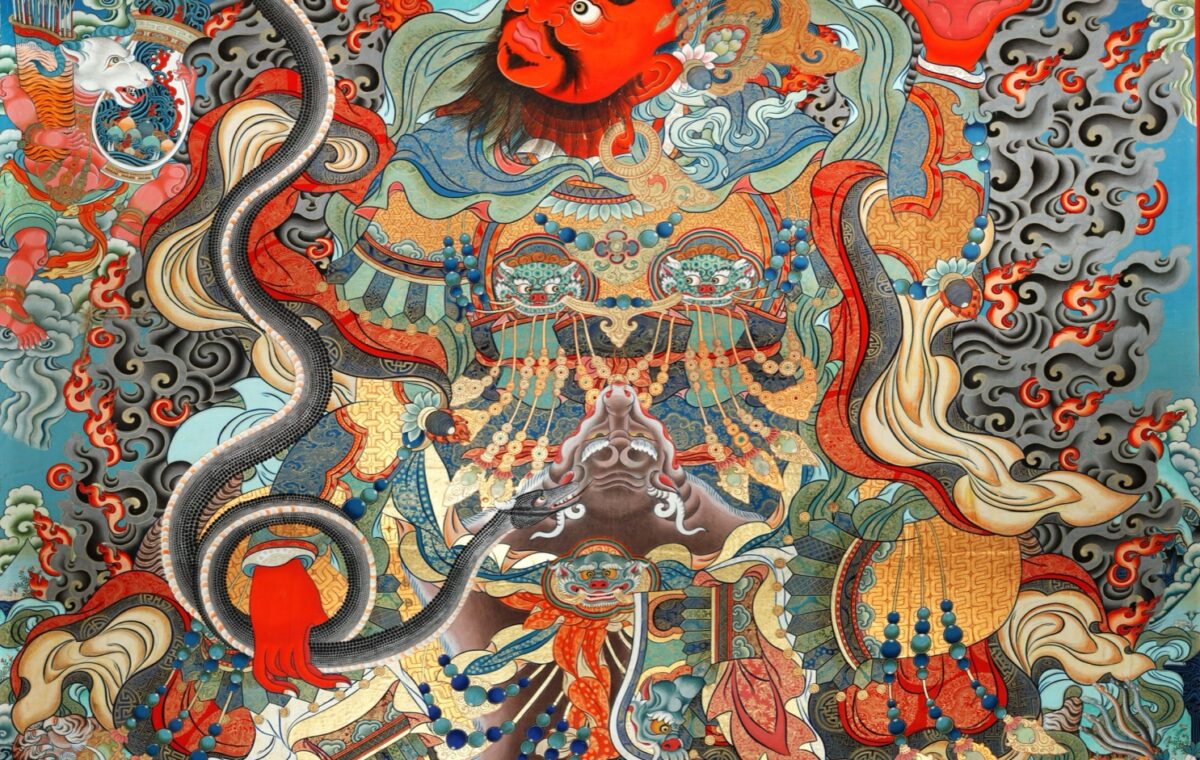
Wrathful Buddhist art composition is designed to feel active before the viewer identifies a single figure. Flames lean, smoke coils, serpents cross the field, textiles stream outward, and a dominant body interrupts the surrounding retinue. These elements are not decorative noise. They direct the eye, establish hierarchy, and turn a still painted surface into a sequence of visual events.
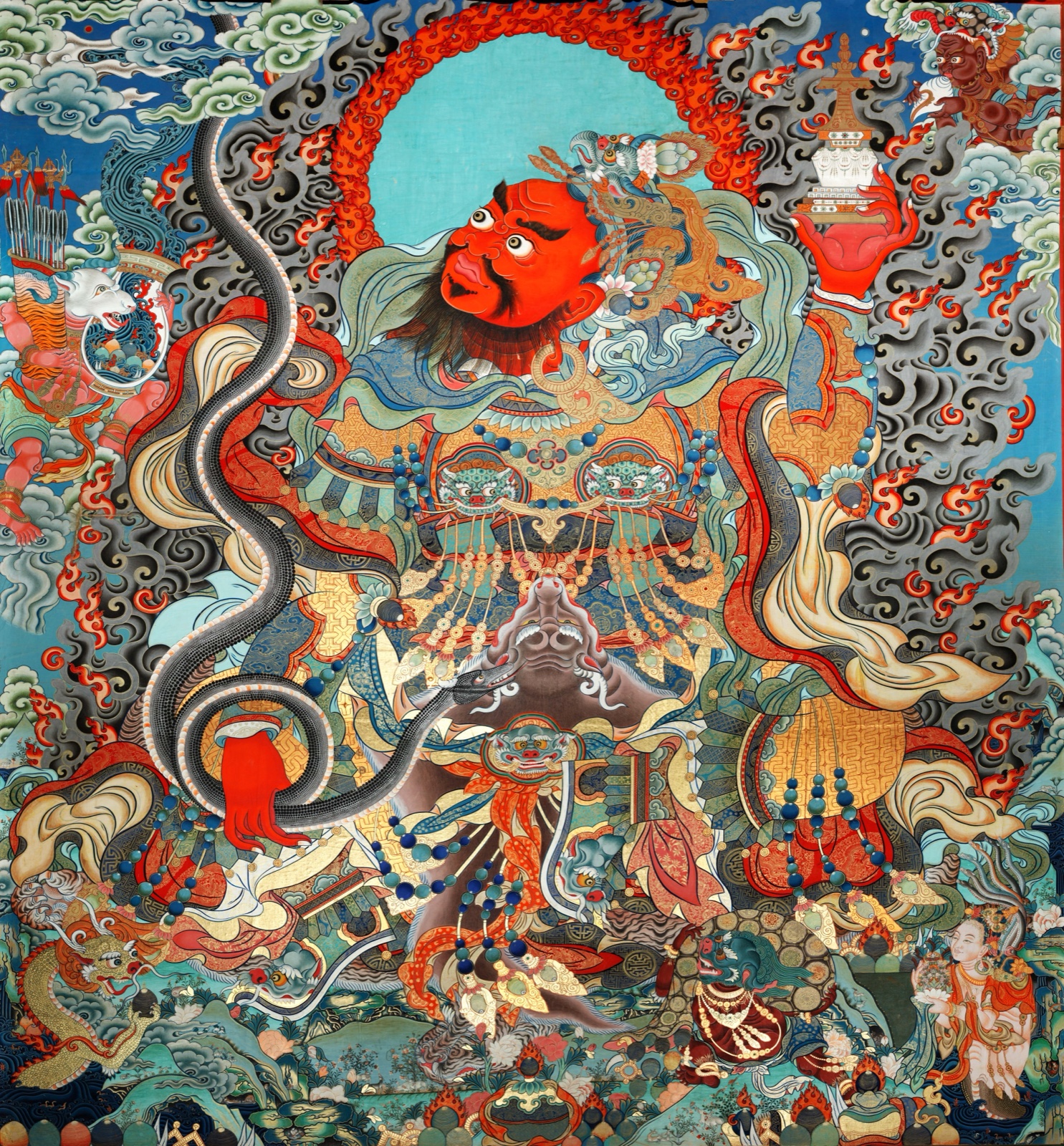
TK1235 is especially useful for learning this method. A monumental red-faced figure looks upward while supporting a multi-tiered, stupa-like object. Large serpents loop across the lower and middle zones; flames and smoke build an irregular ring; animal-headed and hybrid figures crowd the edges; offerings and landscape forms anchor the base. The inherited archive label calls the work “Maitreya — Mural,” yet that label has not been independently verified. The safest reading begins with what the image visibly does.
Why wrathful imagery should not be read as ordinary anger
Fierce faces can be misleading when separated from their Buddhist context. The Rubin Museum explains that wrathful figures commonly display bulging eyes, fangs, flames, skins, and bone or skull ornaments, while their fierce appearance may express protective or compassionate activity rather than ordinary rage. Its viewer’s guide to wrathful iconography also describes surrounding flames as wisdom flames associated with transformation and purification.
Appearance alone still does not establish a name. The Rubin’s overview of wrathful deities distinguishes enlightened beings shown in fierce guises from other protector figures incorporated into Buddhist traditions. That range is one reason researchers must compare attributes, retinue, lineage context, inscriptions, and reliable provenance before proposing an identification. For a practical evidence-first comparison, see our guide to Yama vs Yamantaka.
How TK1235 builds movement
1. Monumental scale fixes the visual hierarchy
The central figure occupies most of the painted field. Its head, torso, and raised arms are much larger than the surrounding figures, so the eye recognizes a primary center immediately. This scale difference is the first layer of visual hierarchy in the composition. Smaller attendants and hybrid beings are not unimportant, but they are read in relation to the dominant body.
The figure is not centered like a calm, symmetrical Buddha. Its body presses against the image field and appears to lean through it. The raised hand and the object above it extend the hierarchy upward, while the lower retinue pulls the gaze back toward the base. The result is a vertical structure that never becomes static.
2. Gaze and gesture create a rising diagonal
The head turns upward toward the stupa-like object, and the lifted hand reinforces the same direction. Viewers tend to follow a depicted gaze, so the face becomes a directional device. Instead of stopping at the eyes, attention travels along the arm and reaches the elevated object. A second arm, weapons, streaming cloth, and nearby bodies send shorter diagonals away from this main route.
These angled lines make the field feel unstable in a deliberate way. Verticality gives the figure authority; diagonals give it action. When studying another dynamic Buddhist painting, trace the direction of the face, hands, implements, and textiles before trying to name any symbol.
3. Serpents form long S-curves
The enormous serpents are among the clearest compositional tools in TK1235. Their bodies cross different zones of the image and bend around other forms, creating continuous S-curves. The eye can enter near the lower edge, follow a serpent upward, pass the central figure, and return through another coil. This route connects areas that would otherwise look like separate clusters.
Curves also contrast with the sharp teeth, weapons, and flame tips. That alternation between smooth coils and pointed accents controls rhythm: the serpents slow the eye into long sweeps, while small angular details produce quick visual beats. “Serpents in Buddhist art” is therefore not only an iconographic question; in this image, their bodies are structural lines.
4. Flames and smoke make an active aureole
Behind and around the central body, red flames mix with black, white, and gray smoke. The surrounding mass behaves like a broken flame aureole. It separates the figure from the background, repeats the curves of the serpents, and creates a rotating pressure around the torso. Because the colors alternate, the ring does not merge into one flat halo.
The open turquoise area near the head is equally important. It gives the eye a brief pause and increases the contrast around the face and raised object. Movement depends on such quiet intervals. If every inch carried the same density, no direction would dominate.
5. The retinue turns the lower field into a stage
Animal-headed attendants, small human figures, offerings, rocks, and landscape forms fill the bottom and sides. Overlap suggests depth: some bodies sit in front of the serpents, others disappear behind smoke or textiles. Repeated faces and gestures distribute attention across the field without challenging the central scale hierarchy.
The lower band also provides a visual ground. Offerings and landscape details slow the downward movement and give the scene a base after the upward thrust of the central gesture. In a complex wrathful composition, the retinue is both contextual evidence and a device for balancing visual weight.
A practical checklist for reading dynamic Buddhist painting
Use this sequence before interpreting the narrative or identifying the deity:
- Find the dominant scale. Which figure or architectural form is largest, and which elements are subordinate?
- Trace the principal axis. Follow the head, gaze, hands, and major implements. Decide whether the composition rises, descends, rotates, or radiates.
- Mark repeated curves. Look for serpents, scarves, smoke, cloud bands, or lotus stems that connect distant zones.
- Mark sharp diagonals. Weapons, limbs, flame tips, and textiles often accelerate the eye.
- Locate negative space. Quieter color fields may isolate a face, emblem, or gesture.
- Read overlaps. Identify which forms sit in front and which recede; this reveals depth and grouping.
- Map the retinue. Note animal-headed figures, attendants, offerings, guardians, or teachers without naming them prematurely.
- Check the frame and condition. Cropping, paint loss, repairs, glare, and digital compression can remove evidence or distort relationships.
- Separate observation from attribution. Record visible features first, inherited labels second, and proposed identity only when multiple attributes agree.
For a broader introduction to visual hierarchy and attributes, begin with How to Read a Thangka. To compare a firmly named protector image with a specific set of attributes, use the Six-Armed Mahakala iconography guide. When surface damage or photography may affect the reading, consult our Thangka condition report checklist.
What can and cannot be concluded from TK1235
We can confidently describe a red-faced wrathful central figure, an upward gaze, a raised stupa-like object, looping serpents, flames, smoke, weapons, animal or hybrid figures, offerings, and a landscape base. We can also show how these elements establish visual hierarchy and movement.
We cannot confidently confirm the precise deity, whether “Maitreya” is correct, the exact object held aloft, or whether the surviving image represents a portable Thangka, a mural, or another painted support. The date, artist, workshop, temple or site, region, collection history, provenance, and restoration history are also uncertain. A future identification would require dependable documentation and comparison with securely attributed works, not a visual resemblance alone.
Conclusion
Wrathful Buddhist art composition turns scale, gaze, diagonals, serpentine curves, flames, smoke, negative space, and a layered retinue into a controlled path for the eye. TK1235 demonstrates that a painting can be studied closely even when its identity and provenance remain uncertain. By describing movement before naming figures, viewers preserve the difference between visual evidence and speculation—and build a stronger foundation for later iconographic research.
Download the full Thangka image collection
Continue exploring and download the complete TANGKAWORLD image library on our free downloads page. Use the full collection to compare compositions, attributes, retinues, materials, and preservation details across a much wider range of Thangka images.