
Buddhist patchwork robe is a useful descriptive term for a robe rendered as a grid or field of repeated rectangular panels. In a Thangka or gold-line Buddhist painting, this pattern can tell a viewer where the garment begins, how it crosses the body, and how the artist separates fabric from halo, lotus seat, landscape, or textile surround. It should not be treated as a complete identification by itself. A segmented robe pattern does not independently confirm a particular Buddha, monastic order, date, workshop, or ritual setting.
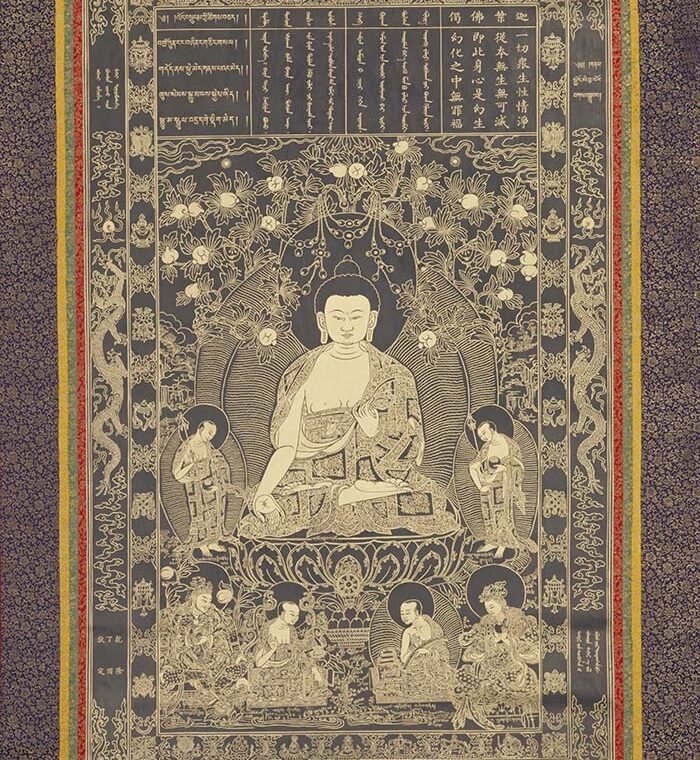
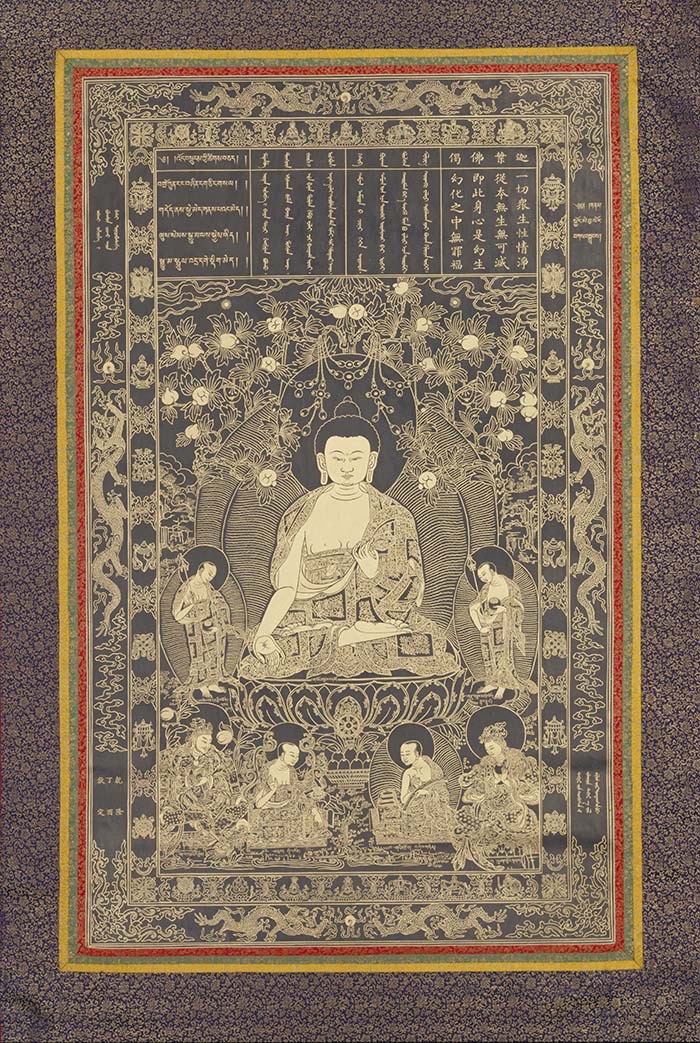
TK1147 offers a focused example. The central seated Buddha is clothed in a robe built from many outlined rectangular segments, with two standing side figures, four lower haloed figures, a multiscript panel, dragons, and floral borders around the main field. The visible pattern supports a study of robe construction in the image. It does not establish the original materials, actual garment construction, or the identity stated in the archive filename; those details remain uncertain unless confirmed by a reliable catalogue, inscription study, or other evidence.
Look at the robe before naming the figure
When a viewer recognizes a Buddha image, it is tempting to move directly to a name. Start instead with the garment. Ask where the outer contour falls, where an edge crosses the shoulder or knee, and whether the internal marks describe folds, seams, brocade, or a repeated panel design. In TK1147, the rectangular pattern is especially visible across the central figure’s torso and lower body. That observation is more secure than a claim about the historic garment the painter may have known.
Describe the robe as it appears in the painting: dark ground, gold outlines, small rectangular units, and a patterned field that follows the body. Avoid calling each rectangle a literal sewn patch unless the work, its medium, and the relevant tradition have been documented. In a painted image, repeated units can be decorative, schematic, or both.
How to document a Buddhist patchwork robe
Map the garment zones
Divide the garment into observable zones: upper torso, shoulder, sleeve, lap, knees, and lower hem. Then note which zones carry the segmented pattern. This method helps distinguish robe decoration from a textile backing or border. In TK1147, the robe belongs to the central seated figure; the broader outer surround belongs to a different framing system.
Trace the pattern direction
Look for the direction of panel rows. They may run across the chest, descend at a diagonal, wrap around a knee, or break at a fold. A row that changes direction can show how the artist imagined the robe turning in space. This is useful visual evidence, but it is not proof that the painter copied an actual garment cut. Record direction and interruptions without adding an unsupported reconstruction.
Separate fabric pattern from line work
Gold-line Buddhist paintings can contain dense outlines in halos, clouds, flowers, dragons, furniture, and textiles. A robe pattern should be traced within the garment outline, not inferred from any nearby grid-like mark. In TK1147, the rectangular field is visually bounded by the central figure’s robe, while the floral, dragon, and border motifs form separate surrounding zones.
What a segmented robe can and cannot show
A Buddhist patchwork robe can help identify the compositional role of the central figure and make a condition record more precise. It may also provide a useful comparison point among images with related garment treatments. It cannot, on its own, settle the figure’s name. The same restraint applies to claims about nationality, school, age, materials, or provenance. Those require evidence beyond a photographed surface.
This distinction matters in digital archives. A filename can preserve a working association, while an image can preserve a visible pattern; neither necessarily gives the full object history. For TK1147, it is responsible to say that the file associates the work with Kasyapa and that a segmented robe is visible. It is not responsible to turn that association into a definitive identification without corroboration.
A close-looking checklist
- Photograph the full figure before taking close details of the garment.
- Mark the robe outline separately from halo, seat, textile surround, and border.
- Describe the panel shape, scale, line color, and visible repetition.
- Record changes in direction where the robe bends or overlaps the body.
- Note areas obscured by hands, attributes, offerings, or later damage.
- Distinguish painted pattern from actual seams, fibers, or repairs unless material evidence is available.
- Keep figure identity, date, workshop, materials, and provenance marked uncertain where unsupported.
This checklist works alongside our Thangka condition report checklist. To place a garment observation within a larger image, see How to Read a Thangka. For a different kind of textile evidence, compare our guide to Buddhist scroll cover fabric.
Robe, attendant figures, and the assembled image
The robe should be read with the rest of the composition, not in isolation. In TK1147, two standing figures flank the central Buddha and four haloed figures fill the lower register. Their garments and halos create a contrast that makes the central patchwork pattern easier to locate. Yet position alone does not establish that the surrounding figures are a fixed named group. Our guide to Buddhist attendant figures in Thangka explains how to document these relationships before making identification claims.
Text panels offer another layer of evidence, but they should be read carefully rather than treated as instant captions. A multiscript panel may require close photography, transcription, language expertise, and comparison with catalogued works. Until that work is done, keep the garment description and the text description separate.
From pattern to responsible comparison
Studying a Buddhist patchwork robe develops a practical habit: begin with what the image visibly shows. In TK1147, the central seated Buddha’s rectangular robe pattern, surrounding attendants, text zone, dragons, floral motifs, and textile frame form a detailed visual field. Record the pattern, map its relation to the body, compare it with documented images, and allow uncertain historical details to remain uncertain. That approach produces notes that are useful now and easier to refine later.
Download the full Thangka image collection
Continue browsing and downloading the complete TANGKAWORLD image collection for close comparison of Buddhist robes, figure groups, textiles, inscriptions, and painting details.