
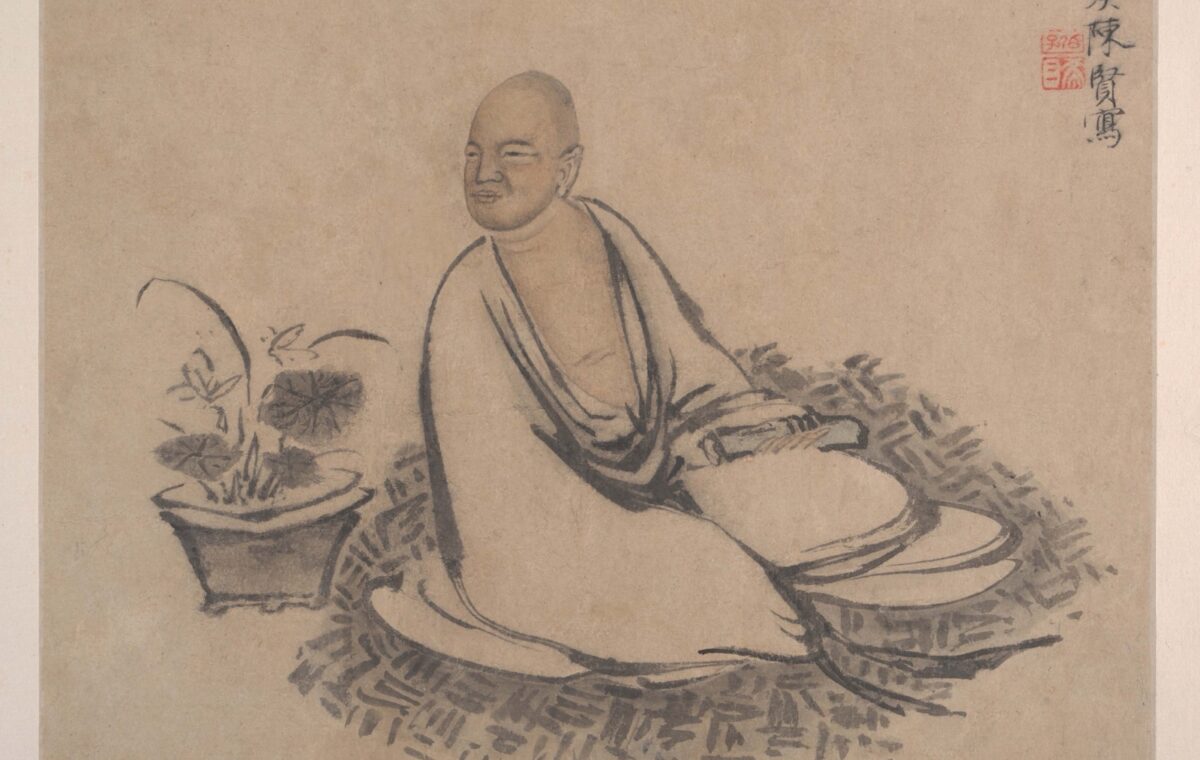
Arhat paintings portray enlightened disciples who preserve and transmit the Buddhist teaching. In Sanskrit they are arhats; in Chinese art they are commonly called luohan. They may appear as a group of sixteen or eighteen, as individual hanging scrolls, in album leaves, murals, prints, and Tibetan Thangka sets. Their varied formats and highly individualized faces make them an important bridge between iconography, portraiture, landscape, and collection research.
What is an Arhat?
An arhat is a realized disciple who has overcome the causes of rebirth. In visual traditions across Asia, groups of arhats became guardians of Buddhist teaching until the coming of the future Buddha. Paintings emphasize their human presence: age, temperament, disciplined attention, eccentric gesture, and life in remote landscapes. Unlike idealized Buddhas, arhats may have wrinkled faces, prominent brows, unusual body types, and strongly differentiated expressions.
This individuality does not make them ordinary genre figures. Their robes, halos or sacred settings, attendants, ritual objects, and placement within a numbered group establish religious identity. A viewer should therefore combine portrait-like observation with group iconography.
Sixteen Arhats, eighteen Luohans, and regional variation
The group of Sixteen Arhats is widespread in Indian, Tibetan, Chinese, Himalayan, Korean, and Japanese Buddhist art. Chinese traditions also developed sets of eighteen luohans, adding figures in ways that vary by period and context. A painting showing one elderly monk does not reveal whether it once belonged to a sixteen- or eighteen-figure cycle. Numbered inscriptions, companion works, old mounts, and collection history are needed.
Names also change in transliteration. The same arhat may appear under Sanskrit, Tibetan, Chinese, or Japanese forms. Before merging records, compare the original script, attributes, seat, attendants, and sequence number. Similar English spellings can hide distinct figures, while different spellings can refer to the same one.
How to recognize Arhat paintings
Monastic robes and humanized bodies
Arhats are typically dressed as monks, with robes wrapped around the shoulders and body. The garment may expose one shoulder or cover both, depending on region and artistic convention. Their bodies are not always idealized: an artist may emphasize thinness, weight, age, or a relaxed seated posture. The combination of monastic dress and individualized physical presence is a strong first clue.
Expressive, portrait-like faces
Arhat painters often explore physiognomy more freely than artists painting a central Buddha. Faces can appear foreign, ascetic, humorous, stern, or inward-looking. Hair and eyebrows may be exaggerated. These choices once supported ideas about spiritual power and distance from ordinary society, but modern viewers should avoid turning stylistic difference into ethnic certainty.
Landscape, rocks, trees, and animals
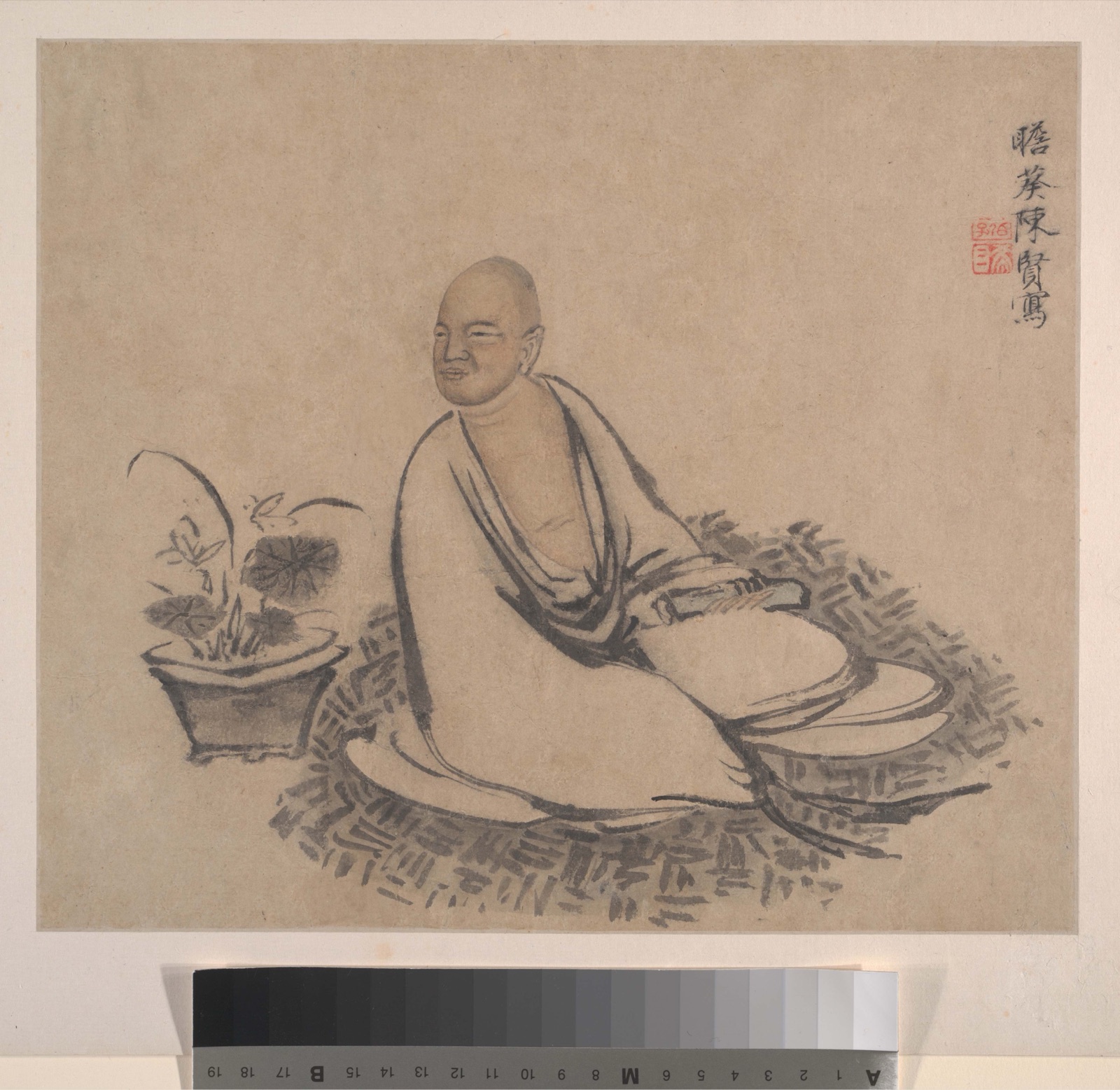
Many arhats inhabit wilderness settings with rocks, old trees, streams, caves, incense, and animals. Tigers, dragons, deer, lions, and birds may appear. Such surroundings evoke retreat, miraculous companionship, and mastery of the natural or supernatural world. Album leaves may reduce the setting to a plant, low mat, rock, or single object, as in TK0881.
Attendants and offerings
Lay attendants may carry books, incense, fruit, staffs, alms bowls, or ritual vessels. Foreign-looking envoys and donors also enter some compositions. These figures create scale and narrative, but they do not automatically identify the arhat. A named elder normally requires an inscription, a recognized attribute, or a documented position within a surviving set.
Album leaf, hanging scroll, or Thangka?
Not every Buddhist painting in a Thangka archive is technically a Thangka. TK0881 is an album painting on paper rather than a Tibetan cloth-mounted Thangka. Its inclusion in a broad image collection is useful for comparative Buddhist art, but the format should remain accurate. A Thangka is usually a portable painting associated with Himalayan Buddhist traditions and often mounted in textiles. An album leaf belongs to a bound or assembled sequence designed for close viewing.
Format affects how the work was handled and seen. A hanging scroll addresses a wall and can organize figures vertically. An album invites page-by-page encounter at intimate scale. A mural surrounds a ritual or architectural space. Record the format before interpreting composition.
Case study: TK0881 and the Chen Xian attribution
TK0881 belongs to an image group corresponding to The Metropolitan Museum of Art’s The Sixteen Luohans, an album of sixteen paintings. The Met describes the work as attributed to Chen Xian, with a spurious date of 1634. It gives a deliberately broad origin and period: China or Japan, Ming or Qing dynasty, or Japan’s Edo period. The curatorial note adds that the album may be a close copy, possibly by a Japanese admirer.
This is exactly the kind of museum evidence that should override a simplified filename. “Ming dynasty, by Chen Xian” is too certain. A better caption preserves the attribution and uncertainty: “The Sixteen Luohans, attributed to Chen Xian; China or Japan; date uncertain.” The leaf shows a seated monk beside a potted plant, rendered with economical ink lines and subdued color. Its quiet scale differs sharply from a monumental protector Thangka, yet both rely on disciplined visual conventions.
Arhat painting identification checklist
- Confirm monastic robes and a disciplined or contemplative figure.
- Look for individualized age, facial structure, and posture.
- Record landscape elements, animals, attendants, books, staffs, and bowls.
- Determine whether the object is an album leaf, scroll, mural, print, or Thangka.
- Search for inscriptions, seals, numbering, and links to companion works.
- Compare the source record before naming a specific arhat.
- Use “attributed to,” “possibly,” and “uncertain” exactly where museum evidence requires them.
Researching provenance and collection history
Start with the object number and museum page, not a reposted image caption. Record the museum’s title, attribution qualifier, culture, date range, medium, dimensions, credit line, and public-domain status. Then compare the image to the museum’s high-resolution file to confirm that the local copy has not been cropped, mirrored, recolored, or detached from its set.
Seals and inscriptions require specialist reading. A signature can be genuine, added later, copied from a model, or deliberately spurious. It is evidence, not automatic proof of authorship. Technical study of paper, silk, pigments, mounting, and underdrawing may be needed to narrow a date or place.
Why Arhat paintings matter for a Thangka collection
Arhat imagery reveals how Buddhist visual culture travels across formats and regions. Tibetan sets often use strong color, halos, mountain settings, and named attendants. Chinese and Japanese works may emphasize ink, brush texture, eccentric bodies, or intimate album design. Comparing them helps readers see which features belong to the subject and which belong to a local artistic language.
The comparison also teaches a larger cataloguing principle: subject, format, attribution, origin, and date are separate fields. A work can securely depict an arhat while its artist and place remain uncertain. That separation makes a collection more useful to researchers and prevents SEO titles from hardening provisional metadata into false fact.
Conclusion
Arhat paintings are recognized through monastic identity, individualized faces, wilderness or studio-like settings, attendants, and their relationship to a larger numbered cycle. The strongest records pair this visual reading with inscriptions and museum documentation. To learn the general structure of portable Himalayan paintings, visit What Is a Thangka? and How to Read a Thangka.
Sources and further reading
- Himalayan Art Resources: comparative records for Arhat
- The Metropolitan Museum of Art: The Arhat Vajraputra (object record)
These references support comparative iconographic study. The TANGKAWORLD TK number is an internal catalogue identifier; artist, date, collection history, and provenance remain uncertain unless separately documented.
Download the full Thangka image collection
Continue exploring TANGKAWORLD and browse and download the full Thangka image collection, including Arhats, Buddhist masters, deities, museum works, Mandalas, and visual-research groups.