
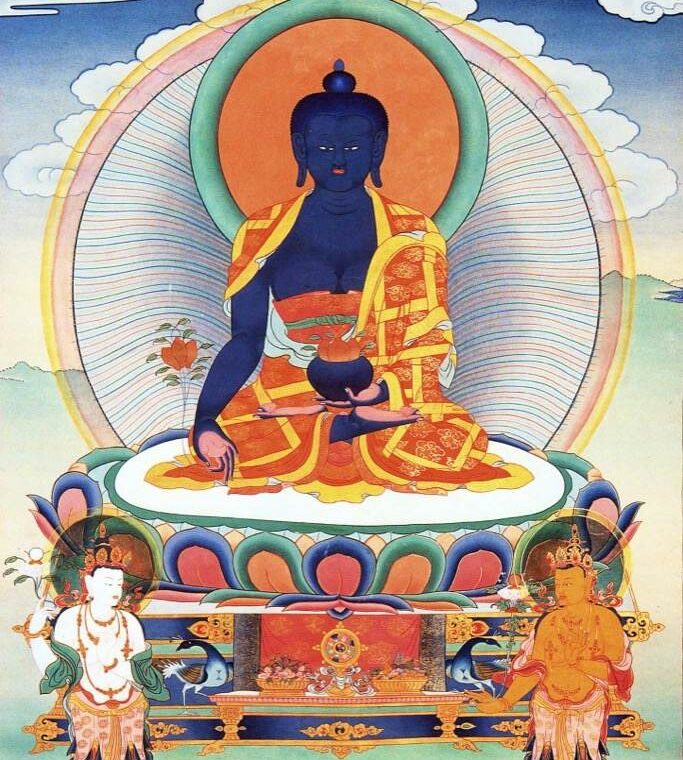
A Medicine Buddha thangka is often recognized at first glance by a blue Buddha seated in meditation. Color alone, however, is not enough. Several Buddhist figures may be blue, and pigments can shift after fading, restoration, photography, or digital reproduction. A responsible identification combines body color with hand gestures, objects, clothing, seat, and the surrounding assembly.
Medicine Buddha is commonly known by the Sanskrit name Bhaisajyaguru. In Tibetan and Himalayan Buddhist art he embodies the healing dimension of awakened activity. This does not turn the painting into a medical diagnosis or a promise of physical cure. It means that the image belongs to a religious tradition in which healing, ethical conduct, ritual, study, and compassionate care are closely connected.
Medicine Buddha thangka identification at a glance
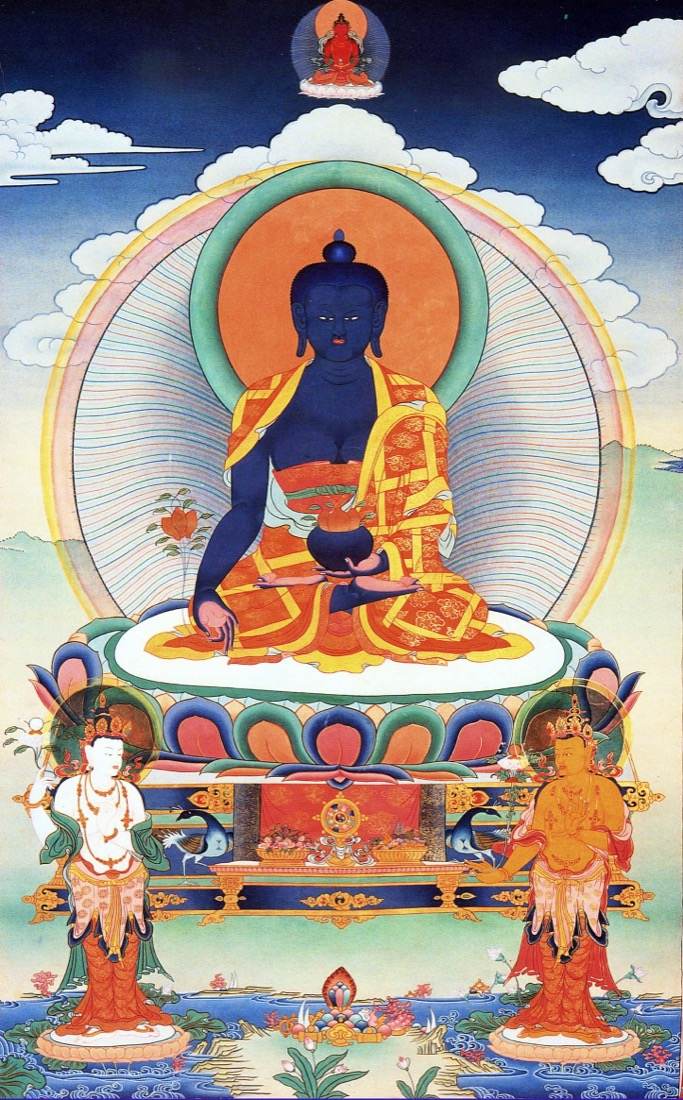
Begin with a cluster of features rather than one isolated detail. A typical central Medicine Buddha has a dark lapis or sapphire-blue body, wears the robes of a monk, and sits in a stable meditation posture. His proper right hand extends toward the knee in a gesture of generosity and may hold a medicinal plant or fruit, commonly identified as myrobalan. His left hand rests in his lap and supports a monastic begging bowl, often described as containing medicinal nectar.
The lapis-blue body
Blue is the most immediate clue, but its visual effect varies. Mineral pigments can appear deep navy, cobalt, or nearly black. Modern paintings and scans may produce a brighter blue. Use the color as an entry point, then confirm it against the hands and objects. If the figure is blue but holds a vajra, makes a different mudra, or wears elaborate wrathful ornaments, another identification may be more likely.
The healing plant in the right hand
The extended right hand is associated with generosity. A small stem, leaf, or fruit may be visible between the fingers. It is frequently called the myrobalan or arura plant in English-language descriptions. In a small reproduction the object can disappear into the outline of the hand, so zooming in is essential. Do not claim the plant is present when the scan does not resolve it clearly; record it as uncertain instead.
The alms bowl in the left hand
The bowl is a stronger compositional anchor. It normally rests in the lap, supported by the left hand in the gesture of meditation. The bowl may be dark, blue, or decorated, and it can contain a pale substance, fruit, or a stylized vessel. Its position distinguishes it from a vase held by a crowned deity. This is especially useful when comparing Medicine Buddha with Amitayus, who is red, wears princely ornaments, and holds a longevity vase in both hands.
Read the Buddha appearance, not only the attributes
Medicine Buddha usually has the appearance of a Buddha rather than a bodhisattva. Look for monastic patchwork robes, an ushnisha or cranial protuberance, elongated earlobes, calm facial expression, and the absence of a jeweled crown. The legs are generally folded in vajra posture on a lotus or throne. A halo and body aureole emphasize the central figure without functioning as unique identifiers.
TK0572 shows the blue central Buddha seated above an elaborate throne. The bowl is clearly placed in the lap, while the right hand reaches downward. Smaller figures and offering structures expand the composition. Their presence matters because Medicine Buddha may appear alone, with two principal bodhisattvas, with the Seven Medicine Buddhas, or in a much larger ritual assembly.
How to read the retinue and composition
A retinue should be read from the center outward. First confirm the principal figure. Next examine attendants beside the throne, teachers or Buddhas above, and protectors or donors below. Do not assume every secondary figure can be named from posture or color. In many paintings, inscriptions, lineage context, or a reliable museum record are necessary for a precise identification.
Medicine Buddha compositions sometimes include solar and lunar bodhisattvas, the Seven Medicine Buddhas, the Twelve Yaksha Generals, or guardian kings. Yet regional workshops and specific ritual cycles arrange these groups differently. A checklist can establish that the central figure is probably Bhaisajyaguru while leaving the identity of individual attendants uncertain.
Medicine Buddha versus similar blue figures
Medicine Buddha and Akshobhya
Both may be blue and Buddha-like. Akshobhya is commonly associated with the earth-touching gesture and may have a vajra on the throne or in a bowl. Medicine Buddha is identified more securely by the medicinal plant and alms bowl combination. If those attributes are missing, the painting’s inscription and ritual context become decisive.
Medicine Buddha and wrathful blue deities
Wrathful figures such as Vajrapani or Mahakala have a very different visual grammar: glaring eyes, bared teeth, dynamic postures, flames, bone ornaments, animal skins, or multiple arms. Blue color does not imply the same identity or function. For comparison, see the Six-Armed Mahakala iconography guide.
Medicine Buddha and Amitayus
Medicine Buddha and Amitayus are both linked with well-being and long life, but they are not interchangeable. Amitayus is a crowned, jeweled, red celestial Buddha holding a vase. Medicine Buddha is blue, monastically robed, and holds a bowl and medicinal plant. Amitayus should also not be casually renamed Amitabha; their related traditions retain distinct visual forms.
A practical identification checklist
- Is the central figure blue, with calm Buddha appearance rather than wrathful or princely dress?
- Does the proper right hand extend toward the knee in generosity?
- Can you see a plant, stem, fruit, or leaf in that hand?
- Does the left hand support a monastic bowl in the lap?
- Are monastic robes, long earlobes, an ushnisha, and a meditation seat present?
- Does the retinue support a healing Buddha context without contradicting it?
- Are date, school, artist, and provenance documented, or should they remain uncertain?
How to record an uncertain painting
Use layered language. “Blue seated Buddha” is an observation. “Probably Medicine Buddha because of the bowl and medicinal stem” is an interpretation. A specific date, workshop, or lineage requires stronger evidence. File names are useful search aids, but they are not substitutes for inscriptions, collection records, conservation reports, or specialist comparison.
This method is part of the broader process explained in How to Read a Thangka. Start with visible evidence, compare a full group of attributes, and preserve uncertainty instead of forcing a name.
Conclusion
A reliable Medicine Buddha thangka identification rests on the lapis-blue body, monastic appearance, generosity gesture with a healing plant, and alms bowl held in meditation. The surrounding assembly can refine the reading, but it should not encourage unsupported names. Careful looking makes the image more meaningful and the catalog record more honest.
Sources and further reading
- Himalayan Art Resources: comparative records for Medicine Buddha
- Rubin Museum of Himalayan Art: Medicine Buddha (object record)
These references support comparative iconographic study. The TANGKAWORLD TK number is an internal catalogue identifier; artist, date, collection history, and provenance remain uncertain unless separately documented.
Download the full Thangka image collection
Continue browsing and download the complete TANGKAWORLD image library through our Thangka downloads. Use the collection to compare compositions, attributes, and visual traditions across a wider range of works.