
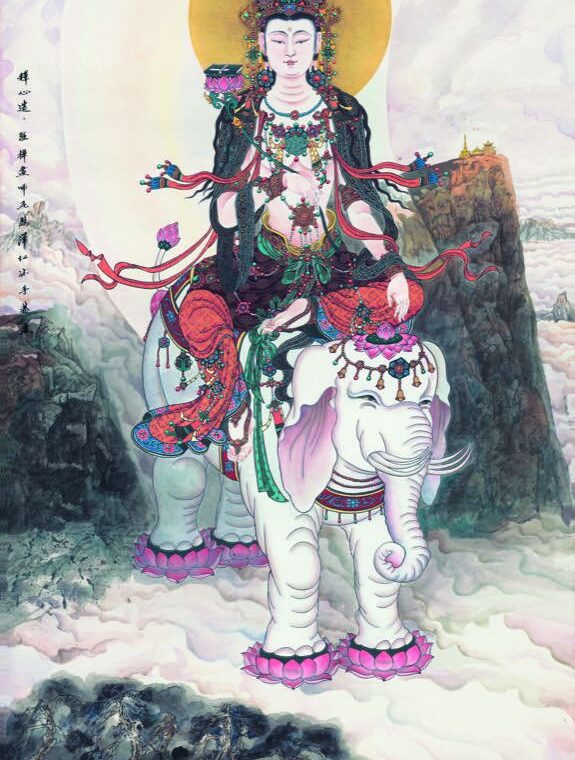
A Samantabhadra thangka can refer to two visually and doctrinally different figures. One is Samantabhadra Bodhisattva, a peaceful bodhisattva often shown riding a white elephant. The other is the primordial Buddha Samantabhadra, known in Tibetan as Kuntuzangpo, who appears in specific Nyingma and Dzogchen contexts. Confusing them produces inaccurate captions and misleading search results.
This guide focuses on Samantabhadra Bodhisattva, the figure represented in TANGKAWORLD image TK1100. The white elephant is the strongest immediate clue. Clothing, posture, companions, inscriptions, and cultural context then refine the identification.
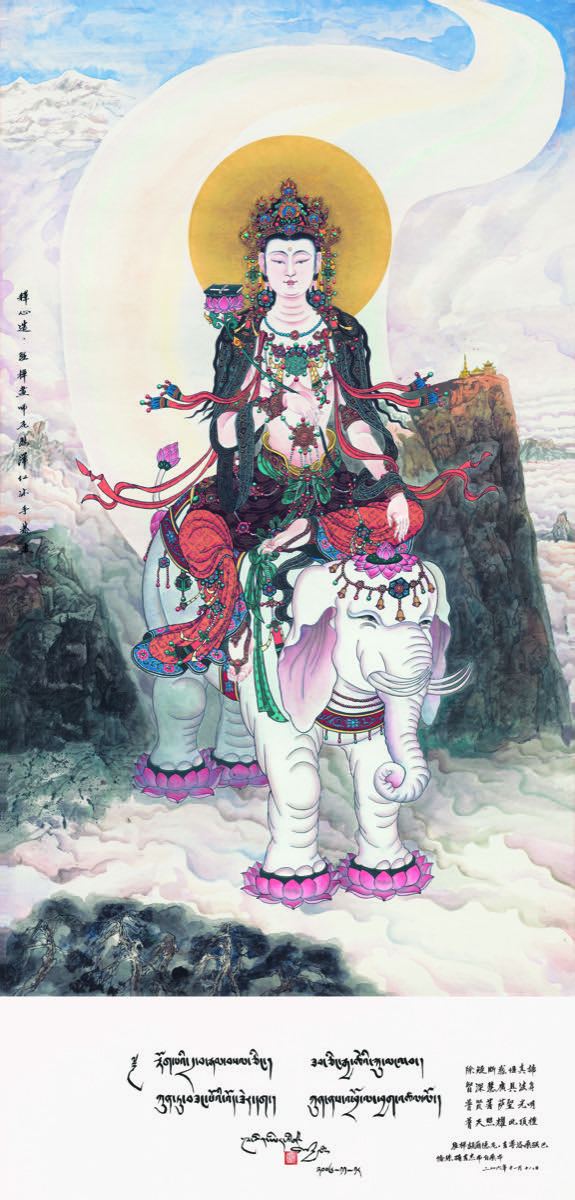
Samantabhadra thangka identification: start with the elephant
Samantabhadra Bodhisattva is widely associated with an elephant mount. The animal is commonly white and may have ornate harnesses, lotus supports, or multiple heads in some traditions. In TK1100 the bodhisattva sits above a large white elephant in a mountain landscape. The animal occupies much of the lower composition, making the mount central to the painting’s visual identity.
The elephant can signify steadfast strength, disciplined practice, and the capacity to carry great vows. Meanings vary across texts and traditions, so a catalog should avoid claiming that one short definition exhausts the symbol. What matters for identification is the repeated visual relationship between Samantabhadra Bodhisattva and the elephant.
Peaceful bodhisattva appearance
Samantabhadra Bodhisattva normally appears peaceful, youthful, and richly adorned. A crown, earrings, necklaces, bracelets, flowing scarves, and patterned garments distinguish bodhisattva dress from a Buddha’s monastic robes. A halo may frame the head. The body can be white or pale in East Asian and Himalayan representations, but color varies with workshop and medium.
Lotus, gesture, and seat
Hands may hold a lotus, form a gesture, or rest in a composed pose. Attributes are less uniform than the elephant mount. The figure may sit directly on the animal, on a lotus placed above it, or within a larger assembly. Record the actual hand position before assigning a named mudra. Modern and cross-regional paintings sometimes combine established motifs with contemporary design.
Samantabhadra Bodhisattva versus primordial Buddha Samantabhadra
The shared English name is a major source of confusion. Samantabhadra Bodhisattva is an adorned, peaceful figure associated with vows, conduct, and the elephant. Primordial Buddha Samantabhadra, or Kuntuzangpo, is usually represented as a blue, unclothed Buddha figure in union with the white consort Samantabhadri, or sometimes alone. The primordial Buddha is not identified by an elephant mount.
A page title that says only “Samantabhadra” may attract readers looking for either figure. The caption and introduction should specify “Samantabhadra Bodhisattva” whenever the elephant-riding figure is meant. Likewise, do not call an elephant-riding bodhisattva “Adi-Buddha Samantabhadra.”
How the white elephant works in the composition
The mount is more than a label. Its scale establishes the hierarchy of the painting. The elephant’s head, trunk, tusks, and decorated body create a broad stable base, while the bodhisattva rises vertically above it. Lotus platforms under the feet may separate the sacred animal from the surrounding landscape.
Artists also use the elephant to express movement. A gently curved trunk, bent knees, or a turning head can make the procession feel active even when the bodhisattva remains calm. In TK1100 the bright white body contrasts with dark rock and colored ornaments. This contrast helps the viewer find the mount before moving upward to the central figure.
Cross-regional style and attribution
Samantabhadra Bodhisattva is important across several Buddhist visual cultures. Chinese, Japanese, Tibetan, Nepalese, and Himalayan works can differ in costume, landscape, line, color, and the treatment of the elephant. Some East Asian compositions pair Samantabhadra with Manjushri, whose lion mount provides a visual counterpart. A single motif can therefore travel through many artistic languages.
TK1100 combines a detailed white elephant with a vertically extended landscape and inscriptions. The local filename identifies the subject as Samantabhadra. It does not, by itself, establish the artist, date, region, or school. Those fields should remain uncertain until an inscription is translated or a reliable collection record is located.
Samantabhadra and Manjushri as a visual pair
In East Asian Buddhist art, Samantabhadra on an elephant and Manjushri on a lion may flank the Buddha or appear as complementary figures. Samantabhadra is associated with practice and vows, while Manjushri embodies wisdom. Their mounts make the pair easy to remember, but individual paintings can alter or omit expected attributes.
For the sword, book, and lotus that identify the wisdom bodhisattva, see the Manjushri thangka guide. Comparing the two demonstrates why mount, hand object, clothing, and context should be read together.
A practical Samantabhadra Bodhisattva checklist
- Is the principal figure a peaceful, jeweled bodhisattva rather than a monastically robed Buddha?
- Is a white elephant clearly present as the mount or support?
- Does the figure sit directly on the animal or on a lotus above it?
- Are a lotus, crown, scarves, and bodhisattva ornaments visible?
- Is Manjushri, a lion mount, or a central Buddha part of a larger grouping?
- Do inscriptions or collection records confirm the subject?
- Have you distinguished this bodhisattva from primordial Buddha Samantabhadra?
How to describe the image without overclaiming
A strong catalog description might read: “Samantabhadra Bodhisattva, identified by the peaceful adorned figure seated on a white elephant; artist and date uncertain.” This sentence separates visual identification from unsupported historical claims. Add observed information about medium, dimensions, inscriptions, repairs, or ownership only when it is documented.
The same method applies across the archive. The beginner’s guide to reading a Thangka explains how to move from central figure to attributes, retinue, style, and evidence. It is especially valuable when familiar English names conceal distinct iconographic identities.
Conclusion
A Samantabhadra Bodhisattva thangka is most reliably recognized by the peaceful adorned figure and white elephant mount. The composition may vary across regions, but the elephant remains a durable clue. Always distinguish this bodhisattva from the primordial Buddha Samantabhadra, and keep date, artist, and school uncertain unless documentation supports them.
Sources and further reading
- Himalayan Art Resources: comparative records for Samantabhadra Bodhisattva
- Rubin Museum of Himalayan Art: Samantabhadra from the Eight Great Bodhisattvas (object record)
These references support comparative iconographic study. The TANGKAWORLD TK number is an internal catalogue identifier; artist, date, collection history, and provenance remain uncertain unless separately documented.
Download the full Thangka image collection
Continue browsing and download the complete TANGKAWORLD image library through our Thangka downloads. The full collection supports side-by-side study of bodhisattvas, mounts, inscriptions, and regional styles.