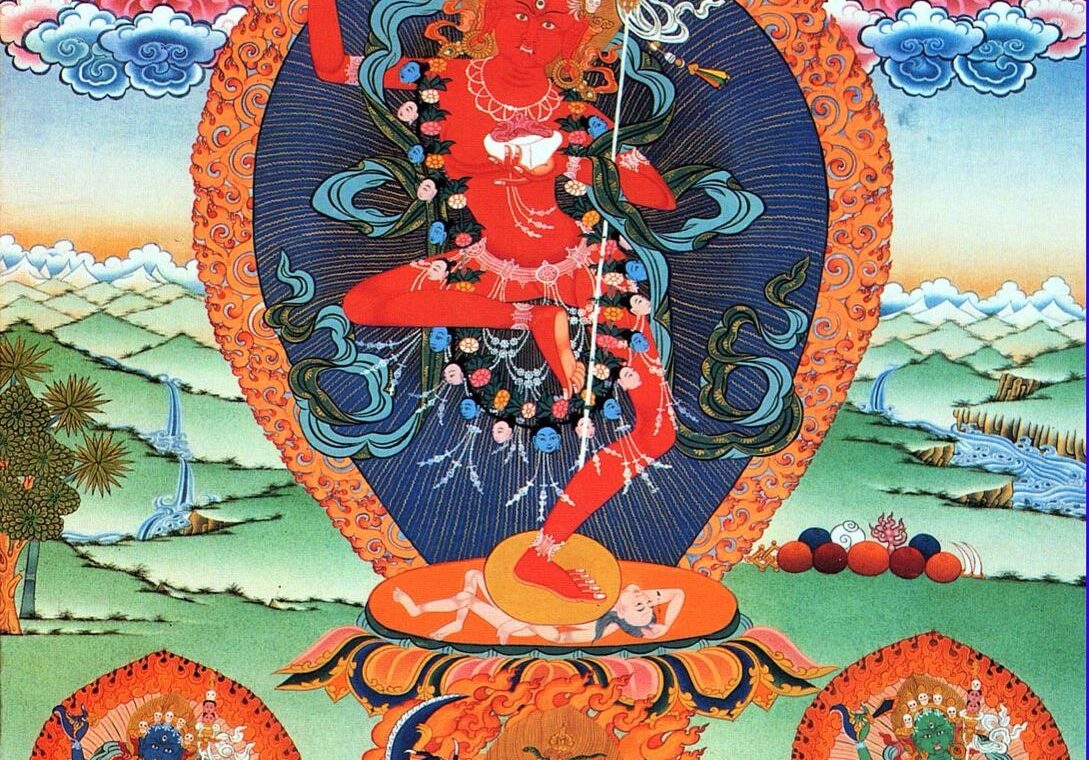
A Vajrayogini thangka often concentrates extraordinary energy into a single red female figure. Her body may twist in a dancing stance; a curved knife, skull cup, and tantric staff can form a compact set of attributes; flames and subsidiary deities may intensify the composition. These clues are important, but Vajrayogini is not one visually uniform figure. Different traditions preserve distinct forms, and the closely related name Vajravarahi adds another layer of variation.
For that reason, responsible identification begins at the family level. First ask whether the figure belongs to the Vajrayogini or Vajravarahi cycle. Only then attempt to name a particular form. A red dancing goddess is not automatically Vajrayogini, and a sow’s head is not present in every form called Vajravarahi. For a related tantric composition with a different central form, compare the Chakrasamvara Thangka guide.
Vajrayogini thangka identification: begin with the whole figure
The red body
Red is strongly associated with many Vajrayogini and Vajravarahi forms, but black and white variations also exist. The red body may evoke transformative energy, magnetizing activity, heat, and intense awareness. It should be recorded as a visible feature rather than treated as a complete identity. Compare the color with the posture, number of faces and arms, hand objects, and figures placed around the central deity.
The dancing or dynamic posture
Many forms stand with one leg bent and the other supporting the body, often on a prone figure or corpse seat. The pose creates a diagonal rhythm through the torso and limbs. Some traditions reverse which leg is raised, while others use seated or two-legged postures. Therefore, leg position can help identify a subtype but should not be generalized across every Vajrayogini image.
Face, hair, and gaze
The face may be intense, with three eyes and an upward gaze. Hair can stream freely behind the head. A small sow’s head may appear at the side or top of the head in forms associated with Vajravarahi, yet some works retain the Vajravarahi name without depicting it. If the reproduction is too small to confirm the extra head, mark that detail uncertain.
The curved knife, skull cup, and tantric staff
The most familiar attribute pair is a curved knife in one hand and a skull cup in the other. The curved knife is a ritual implement, not evidence of ordinary violence. In symbolic interpretation it cuts through ignorance and obstruction. The skull cup can signify transformed experience and wisdom. Meaning depends on the ritual system, so museum-style descriptions should avoid presenting one brief symbolism as the only possible reading.
A khatvanga or tantric staff may rest in the crook of the arm or lean against the shoulder. It can carry small heads, a trident-like finial, a vajra, or decorative streamers. In some forms the staff represents the complementary aspect of the deity’s practice. As with the knife, its exact shape must be observed rather than assumed.
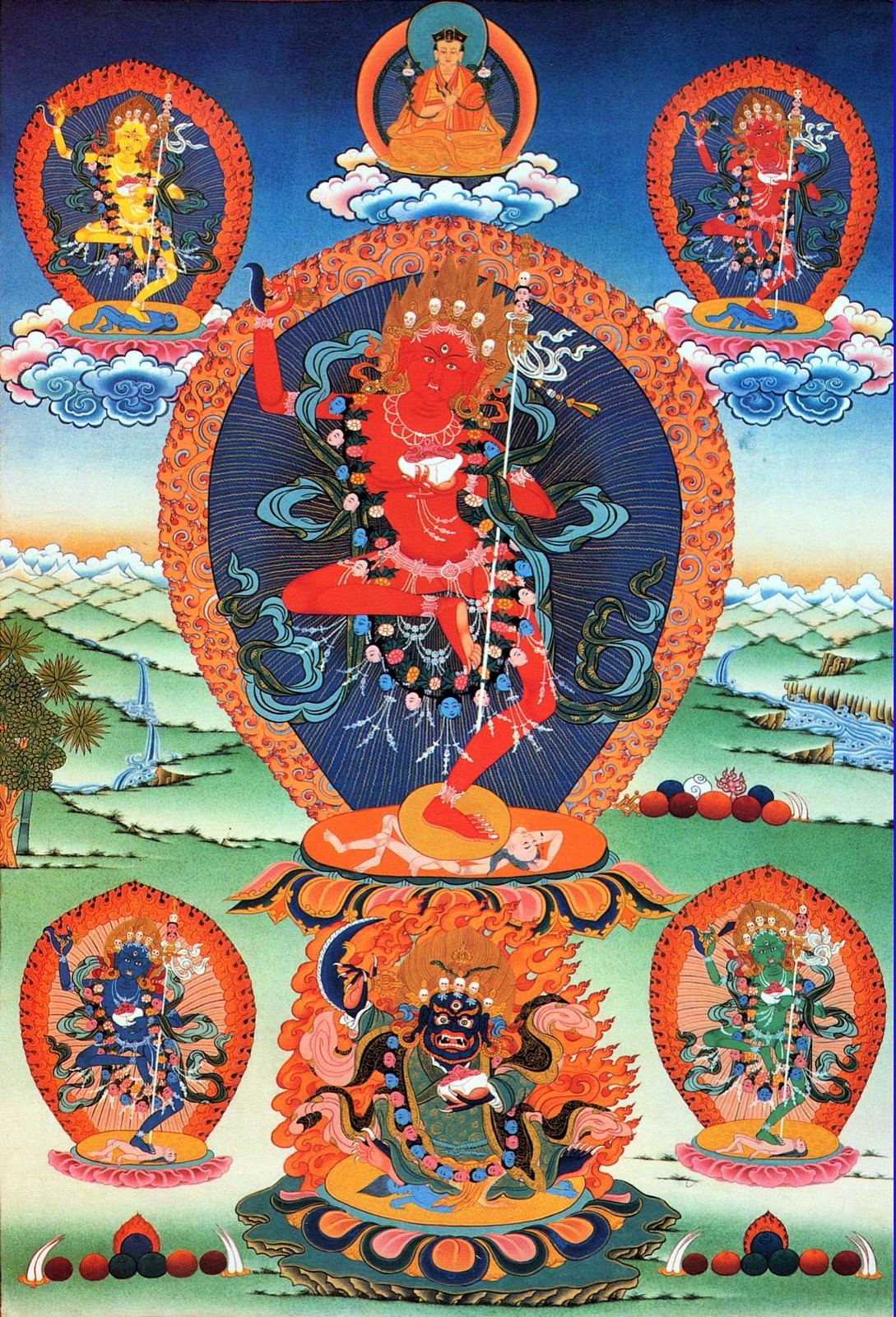
TK0586 shows a red central female figure within a dark aureole and bright flame border. Her posture is dynamic, and several related colored figures surround her. A wrathful protector occupies the lower register. Because the central figure appears more complex than the simplest one-faced, two-armed type, the local title supports a Vajrayogini identification while the exact textual form remains uncertain.
Vajrayogini and Vajravarahi: related but not interchangeable labels
Vajrayogini can function as a broad category and as the name of specific forms. Vajravarahi, whose name relates to the sow, is one of the most important related identities. Some Vajravarahi images show a small sow’s head emerging near the human face. Others do not. Hand attributes, leg posture, color, face count, and lineage must be considered together.
A careful catalog can say “Vajrayogini/Vajravarahi family” when the visible evidence is insufficient for a narrower label. If a reliable inscription or collection record names a form, cite it. If the only evidence is a filename, retain the filename as a source note rather than converting it into certainty.
How to avoid common misidentifications
Do not rely on red color alone
Other tantric goddesses and fierce figures can also be red. Green Tara and White Tara provide an instructive contrast: their peaceful seated forms, lotus attributes, and gestures follow a different visual system. See the Green Tara guide and White Tara guide.
Do not confuse a curved knife with a sword
A curved ritual knife has a hooked blade and compact handle. Manjushri’s flaming sword is longer and usually raised beside a peaceful yellow or orange bodhisattva. The book and lotus complete that separate identification. Compare the Manjushri iconography guide.
Do not name every surrounding figure
Tantric compositions may contain lineage teachers, attendant yoginis, protectors, offering goddesses, and related mandalas. Their positions can be meaningful, but a small online image rarely supplies enough evidence for every name. Describe color, posture, and register first. Preserve uncertainty until a textual program or inscription is available. Use the high-resolution Thangka iconography method for systematic comparison, and see the Simhamukha Thangka guide for another dakini form with its own defining attributes.
A practical Vajrayogini checklist
- Is the principal figure female and red, black, or white?
- Does the body use a dynamic dancing or standing posture?
- Can you identify a curved knife and skull cup?
- Is a khatvanga staff visible at the shoulder or arm?
- Is there a sow’s head, and is it clear enough to record confidently?
- How many faces, eyes, and arms are visible?
- Do subsidiary figures repeat the central attributes or indicate a mandala cycle?
- Does an inscription or authoritative record name the exact form?
Reading fierce imagery without sensationalizing it
Skulls, corpses, flames, and knives can be visually dramatic. A useful explanation places them inside Buddhist tantric symbolism rather than treating the image as horror. The imagery stages transformation: mortality, ego-clinging, and destructive emotions become part of a path toward awakening. The painting is also a ritual object tied to initiation and practice, not simply an autonomous fantasy scene.
Public descriptions should remain educational and non-instructional. Iconographic analysis can identify objects and compositional relationships without pretending to teach restricted practices or replacing qualified lineage guidance.
Conclusion
A Vajrayogini thangka is identified through a coordinated pattern: body color, dynamic posture, face and hair, curved knife, skull cup, tantric staff, and ritual context. Major variations are normal, particularly across Vajrayogini and Vajravarahi traditions. When the exact form cannot be established, a broader identification with an explicit uncertainty note is both accurate and useful.
Sources and further reading
- Himalayan Art Resources: comparative records for Vajrayogini
- Rubin Museum of Himalayan Art: Vajrayogini (object record)
These references support comparative iconographic study. The TANGKAWORLD TK number is an internal catalogue identifier; artist, date, collection history, and provenance remain uncertain unless separately documented.
Download the full Thangka image collection
Browse and download the complete TANGKAWORLD image library through our Thangka downloads. Side-by-side comparison helps reveal how posture, implements, and retinues change across tantric image cycles.