
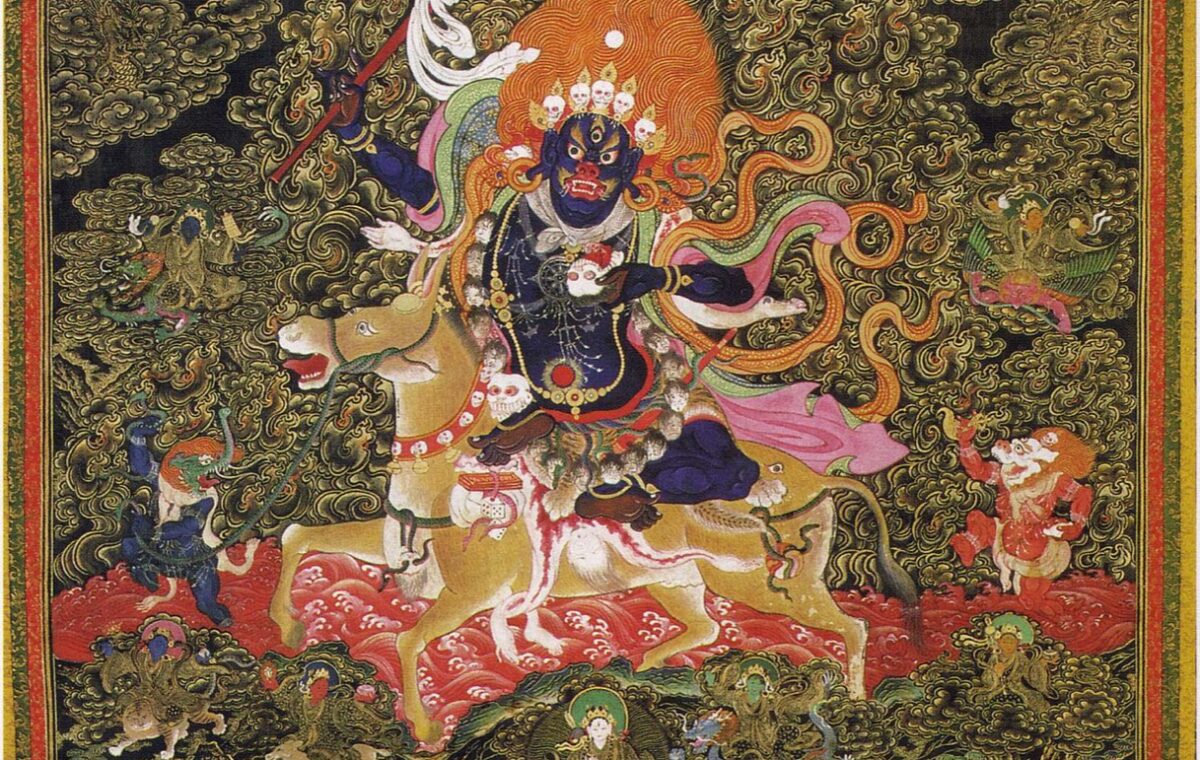
A Palden Lhamo thangka can look terrifying at first glance: a dark wrathful goddess rides a mule through a turbulent landscape, surrounded by flames, smoke, skull ornaments, animals, and armed attendants. In Buddhist visual culture, however, wrathful appearance does not mean evil. It signals forceful protective activity directed against obstacles and harmful conditions.
Palden Lhamo is also known by the Sanskrit name Shri Devi, “Glorious Goddess.” The name covers multiple forms with different arm counts, implements, retinues, and lineage associations. This guide explains the broad visual clues while avoiding an unsupported claim about the exact subtype shown in TK0406.
Why wrathful imagery must be read in context
Flames, skulls, fangs, blood-red water, and trampling animals are a specialized symbolic vocabulary. They communicate the transformation of destructive forces and the urgency of protection. Reading these features literally as a scene of ordinary violence misses the ritual and philosophical context.
The same principle applies to other protector images. In the Six-Armed Mahakala guide, a black body, skull crown, and fire aureole identify a protector rather than a demon. Palden Lhamo adds a specifically female central figure and the distinctive mule mount.
Core features of Palden Lhamo iconography
The mule
The mule is one of the strongest identifying clues for major forms of Palden Lhamo. It is usually shown in rapid movement, crossing a sea or stormy ground. Saddle cloths, reins, hanging objects, and symbolic markings can be highly detailed. Do not confuse the mount with a horse simply because the ears or body are partly hidden by the rider’s robes.
A dark wrathful female figure
Palden Lhamo is commonly dark blue or black, with a fierce face, bared teeth, and a third eye. Her hair may rise upward in flames. Skull crowns, bone ornaments, snakes, and flayed skins can appear. The female body may be less obvious under layered ornaments and movement, so the label should be checked against mount, attributes, and retinue.
Flame and smoke aureole
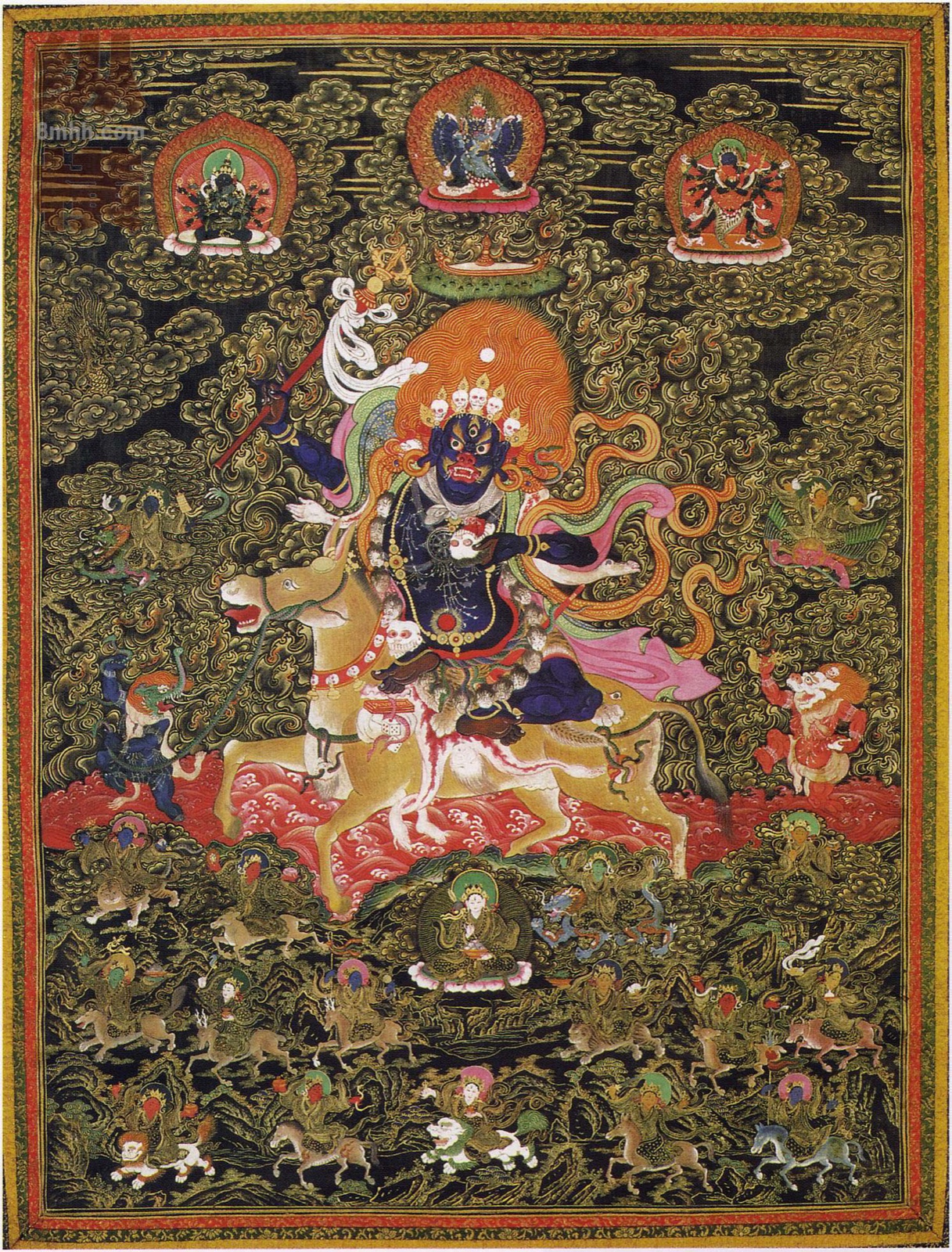
A ring or mass of fire surrounds the central figure. Dark smoke and patterned clouds may extend across the entire background. The flames distinguish sacred wrathful energy from an ordinary mounted portrait. In TK0406, the central fire field is visually linked to dense gold-edged clouds that fill the painting.
Skull imagery and ritual objects
Skull cups, skull crowns, garlands, staffs, weapons, and other tantric objects may appear. Their exact combinations vary by form. It is risky to assign a specific subtype from one object, especially when the image is small or damaged. Record what is visible first, then compare it with a documented iconographic description.
Attendants and retinue
Mounted attendants, animals, offering figures, lineage teachers, and other deities frequently surround Palden Lhamo. They are not decorative filler. Their number and identity can define a ritual system, but small secondary figures are also easy to misread. If inscriptions or a catalogue are absent, describe them conservatively as attendants or retinue figures.
How forms of Palden Lhamo vary
Shri Devi is a broad category that includes two-armed, four-armed, and other forms. Magzor Gyalmo, a widely represented form, is often shown riding a mule and carrying wrathful attributes. Other forms have different weapons, companions, and theological roles. A general article can identify Palden Lhamo while leaving the exact form uncertain.
This distinction prevents a common cataloguing error: treating every mule-riding wrathful goddess as an identical icon. Museum and lineage records may separate forms that look similar at first glance. Arm count, hand objects, face count, mount equipment, top-register teachers, and lower retinue all deserve attention.
Reading TK0406 from center to edge
Begin with the central rider. The dark body, fierce face, skull crown, flaring scarves, and mule establish a strong Palden Lhamo reading. A broad orange halo and surrounding flames isolate the figure from the dense background. The mule moves across a red wave-like field, while numerous mounted figures occupy the lower register.
Next examine the top. Three small deities sit within halos above the central figure. Their colors and postures suggest a structured hierarchy, but their precise identities are uncertain without clearer attributes or inscriptions. At the sides, smaller attendants and animals form an active retinue. The painting’s complexity likely carries more specific ritual information than the digital file can securely reveal.
Palden Lhamo versus other wrathful figures
Palden Lhamo and Mahakala
Both can be dark, flame-surrounded protectors wearing skull ornaments. Mahakala is typically male and often stands rather than rides a mule. Palden Lhamo’s female identity and mount are therefore major distinctions. Arm count alone is not reliable because both names encompass multiple forms.
Palden Lhamo and Vajrayogini
Vajrayogini is usually red, dancing or striding, and holds a curved knife and skull cup; she may carry a tantric staff. Palden Lhamo is a mounted protector surrounded by a retinue. Compare the red dynamic body and ritual implements in the Vajrayogini Thangka guide.
Palden Lhamo and worldly goddesses
Some local or non-Buddhist deities can share a fierce female appearance and animal mount. A documented Buddhist context, top-register lineage figures, protector retinue, and recognized Palden Lhamo attributes strengthen the identification. When those anchors are missing, the safest label may be “wrathful female deity, possibly Palden Lhamo.”
Practical identification checklist
- Is the central figure female, dark-colored, and wrathful?
- Does she ride a mule rather than stand on a lotus or corpse?
- Do flames, smoke, and turbulent water frame the rider?
- Are a third eye, skull crown, bone ornaments, or snakes visible?
- Do ritual implements match a documented Palden Lhamo form?
- Are mounted attendants or a structured protector retinue present?
- Can the exact arm count and hand objects be seen clearly?
- Are the subtype, date, school, artist, and provenance documented or uncertain?
Condition, reproduction, and responsible description
TK0406 includes a visible website watermark near the upper left. That mark belongs to the digital reproduction and should not be mistaken for an inscription on the painting. Color, contrast, and cropping may also have changed during digitization. These limitations matter when judging pigments, line quality, or age.
A responsible catalogue entry separates three layers: what the image visibly shows, what the archive label states, and what remains unverified. Here, the mule-riding wrathful goddess strongly supports Palden Lhamo. The precise ritual form, geographic origin, date, maker, material history, and ownership record remain uncertain.
Conclusion
The best way to read a Palden Lhamo thangka is to connect the mule, dark wrathful female body, flame-and-smoke field, skull imagery, ritual implements, and mounted retinue. These features explain both identity and function: the image presents a powerful Buddhist protector, not a figure of uncontrolled malice. Exact subtypes demand closer comparison and documented context.
For a step-by-step method that begins with the central figure and expands to retinue and registers, see How to Read a Thangka.
Sources and further reading
- Himalayan Art Resources: comparative records for Palden Lhamo
- The Metropolitan Museum of Art: Offerings to the Goddess Palden Lhamo (object record)
These references support comparative iconographic study. The TANGKAWORLD TK number is an internal catalogue identifier; artist, date, collection history, and provenance remain uncertain unless separately documented.
Download the full Thangka image collection
Continue browsing and download the complete TANGKAWORLD image library on the Downloads page.