
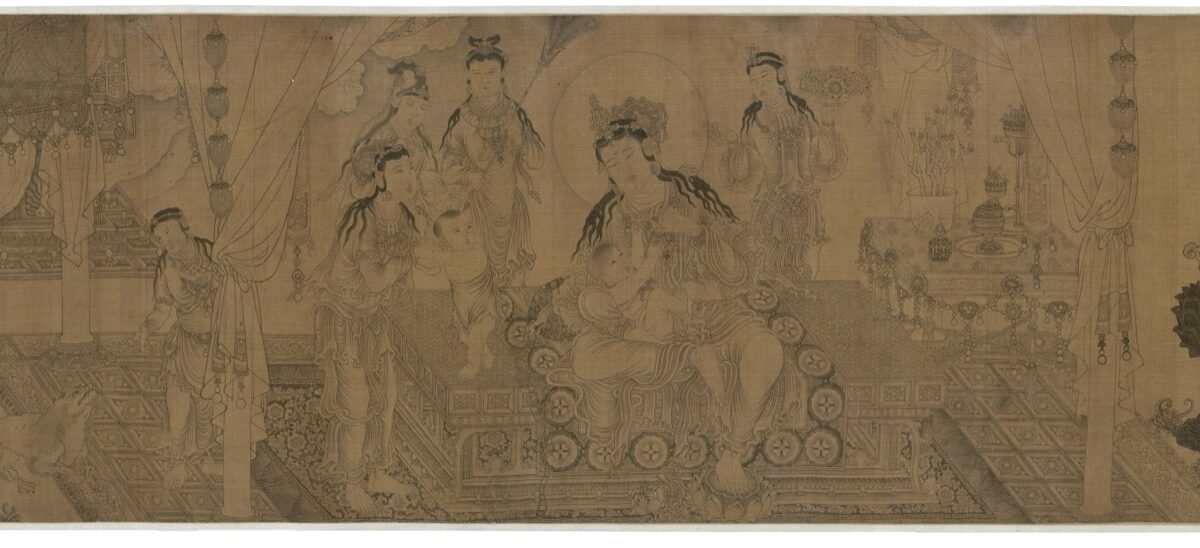
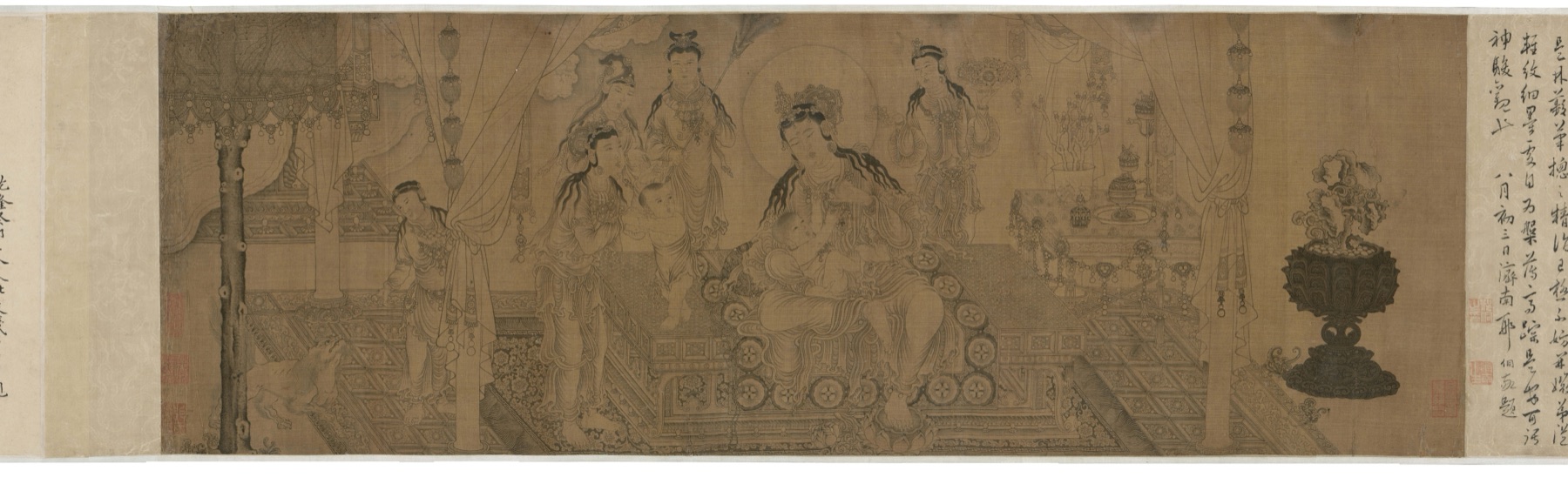
Buddha’s foster mother in Buddhist art is a subject best approached through both story and close looking. The TANGKAWORLD gallery catalogues the horizontal painting shown here as The Buddha Raised by His Maternal Aunt (TK0200), with a Yuan-period and Wang Zhenpeng attribution. Those catalog details have not been independently verified, so the date, artist, and exact scene identification remain uncertain. What can be examined directly is the long handscroll’s palace setting, the infant, the group of women, and the way architecture turns intimate care into a public narrative.
Who is the Buddha’s maternal aunt?
In Buddhist biographical traditions, Mahāpajāpatī Gotamī (Sanskrit: Mahāprajāpatī Gautamī) is remembered as the Buddha’s maternal aunt and foster mother. She was the sister of Māyā, the Buddha’s birth mother. Textual traditions describe Gotamī caring for the young Siddhattha/Siddhārtha after Māyā’s death, and later associate her with the beginning of the order of Buddhist nuns. Names and narrative details vary across languages and textual lineages; for a visual guide, it is therefore useful to distinguish a well-known story from a verified identification of any particular painting.
The scene’s catalog title points toward that story, but a title alone is not proof. Without a legible inscription that names the figures, a secure provenance, or a scholarly catalogue record, the woman and child should be described as a possible reference to Gotamī and the young Bodhisatta—not asserted as certain. This distinction matters because Buddhist paintings often combine episodes, compress time, or use familiar palace imagery to make a story intelligible.
How to read the handscroll from left to right
A handscroll is experienced sequentially. Unlike a framed image meant to be seen all at once, it is unrolled in sections; the viewer discovers a path through space and time. In TK0200, the architectural setting stretches across a broad horizontal format. Curtains, canopies, furnishings, and attendants create nested zones. The composition does not simply place a baby in a room: it stages a network of care around the child.
Begin at the edges. The architectural forms at the left establish an interior, while the right side includes a formal arrangement of objects and a vertical inscription. The inscription is visible as writing, but its content has not been transcribed here; it should not be treated as a confirmed title or date. Move inward and notice how the women’s bodies and gazes turn attention toward the infant. The repeated gestures create a visual rhythm that can guide a viewer through the story even when no text is available.
The child is small compared with the architecture and adult figures, yet the surrounding arrangement makes the infant the narrative center. This is a different kind of hierarchy from the rigid scale used in many devotional icons. Here, relative size serves a story: an infant is physically dependent, while the room and attendants communicate family status, protection, and continuity.
What the image can—and cannot—tell us
Care is shown through relationships
The painting’s strongest visual evidence is relational: an infant is held or attended within a group of women. The figures’ proximity, posture, and direction of attention make care visible. If the catalog identification is correct, that tenderness would connect a private act of nursing and upbringing with the Buddha’s later public life. But the painting itself does not prove the historical identity of every figure. A responsible caption keeps the distinction clear: observable details first, interpretation second.
Palace space makes the story legible
Decorative architecture creates a setting rather than a neutral backdrop. Screens and canopies divide the room, while attendants and furnishings signal a courtly environment. These details help viewers understand that the child belongs to a family and a community. They should not, on their own, be used to assign a precise place, dynasty, workshop, or date. Architectural conventions can be reused across periods and regions.
Inscription and provenance require separate study
Calligraphy, seals, mounting, and collector marks can be crucial evidence, but they must be read carefully and in context. A visible inscription might be a later colophon, a poem, a title, or a record of ownership. No conclusion about TK0200’s maker or date should rest on a quick visual impression. Museum catalogue records, material examination, and provenance documentation would be needed to verify the gallery’s attribution.
Story context: Gotamī beyond the nursery scene
Mahāpajāpatī Gotamī’s place in Buddhist tradition extends beyond childhood care. The Gotamī Sutta preserves an account in which Ānanda reminds the Buddha of the care she gave him, while the Therīgāthā includes verses attributed to her. These texts show why Gotamī can carry more than a supporting role: she is remembered as a caregiver and as a religious practitioner in her own right. They are useful context for reading a painting titled around the Buddha’s upbringing, but they do not independently authenticate this handscroll’s subject.
For readers comparing narrative images, TANGKAWORLD’s guides to Buddhist narrative painting and the Buddha’s preaching assembly show how one image can combine a central episode with subsidiary figures. The Therīgāthā verses of Mahā Pajāpati Gotamī offer a primary-text comparison in translation.
A practical checklist for viewing TK0200
- Describe before naming: note the infant, adult figures, room, furnishings, and visible writing without assuming identities.
- Follow the scroll: read from left to right and record how architecture, attendants, and gestures direct attention.
- Separate evidence from interpretation: label the Gotamī identification as catalog-based and uncertain unless corroborated.
- Record inscription details: transcribe only legible characters and seek a qualified reading before using them as dating evidence.
- Keep attribution cautious: treat the Yuan-period and Wang Zhenpeng labels as unverified catalog claims, not established facts.
- Compare versions: check whether another painting or text presents a similar childhood episode, while avoiding the assumption that shared motifs prove a direct connection.
Conclusion
TK0200 invites a reading of care, family, and narrative space. The handscroll’s palace interior and clustered figures make an intimate episode visible at a grand scale. The catalog identifies the scene with the Buddha’s maternal aunt, a tradition associated with Mahāpajāpatī Gotamī, but the attribution, date, and precise identification remain uncertain. By separating what the eye can establish from what a title suggests, viewers can appreciate the image without turning a plausible reading into an unsupported fact.
Download the full Thangka image collection
Continue exploring and download the complete TANGKAWORLD image collection from the full Thangka gallery.