
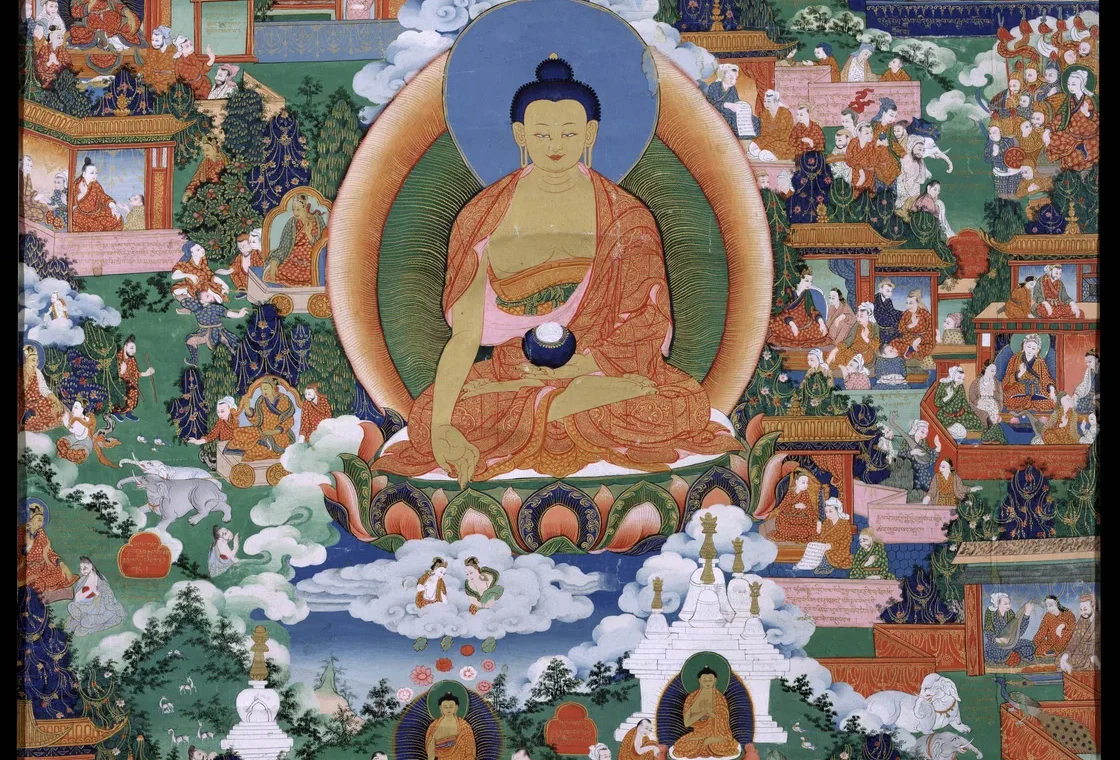
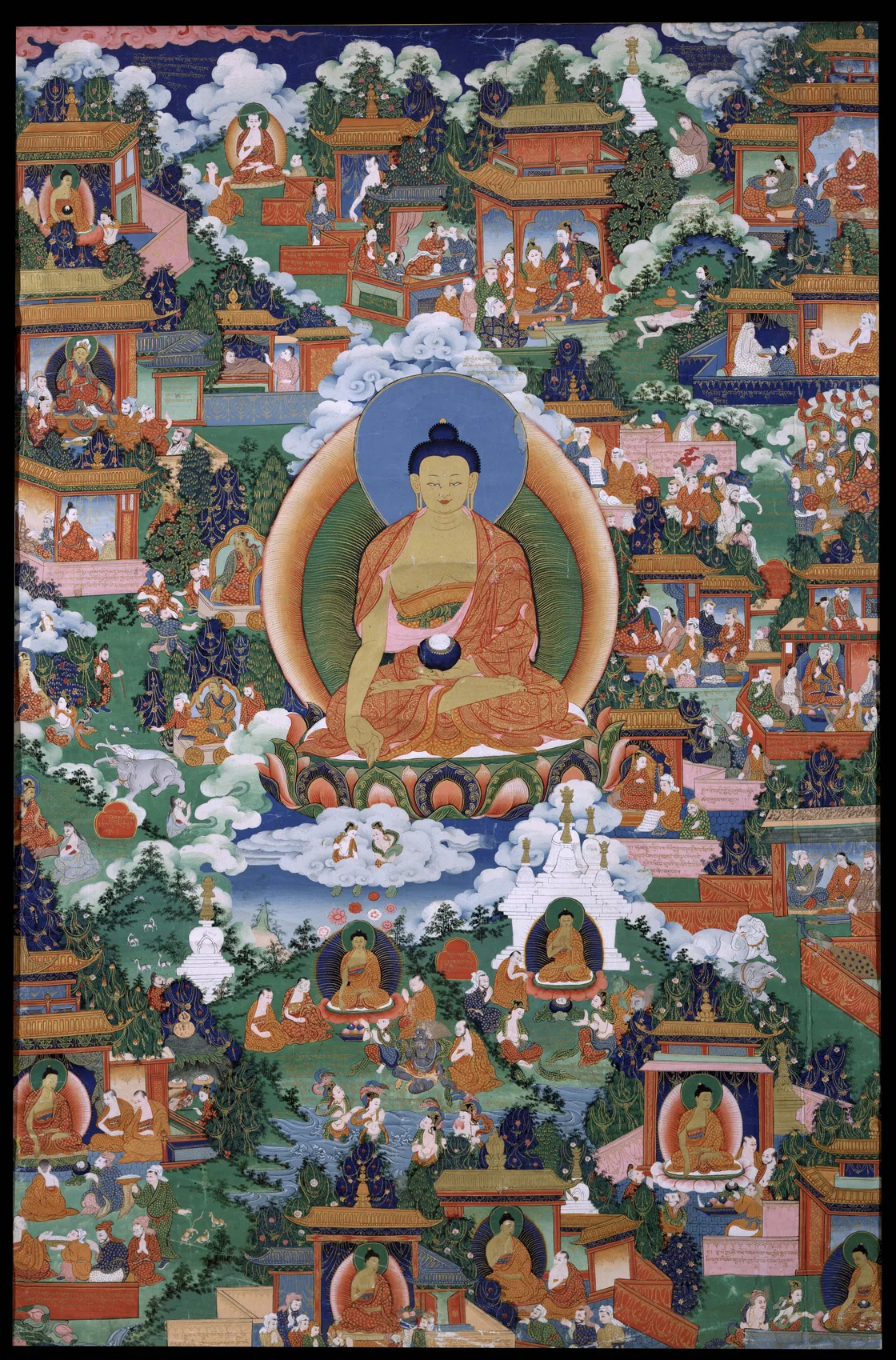
Buddhist narrative painting often asks the viewer to do two things at once: recognize a sacred figure and follow a field of smaller stories. TK0580 is a dense example. A large seated Buddha-like figure anchors the composition, while dozens of compact episodes appear above, below, and around him. The filename identifies Shakyamuni Buddha, and the central earth-touching hand and dark bowl are consistent with that reading. Yet the individual surrounding episodes, date, maker, school, collection history, and provenance remain uncertain. A responsible interpretation therefore begins with what is visible before attaching names to every scene.
This guide explains how to separate the main icon from embedded narrative scenes, trace visual routes, compare repeated figures, and record uncertainty. The method is useful for Thangka research, museum study, cataloguing, and close viewing of Buddhist storytelling art.
What Is a Buddhist Narrative Painting?
A Buddhist narrative painting organizes sacred stories in visual form. Some works present a clear sequence in separate panels. Others gather many episodes around a dominant image, allowing the central icon to remain the devotional focus while surrounding scenes add biography, teaching, lineage, pilgrimage, or exemplary deeds.
A useful museum comparison is the Metropolitan Museum of Art’s Buddha Shakyamuni and Scenes of His Previous Lives. That painting places narratives around a radiant Buddha and uses mountains and monastic buildings to divide episodes. TK0580 should not automatically be assigned the same stories, date, or origin, but the comparison demonstrates a broader compositional method: a large sacred presence can organize many smaller narrative units.
The first task is therefore not to read every detail from top left to bottom right. It is to determine whether the composition is primarily sequential, radial, hierarchical, or a combination of these systems.
Begin with the Main Icon
Use scale and placement before names
The central figure in TK0580 is dramatically larger than the surrounding people. He sits near the vertical axis, occupies the broadest uninterrupted area, and is enclosed by layered halos. These choices establish visual hierarchy. Scale here signals importance rather than physical distance. The smaller scenes do not necessarily occur farther away; they occupy a secondary level of attention.
This is a dependable starting rule for crowded Buddhist art: locate the largest stable figure, then identify the elements that visually point toward or orbit that figure. If you are new to this process, the beginner’s guide to reading a Thangka provides a reusable center-to-edge method.
Separate visible attributes from inferred identity
The central figure’s lowered right hand reaches toward the ground, while the left hand supports a dark bowl. These features are compatible with Shakyamuni in the earth-touching form. The Shakyamuni earth-touching guide explains why posture, hand gesture, bowl, robe, and throne should be considered together.
Even when an identification is persuasive, record the evidence in separate fields: filename or label, visible attributes, comparison images, and degree of confidence. This keeps a probable identification from becoming an unsupported claim about every surrounding scene.
How Embedded Narrative Scenes Are Organized
Architecture creates visual rooms
Many episodes in TK0580 take place inside roofed structures, courtyards, terraces, or walled platforms. Architecture acts like punctuation. It groups figures into a local event and prevents neighboring episodes from merging. Doorways, rooflines, balustrades, and colored walls can mark the edge of a scene even when no literal frame is present.
When cataloguing, assign each architectural cluster a neutral working label such as “upper-right teaching group” or “lower-center shrine scene.” Do not name the event until attributes, inscriptions, and reliable comparisons support that conclusion.
Clouds and landscape divide time
Cloud banks, trees, hills, water, and open ground also separate episodes. These elements can indicate changes of setting or time without forcing the painting into a single straight chronology. A cloud may function as a boundary; a river may guide the eye; a tree may isolate a teacher and attendants from the activity beside them.
Trace these boundaries before tracing characters. A scene map made from architecture and landscape is usually more reliable than a guessed story sequence based only on reading direction.
Repeated sacred figures may mark different episodes
Smaller seated Buddhas appear in several parts of the image. Repetition does not necessarily mean decorative duplication. It may indicate separate events, locations, teachings, or stages of a narrative. Compare each repeated figure’s gesture, attendants, throne, halo, and setting. If those details change, record the variation rather than assuming the figures represent the same moment.
Reading TK0580 from Evidence
What the image visibly confirms
- A dominant seated Buddha-like main icon with a lowered right hand, dark bowl, lotus seat, and layered halo.
- Numerous smaller groups arranged through temples, courtyards, platforms, landscapes, clouds, and water.
- Repeated seated sacred figures, teaching groups, monks or teachers, lay attendants, animals, stupa forms, and offering activity.
- Several inscription panels that may be important for identification, although their text is not reliably readable from this derivative.
- Strong visual hierarchy: the main icon remains legible despite the density of surrounding episodes.
What remains uncertain
The exact identities and order of the smaller episodes are uncertain. It is also uncertain whether every scene belongs to one biography, combines episodes from several textual traditions, records lineage teachers, or incorporates later historical material. The painting’s date, maker, workshop, regional school, original ritual use, collection, and provenance cannot be established from this image alone.
This distinction matters. A dense painting can resemble a life-of-the-Buddha cycle without proving that every surrounding group depicts a standard event. Visual similarity is a research lead, not a final attribution.
A Practical Identification Checklist
- Record the source. Note the filename, TK number, dimensions, crop, and whether you are studying an original, photograph, or derivative.
- Locate the main icon. Use scale, centrality, halos, throne, and uninterrupted space before relying on a supplied title.
- List attributes. Describe hands, objects, robe, seat, body color, attendants, and setting in plain language.
- Map scene boundaries. Mark buildings, clouds, trees, water, terraces, and inscription panels that divide clusters.
- Number episodes neutrally. Use positions such as upper left, center right, and lower register before assigning story names.
- Compare repeated figures. Check gestures, halos, companions, and architecture to determine whether the image repeats a deity across different events.
- Separate certainty levels. Label conclusions as confirmed, probable, possible, or uncertain, and state what evidence would improve the identification.
Compare Key Life Events Without Forcing a Match
Some visual patterns can guide comparison. A teacher surrounded by listeners may be compared with a Buddha preaching assembly. A reclining figure between trees would suggest comparison with Parinirvana imagery. A kneeling figure before a Buddha may invite comparison with the Dipankara prophecy scene.
These links are diagnostic references, not identifications of TK0580’s episodes. Match multiple features before naming a scene: posture, participants, objects, setting, inscriptions, and position within the larger cycle. If only one feature agrees, keep the proposed reading uncertain.
Why Inscriptions and Image Condition Matter
Inscriptions can transform an uncertain cluster into a documented episode, but only when the text is legible and correctly associated with the scene. Avoid guessing from partial characters or relying on automated recognition without expert review. Photograph each inscription at higher resolution, preserve its location in the scene map, and distinguish transcription from translation.
Condition also affects interpretation. Abrasion, fading, overpainting, cropping, or darkened pigments may remove attributes that once made a scene obvious. A digital image can conceal surface texture and repairs. Record missing or ambiguous details rather than filling them in from a cleaner comparison.
Conclusion
A crowded Buddhist narrative painting becomes manageable when you move from hierarchy to evidence. First identify the main icon through scale and attributes. Then map architectural and landscape boundaries, compare repeated figures, and test possible episodes against several visual clues. TK0580 demonstrates how a large central Buddha-like figure can hold together an exceptionally dense field of embedded scenes while still leaving many historical questions open.
The goal is not to name everything quickly. It is to build a transparent record that another researcher can check, correct, and extend.
Download the full Thangka image collection
Continue browsing and download the complete TANGKAWORLD image library from the full Thangka image collection page for iconographic comparison, close study, and visual research.