
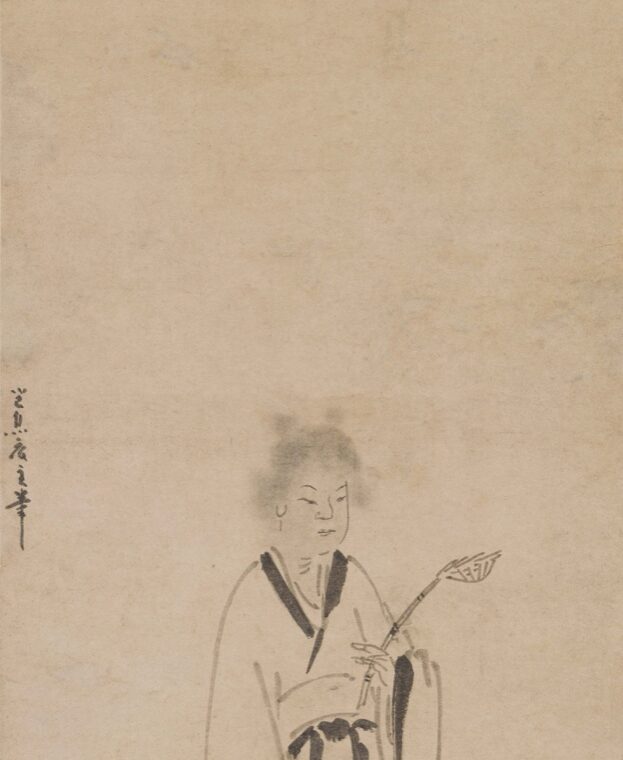
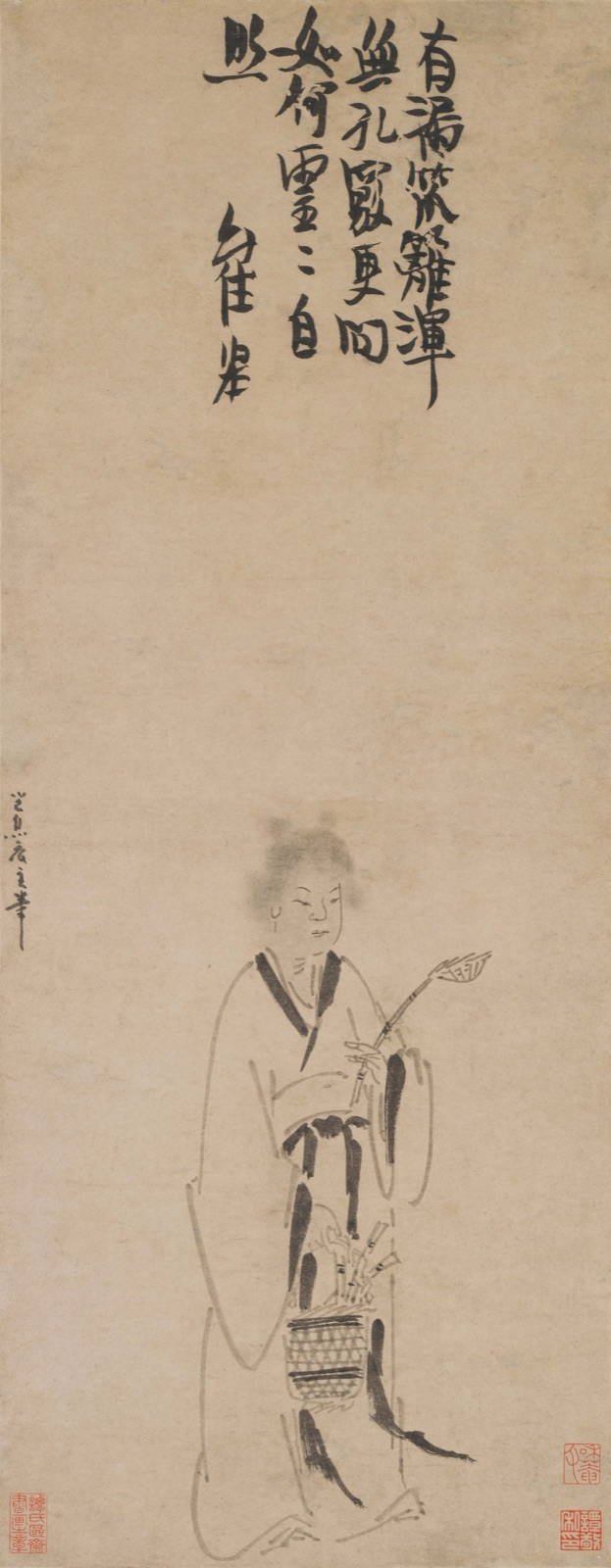
Fish-basket Guanyin is one of the most recognizable forms in the wider visual life of Avalokiteshvara, yet it is easy to read too quickly. A woven basket may look like an ordinary prop; a plainly dressed figure may seem unlike a bodhisattva; and an old catalog label can invite assumptions about date or authorship that the picture itself cannot prove. This guide separates what can be observed from what belongs to legend, later interpretation, or uncertain attribution. It uses the TANGKAWORLD gallery image TK0199 as a visual case study, not as an authenticated or fully documented museum object.
What “Fish-Basket Guanyin” names
Guanyin is the Chinese name for Avalokiteshvara, the bodhisattva associated with compassion. In Chinese Buddhist painting, Fish-Basket Guanyin is a named manifestation within Avalokiteshvara iconography: a basket—and in many depictions, a fish—helps viewers recognize a narrative identity. The figure may appear as a woman or village maiden rather than in the jeweled, courtly costume familiar from other bodhisattva images. This is not a contradiction: Buddhist art can depict a sacred figure through an accessible local appearance, while a small attribute or story points beyond ordinary identity.
The basket is therefore more than a rustic accessory. It is a visual cue that links the figure to a story of compassionate response. Yet no single attribute should be treated as conclusive in isolation. A basket can occur in many kinds of paintings; identification becomes stronger when the figure, held object, inscription, composition, and known narrative align.
The Guanyin manifestation legend: compassion in an ordinary guise
The story is preserved in versions associated with the Biographies of Guanyin’s Manifestations. In one account, a beautiful young woman arrives in Jinshatan, in Shaanxi, selling fish from a basket. Many men seek to marry her. She sets a test: a suitor must memorize the Lotus Sutra. After the marriage, she dies; a monk then reveals her as a manifestation of Guanyin who appeared to guide people toward salvation. The National Palace Museum in Taipei summarizes this narrative in its collection entry for Kuan-yin with the Fish Basket.
Read this as a religious legend, not as a report that can be verified like a dated inscription. Its visual importance lies in the transformation of an everyday encounter—buying fish, choosing a spouse, reciting a sutra—into a lesson about recognizing compassion beneath an ordinary appearance. The fish and basket make the story legible to viewers who may not know a complex doctrinal text.
Stories of this kind also change across time and place. The National Palace Museum’s explanation connects the episode to a specific narrative source, while the Palace Museum in Beijing describes a separate Ming-dynasty bronze Fish-Basket Guanyin dated 1545 and notes the motif’s popularity in later Ming and Qing contexts (Palace Museum object record). These are useful witnesses to the motif’s reception, but they are different objects and should not be conflated with TK0199.
How to read the figure and attributes
Start with the whole composition
Before naming the figure, note the format and setting. Is the image a hanging scroll, a thangka, a mural, or a later reproduction? Is the figure seated, standing, or moving? Does the background include a shoreline, village, lotus, attendants, or ritual objects? In TK0199, the surviving image is a spare vertical composition: a simply robed figure, a woven container near the lower body, a slender object in the hand, and prominent writing above. The restrained ink line and open ground are part of the evidence, not empty space to be filled with guessed details.
Then inspect the basket and fish
Look for the basket’s shape, weave, handle, position, and contents. Some versions show a fish clearly; others make the basket more legible than its contents. In a small or faded reproduction, the fish may be indistinct. Describe what is visible before interpreting it: “woven basket with uncertain contents” is more reliable than “fish” when no fish can be resolved. The detail may have been lost through wear, cropping, low resolution, or reproduction. A label can guide a search, but it cannot substitute for the object’s visible evidence.
Also record how the basket relates to the figure. Is it carried, held, placed at the feet, or offered by an attendant? These choices can shift the scene from a narrative episode to a devotional portrait. The basket’s placement often matters as much as its presence.
Why the inscription matters—and why caution matters more
Writing can preserve a title, a verse, a dedication, a signature, or a later collector’s note. These functions are not interchangeable. A text written on a painting may be contemporary with the image, added later, or copied from another source. In TK0199, the inscription is visually prominent, but a high-resolution image and competent reading are needed before its words can be used to identify the subject or establish a date. Do not translate a few recognizable characters and treat the result as complete provenance.
A responsible record separates observations from conclusions:
- Observed: vertical writing appears above the figure; several seals are visible.
- Transcription: record only characters that can be read with confidence, preserving line breaks.
- Interpretation: explain whether the text names the figure, quotes a verse, or gives a date—if that can be demonstrated.
- Uncertainty: mark illegible, damaged, or disputed passages plainly rather than filling gaps from expectation.
This method is especially important when an image circulates under multiple titles. A catalog title can be a useful starting point, but it does not by itself prove the artist, dynasty, original collection, or the history of the object.
Story, iconography, and historical attribution are different questions
Three questions are often collapsed into one: “What is this image called?”, “What does its motif mean?”, and “When and by whom was it made?” The first may be answered by a catalog title; the second through comparison with texts and related images; the third requires material, stylistic, inscriptional, and documentary evidence. A compelling match to the Fish-Basket Guanyin story does not automatically establish a Yuan date or a named painter.
The filename accompanying TK0199 associates it with a Yuan-period work and includes a Cui Gao attribution and Palace Museum reference. That file label is not independent authentication. Until a verifiable institutional record and object-level documentation are matched to the image, keep the date, artist, and provenance uncertain. The visible subject can still be studied without overstating those claims.
A practical checklist for identifying a related image
- Record the complete image and its format before cropping details.
- Describe the figure’s clothing, posture, face, and setting without naming the subject first.
- Locate the basket; note its weave, handle, contents, and relation to the figure.
- Check whether an attendant, fish, shoreline, or other narrative cue appears.
- Photograph and transcribe inscriptions and seals separately; distinguish legible text from interpretation.
- Compare the image with documented Fish-Basket Guanyin examples, while noting differences in medium and date.
- Keep catalog wording, visual observations, and attribution claims in separate fields.
- Use “uncertain” when the picture or its records do not support a firm conclusion.
Conclusion: let the small attribute open the larger story
Fish-Basket Guanyin imagery shows how a familiar object can carry a rich narrative of compassion, recognition, and teaching. The basket is a useful clue, but careful reading depends on the full composition, the inscription, and the history of the individual object. TK0199 invites close looking; its precise date, artist, and provenance remain uncertain in the available source record. For broader context, compare it with our guides to Water-Moon Avalokiteshvara and the many-armed Avalokiteshvara, where distinct visual forms show why attributes should be read in context.
Download the full Thangka image collection
Continue exploring and download the complete TANGKAWORLD image collection at free downloads. Use the images to compare compositions, symbols, inscriptions, and material details while keeping each work’s identification and provenance appropriately qualified.