
Buddhist halo in Thangka is more than a bright circle behind a head. It is a visual field that separates a figure from the surrounding landscape, measures the figure’s place within the composition, and helps a viewer distinguish principal and secondary forms. A halo can be simple, patterned, flame-edged, dark, gold, or layered. Its exact meaning depends on the work and its evidence. The safest starting point is to describe shape, boundary, colour, scale, and overlap before assigning a fixed theological meaning.
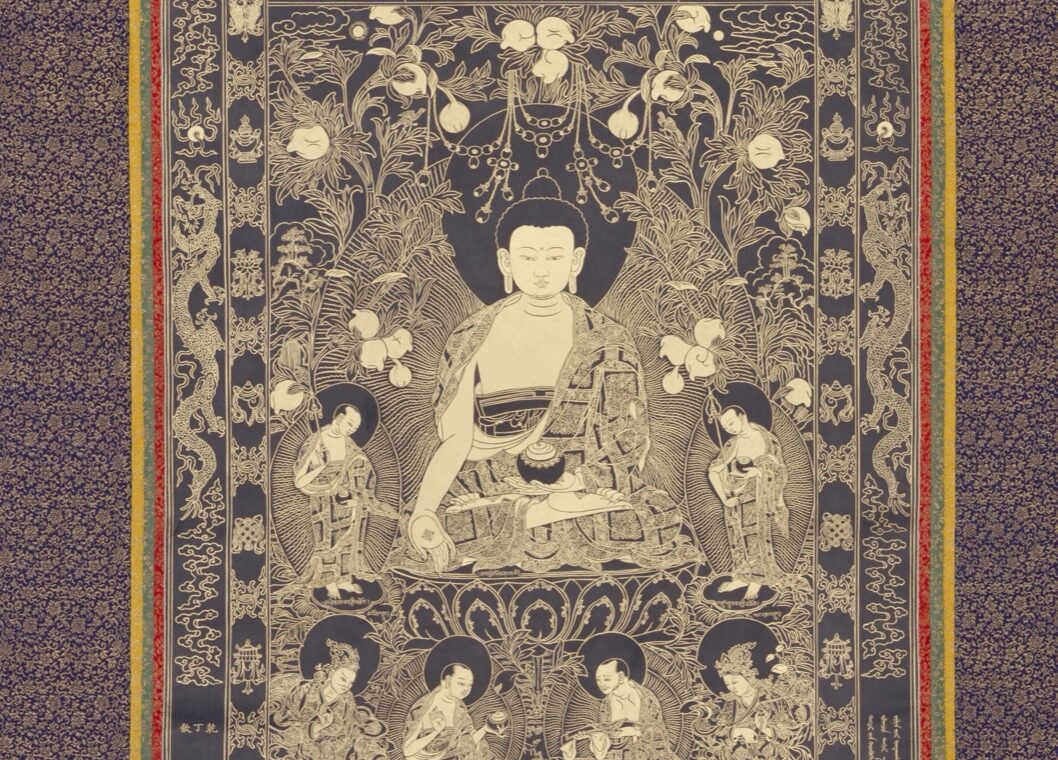
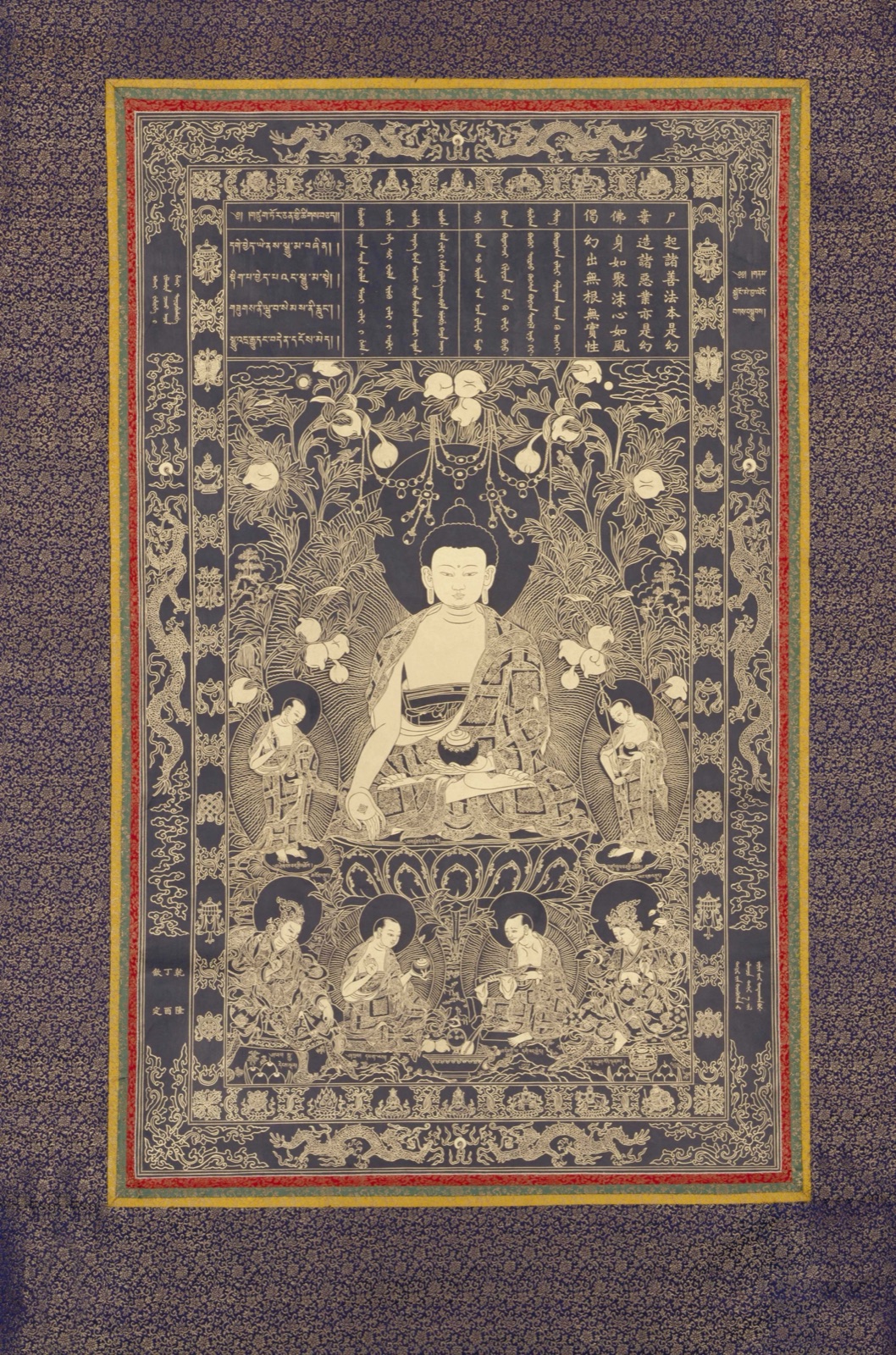
TK0377 provides a useful visual case. A central seated Buddha is set against a broad dark circular field, with two standing attendants and four lower figures each framed by their own halos. Trees, a lotus throne, multiscript panels, dragons, and layered borders surround the assembly. The image clearly supports a reading of halo placement and hierarchy. It does not prove the date, workshop, named figures, or ritual use associated with the archive filename; those details remain uncertain unless a reliable source confirms them.
Begin with the halo boundary
First find the line where halo ends and background begins. In a gold-line image, this may be a clean circular outline, a ring of ornament, or a contrast between a dark disk and a dense surrounding pattern. In TK0377, the central figure’s large dark circular field provides a distinct boundary against the tree canopy behind it. That is an observable compositional fact. It is not necessary to identify the figure in order to record it.
Then ask whether the halo is behind the head only, behind the full body, or part of a larger architectural or landscape enclosure. A simple circular nimbus may frame the head, while a wider field can relate the torso and surrounding space. Do not merge these different structures into one generic “aureole” without describing what the image actually shows.
How to read a Buddhist halo in Thangka
Compare scale
Compare each halo with the figure it surrounds. A halo that nearly touches the shoulders works differently from one that extends well beyond them. In TK0377, the central Buddha’s halo is larger than the halos of the side figures and lower group. This scale difference directs the eye toward the central field. It can indicate visual priority, but by itself it does not establish a complete hierarchy of named figures.
Trace overlap and interruption
Notice what crosses the halo boundary. Trees, flowers, clouds, ornaments, and text zones may approach or overlap it. A clear gap can keep the figure visually separate; an overlap can connect the halo to the scene around it. In TK0377, the botanical forms rise around the central circle while the figure remains legible against the darker field. Record these relationships before interpreting them as a specific narrative or ritual setting.
Separate halo from background pattern
Gold-line paintings often fill the ground with decorative detail. Halos can be mistaken for background disks, tree openings, or textile roundels when viewed at reduced size. Trace the figure outline, then the halo outline, then the surrounding motif. A good description might say “a circular dark halo behind the head and upper body” rather than treating every circular form near a figure as a halo.
What a halo can and cannot identify
A halo is strong evidence that a figure has a special visual status, but it is rarely enough to identify a deity, Buddha, or lineage holder. Several figures in the same painting may have halos; size, colour, and ornament can vary for compositional reasons as well as iconographic ones. Attributes, inscriptions, labels, gesture, and well-documented comparisons remain necessary for a secure identification.
For TK0377, the central halo, two flanking halos, and four lower halos describe a structured assembly. The archive filename offers a working association, not a final conclusion. It is accurate to note the halo geometry, the central seated Buddha, and the figure groups. It is not accurate to claim that the image alone settles every identity, date, place of production, or original ritual use.
A visual documentation checklist
- Photograph the whole composition before isolating halo details.
- Record whether each halo frames the head, upper body, or a larger field.
- Describe outline, colour, pattern, and relative scale.
- Mark overlaps with trees, clouds, text panels, borders, or other figures.
- Separate halos from mandala rings, architectural frames, background disks, and textile motifs.
- Note losses, abrasions, repainting, or cropped edges without guessing their cause.
- Keep figure names, date, school, maker, materials, and provenance uncertain where unsupported.
This checklist can be used with our Thangka condition report checklist. For a broader approach to composition and iconography, see How to Read a Thangka.
Halo, throne, and figure group
A halo gains meaning through its relationships. In TK0377, the central circular field sits above a layered lotus throne, between standing attendants, and above a lower assembly. The halo helps the viewer move from the central Buddha outward to the group and then to the text panels and borders. This is a compositional reading, not a substitute for historical identification. Our guides to the lotus throne in Buddhist art and Buddhist attendant figures in Thangka show how those elements can be documented alongside one another.
Do not use a text panel as an automatic halo label. Inscription reading requires sufficient resolution and relevant language expertise. Until a text has been reliably transcribed and connected to a figure, record its placement separately from halo observations.
From circle to visual structure
Studying a Buddhist halo in Thangka is a practical way to see structure. In TK0377, the large central halo, smaller halos, lotus throne, trees, lower group, text panels, dragons, and borders create several levels of attention. Begin with visible boundaries and scale, compare documented works carefully, and let uncertain historical details remain uncertain. The result is a more precise description and a better foundation for later research.
Download the full Thangka image collection
Continue browsing and downloading the complete TANGKAWORLD image collection for close comparison of Buddhist halos, figure groups, thrones, inscriptions, and painting details.