
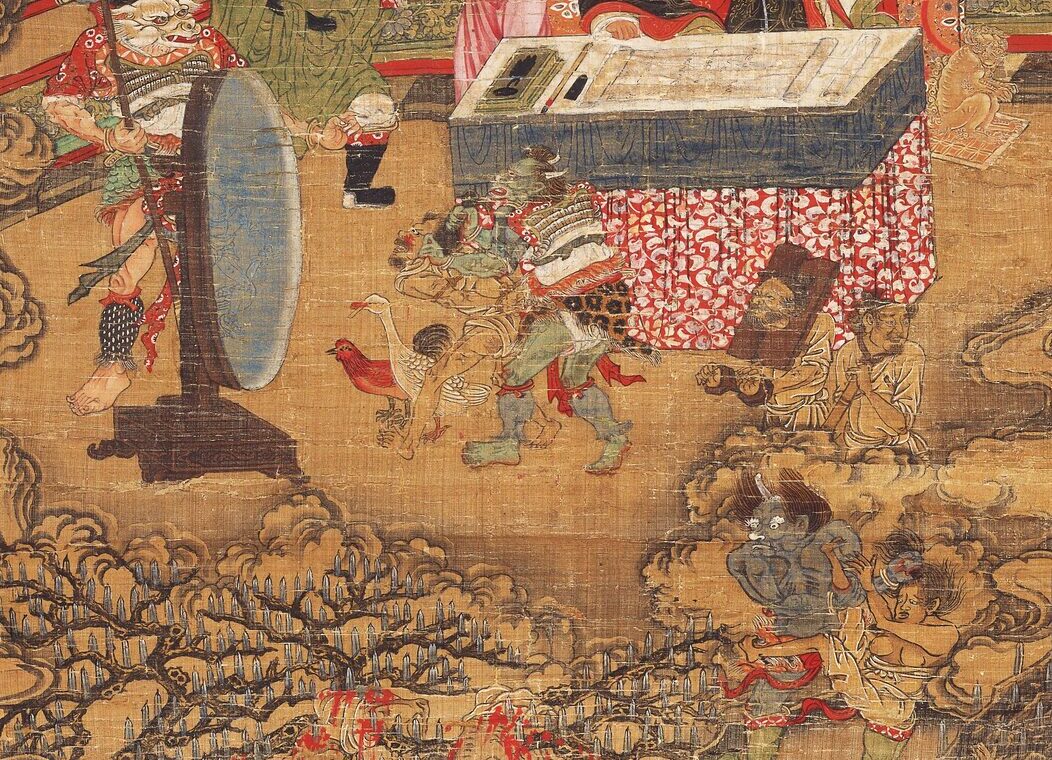
Paintings of the Buddhist underworld can look crowded at first: an enthroned judge, clerks with documents, armed guards, anxious petitioners, and punishment scenes may all occupy one vertical field. Yet the composition is not random. Ten Kings of Hell in Buddhist art presents judgment as an ordered process in which actions are recorded, reviewed, and answered for. Reading the image from the court outward reveals how painters turned an abstract teaching about karma into a legible visual drama.
What are the Ten Kings of Hell in Buddhist art?
The Ten Kings are underworld rulers associated with a sequence of posthumous judgments in East Asian Buddhist traditions. Their courts evaluate the deeds of the dead, while clerks, registers, witnesses, messengers, and guards make the process visible. The imagery combines Buddhist teachings about karma and rebirth with the familiar language of an official tribunal. It is therefore better understood as moral instruction than as a simple picture of eternal damnation.
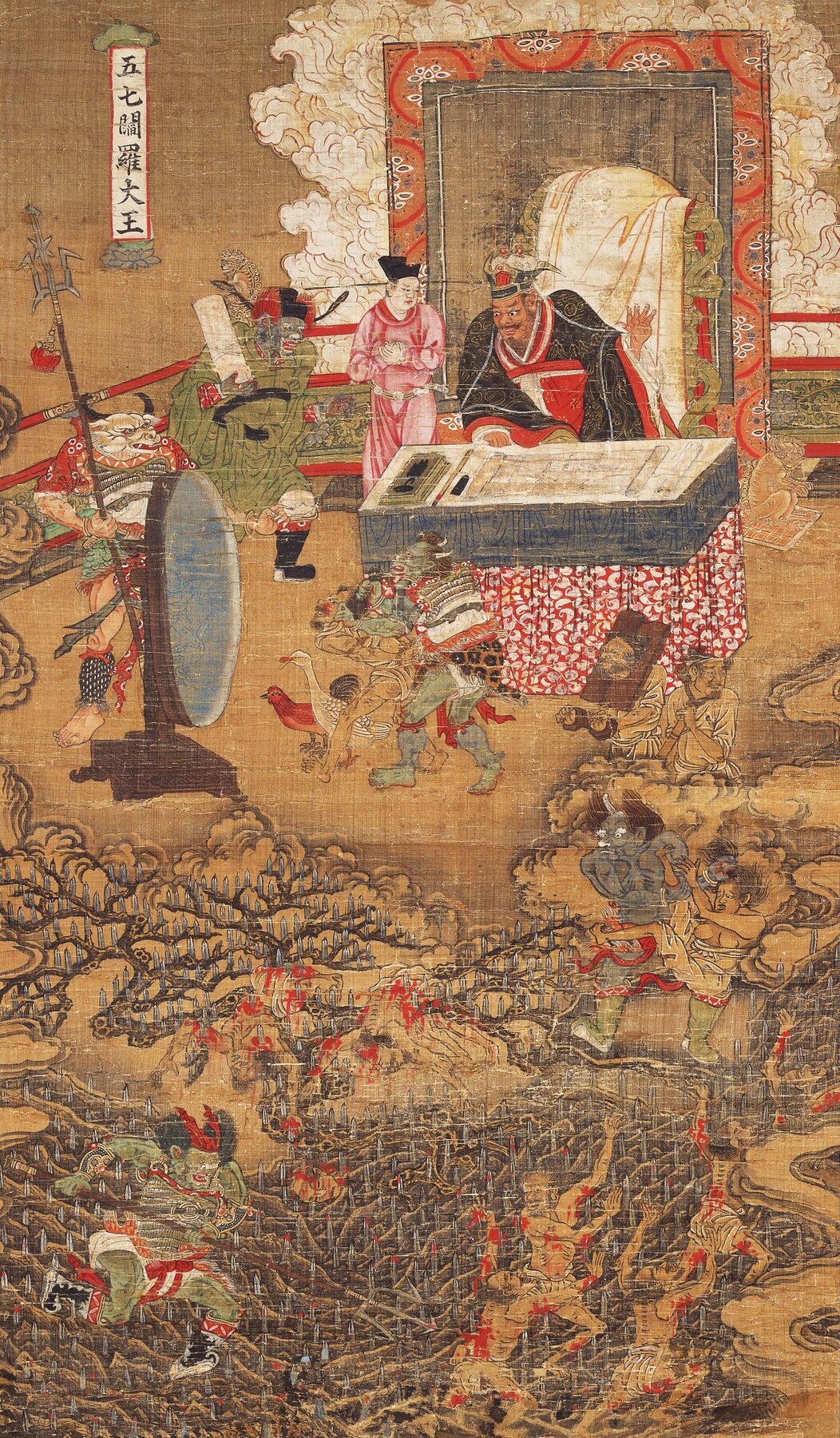
Individual paintings may represent one court, while sets can present a sequence of rulers and trials. Names, order, attributes, and narrative details are not identical across every region or period. A label such as “Ten Kings” should not tempt us to assign a specific ruler solely from costume or facial expression. In the featured work, the vertical inscription appears to identify a court connected with Yanluo, or King Yama, and a seven-day observance, but a definitive reading requires specialist examination of the inscription and the wider set.
Yama is especially easy to confuse with other wrathful figures. Our separate guide to Yama and Yamantaka in Tibetan art explains why an underworld judge and a tantric deity should not be treated as interchangeable.
Start with the judgment court
The enthroned ruler
The highest-ranking figure usually occupies the strongest architectural frame. In TK0127, a dark-robed ruler sits before a tall backrest and a broad desk. His scale, front-facing authority, crown, and elevated position establish him as the center of the court. This visual hierarchy matters more than any single color. Painters often use size, placement, furniture, and attendant figures together to mark rank.
The ruler’s raised hand suggests active judgment rather than meditation. Unlike a serene Buddha seated on a lotus, he is embedded in an administrative setting. That difference is a useful first test: if the central figure presides over documents, clerks, guards, and petitioners, the scene is probably judicial or narrative rather than a devotional portrait of a solitary deity.
Registers, brushes, and official records
The desk is not decorative filler. Long sheets, a writing brush, and ink equipment make the idea of moral accounting concrete. Court officials stand nearby holding or consulting written records. These objects signal that deeds have consequences and that judgment follows evidence within the story world of the painting.
When studying a Buddhist judgment painting, trace the movement of information. Who holds the document? Who reads it? Who faces the ruler? A register may connect actions performed in life with the decision announced in the court. The administrative details also help distinguish the scene from a generic assembly of protectors.
Read the composition from authority to consequence
The upper register of TK0127 contains the court: the judge, screen, officials, guards, and people awaiting a decision. Below it, the space becomes unstable and crowded. Smoke, jagged terrain, demons, bound figures, and bodily punishments translate the court’s verdict into narrative consequence. This top-to-bottom movement creates a moral chain:
- Authority: the enthroned ruler establishes the court.
- Evidence: clerks and written records represent the review of deeds.
- Judgment: gestures and attendants indicate an official decision.
- Consequence: lower scenes show the suffering associated with harmful actions.
- Instruction: the viewer is invited to reflect on conduct before consequences arise.
This organization is related to the broader way Buddhist painters use scale and placement to guide attention. See our guide to scale and hierarchy in Buddhist art for a closer explanation of how size can encode rank and narrative importance.
How to identify a Buddhist judgment painting
No isolated object proves that a painting belongs to the Ten Kings tradition. Use a cluster of visual signals and keep uncertain identifications open.
- A court-like center: look for an enthroned or seated ruler framed by furniture or architecture.
- Administrative attendants: clerks, officials, scrolls, tablets, books, brushes, or registers often surround the judge.
- People under review: kneeling, standing, or restrained figures may face the court.
- Enforcement figures: armored guards, demon attendants, weapons, and instruments of restraint show the court’s power.
- Separate consequence zones: punishment episodes may appear beneath or beside the tribunal.
- Inscriptions: cartouches can identify a ruler, court, or ritual interval, but damaged or abbreviated text needs expert reading.
- Sequential logic: related works may form a set, so compare dimensions, borders, inscriptions, and repeated compositional features.
These same methods apply to complex ritual and narrative imagery. The Buddhist Water-Land ritual painting guide shows how large assemblies organize beings by realm and function, while our guide to main icons and side scenes in Buddhist narrative painting explains how to separate a central subject from supporting episodes.
What the punishment scenes mean
Underworld punishments are vivid because they were designed to be remembered. In TK0127, the lower half is filled with sharp forms, flames, restrained bodies, and fierce enforcers. Such imagery warns that harmful actions bring painful results. It should not be read as permission to identify a person’s fate, nor as a universal map shared unchanged by all Buddhist communities.
The larger doctrinal point is causation: actions have effects. Judgment imagery externalizes that principle through a courtroom model familiar to its intended viewers. The frightening details create urgency, but the picture also assumes that moral choices, ritual remembrance, and the cultivation of wholesome conduct matter. The scene is didactic, not merely sensational.
Attribution and dating: what remains uncertain
The local archive file name describes TK0127 as part of a Ten Kings series, attributes it to Lu Zhongyuan, and assigns it to the Yuan dynasty. Those details have not been independently verified here. A reliable attribution would require examination of inscriptions and seals, comparison with securely documented works, technical study of the support and pigments, and a traceable collection history.
Visible age, textile texture, costume, or a historical-looking inscription cannot by themselves prove the named artist or date. Digital color may also differ from the original object. Until stronger evidence is available, the safest description is: a judgment-court painting from a Ten Kings of Hell group, archive-labeled as Lu Zhongyuan and Yuan dynasty, with authorship, precise date, material, and provenance uncertain.
A practical visual reading checklist
Before assigning a title to an unfamiliar underworld image, record the evidence in a fixed order:
- Locate the largest or most strongly framed figure.
- List the ruler’s costume, crown, gesture, seat, and surrounding architecture.
- Note every document, brush, tablet, mirror, scale, or other instrument of judgment.
- Separate officials and guards from the people being judged.
- Map the court, transition zone, and punishment scenes.
- Transcribe inscriptions without silently completing damaged characters.
- Compare the work with other panels from the same set before naming the ruler.
- Keep artist, dynasty, school, medium, and provenance marked uncertain unless supported by documentation.
Conclusion
To read the Ten Kings of Hell in Buddhist art, begin with structure rather than horror. The enthroned ruler establishes authority; registers and clerks make karmic accounting visible; guards enforce the decision; and lower narrative zones show consequence. That sequence turns a dense image into an intelligible moral narrative. TK0127 offers a strong example of this courtroom logic, while its exact attribution, date, and place within a complete series remain uncertain.
Download the full Thangka image collection
Continue exploring court scenes, deities, Mandala paintings, narrative works, and related images in the complete TANGKAWORLD gallery. Browse and download the full Thangka image collection.