
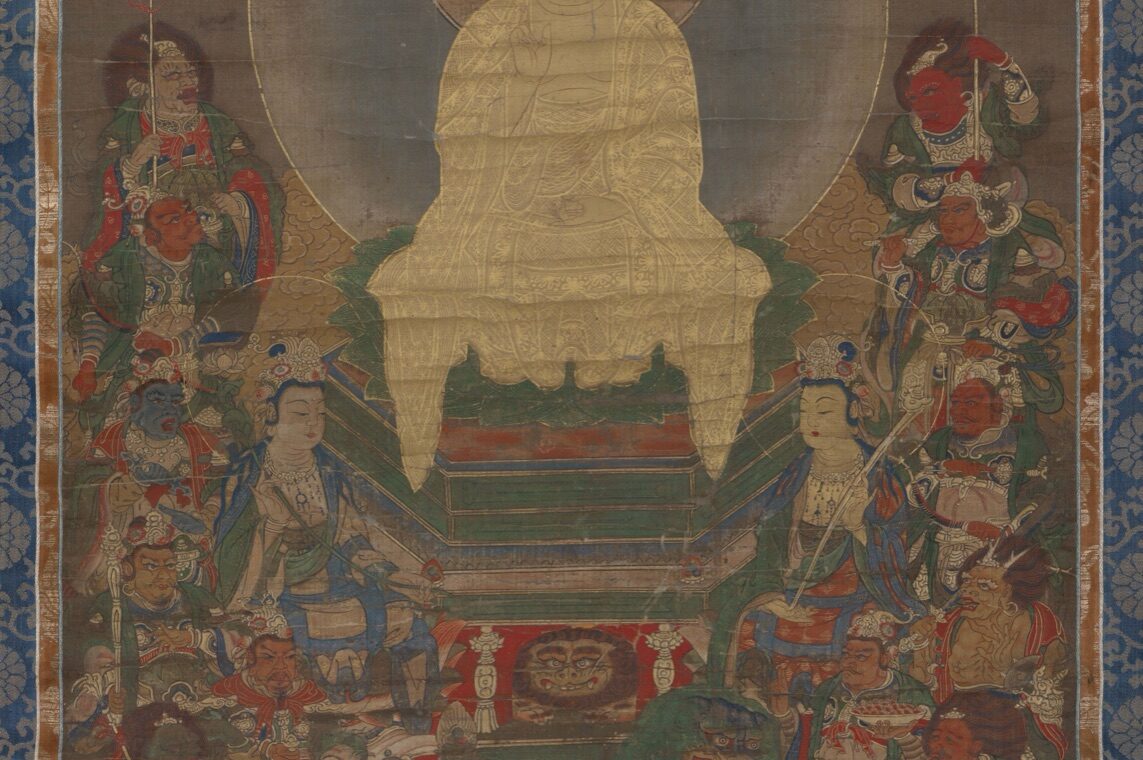
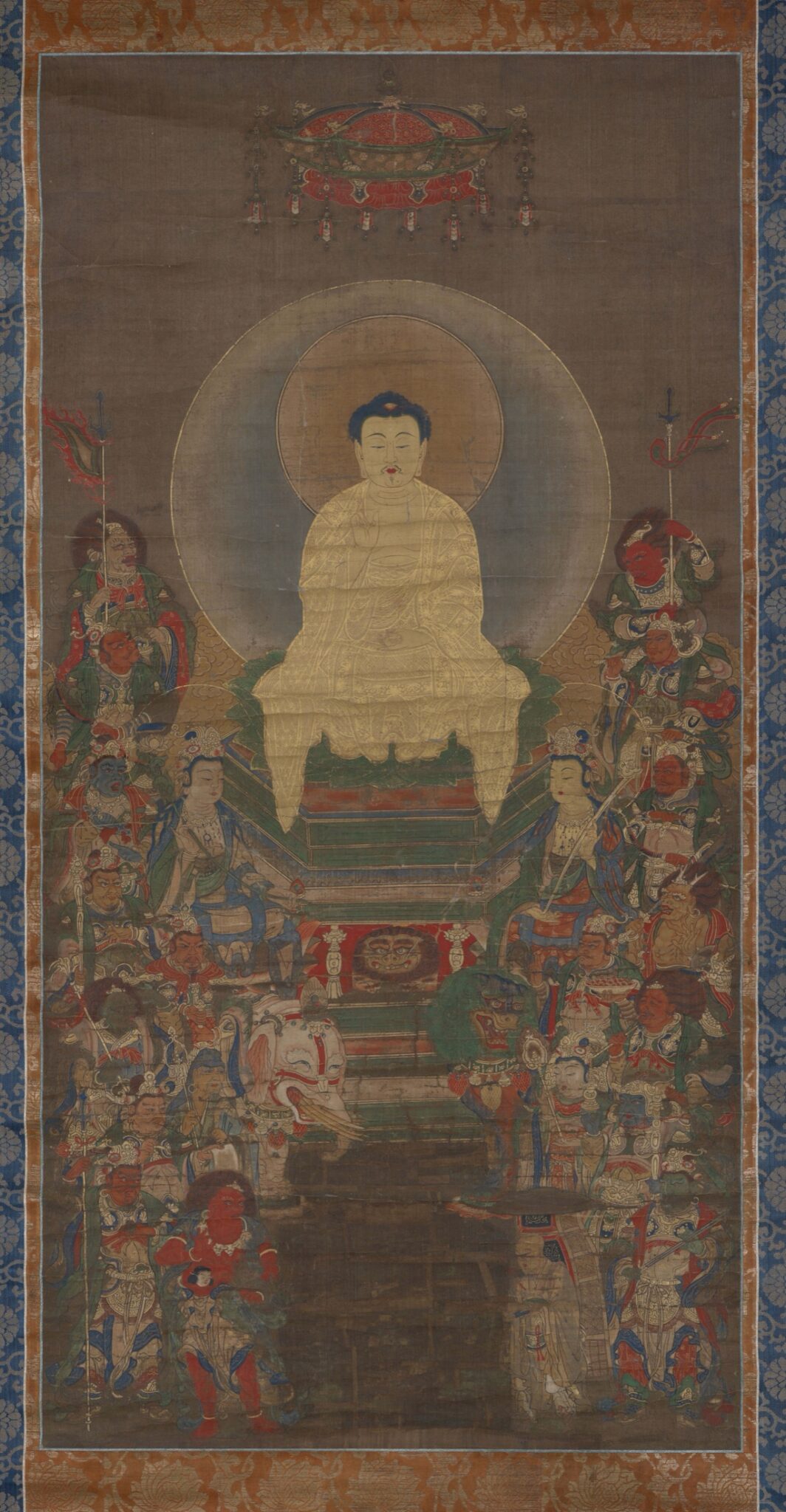
Shakyamuni with the Sixteen Protective Deities is a Japanese Buddhist painting subject in which the historical Buddha is surrounded by a group of guardians. In TANGKAWORLD image TK0272, a calm central Buddha sits beneath a canopy while richly colored attendants and fierce-looking figures gather around the throne. The archive title suggests the “Sixteen Protective Deities,” but the image itself does not verify every attendant’s name or the work’s date, artist, or original ritual setting. Start with what is visible, then compare the proposed subject with documented examples.
This guide explains how to read the central figure, protective assembly, and visual hierarchy; how to distinguish this subject from the Sixteen Arhats and Four Heavenly Kings; and how to record uncertainty without losing useful detail. The Japanese term Shaka Jūroku Zenjin is often translated as Shakyamuni and the Sixteen Benevolent or Guardian Deities.
What does “Sixteen Protective Deities” mean?
In Japanese Buddhist painting, Shakyamuni may appear with a group of sixteen benevolent deities associated with protecting the Buddha’s teaching and its recitation. Museum descriptions connect some examples with the Great Perfection of Wisdom (Prajñāpāramitā) Sutra and devotional rites centered on its recitation. The exact roster, attendant arrangement, and local title can vary, so “sixteen” should be read as a named iconographic group—not as a license to identify every armed figure by appearance alone.
The Metropolitan Museum’s late-fourteenth-century painting of Shaka with two attendant bodhisattvas and sixteen benevolent deities describes the group as protecting the sutra and those who recite it. The Nara National Museum’s Śākyamuni and Sixteen Guardian Deities gives a more specific example, naming attendants and a figure associated with Xuanzang. These are useful comparisons, but neither record establishes that TK0272 is the same object, date, or exact arrangement.
Read the painting from the center outward
1. Establish the central Buddha
In TK0272, the largest figure is seated frontally on a layered throne. A broad halo frames the head and body, and a canopy occupies the upper field. Scale, central placement, and the visual space around the figure make him the composition’s focus. The archive title identifies him as Shakyamuni. This is plausible, but a cataloguer should still record the title as a supplied identification unless a reliable object record or legible inscription confirms it.
Describe the posture, hand gestures, robe, seat, halo, and any visible marks before assigning a name. The beginner’s guide to reading a Thangka uses the same center-to-edge method: separate visible attributes from interpretation, then test the interpretation against context.
2. Treat the surrounding figures as an assembly
TK0272 contains groups on both sides of the central throne. Several figures wear armor or carry weapons; others appear in courtly or monastic dress. Their gestures and faces vary, and the assembly creates a protective frame around the Buddha. That collective role is more secure than naming each individual from a small digital reproduction.
Make a position map—upper left, lower right, beside the throne—before attempting a roster. Note each figure’s color, headgear, implement, mount, posture, and relation to the central Buddha. A single attribute may recur across different deities or change between regional traditions. Confidence rises when several clues agree and a documented comparison supports the match.
3. Notice the canopy and throne
The suspended canopy marks a sacred center and visually shelters the Buddha. The throne’s steps and platform lift him above the surrounding assembly. Together, these features create a hierarchy: the guardians are active and diverse, while Shakyamuni remains calm and still. The contrast is not merely decorative; it makes the protective function legible without turning the painting into a battle scene.
Do not confuse three different groups
The Sixteen Protective Deities are not the Four Heavenly Kings. The Four Kings are a separate directional-guardian group, often recognizable through their armor, weapons, and placement at the cardinal directions. They may appear within a larger protective assembly, but a painting with many guardians is not automatically a Four-King image.
They are also not the Sixteen Arhats. Arhats are enlightened disciples represented as a distinct group, often with varied human features, robes, and individual attributes. Their number overlaps, which can cause confusion in titles and casual descriptions. Check the central subject and the documented function of the group: “sixteen figures” alone does not settle whether they are guardians or Arhats.
Nor should the assembly be casually called the Twelve Devas. The Twelve Devas guide covers another protective grouping with its own structure. Sets can overlap in a broad pantheon, but their names and ritual roles are not interchangeable.
What can be said about TK0272—and what remains uncertain?
- Visible: a large seated Buddha beneath a canopy; a frontal halo; a raised throne; numerous attendants and guardian-like figures on both sides; varied colors, armor, garments, and implements.
- Proposed by the archive filename: Shakyamuni with the Sixteen Protective Deities, also called Sixteen Benevolent Deities.
- Not established by the image alone: the names of all attendants; whether every figure belongs to a standard sixteen-member roster; the painting’s precise date, artist, workshop, original use, present collection, provenance, or restoration history.
This distinction is important because Japanese Buddhist paintings of similar subjects can include named bodhisattvas, guardian figures, monks, or historical participants. The Met and Nara examples demonstrate that richer identifications are possible when object records support them. They should be used as comparative evidence, not copied onto TK0272.
A practical identification checklist
- Record the archive title and TK number separately from your own identification.
- Confirm the central figure’s posture, gestures, halo, throne, and canopy.
- Count visible attendants only when the image is clear; do not infer missing figures from a conventional title.
- Map the assembly by position and describe each figure in plain visual language.
- Compare the group with museum records for Shaka Jūroku Zenjin and Prajñāpāramitā-related paintings.
- Keep the Four Heavenly Kings, Twelve Devas, and Sixteen Arhats distinct unless the object record explicitly connects them.
- Label claims as observed, proposed, or uncertain, and cite the evidence behind each proposed name.
Why context matters
A painting’s title, ritual use, and later collection history are separate research questions. A museum example may have been used during sutra recitation, but that does not prove TK0272 served the same rite. A canopy and protective assembly support an iconographic reading; they do not establish a temple, patron, or date. Likewise, wear, fading, repairs, and cropping may hide attributes that would clarify a figure’s identity. If the original object record is unavailable, preserve that gap rather than filling it with a confident-sounding story.
Conclusion
Shakyamuni and the Sixteen Protective Deities is best read as a relationship between a serene central Buddha and a varied guardian assembly. TK0272’s canopy, throne, halo, and surrounding figures make that structure visible, while the precise names and history remain open until supported by a catalog record. Comparing documented Japanese examples can sharpen the questions, but careful description keeps the answer honest.
Download the full Thangka image collection
Continue browsing and download the complete TANGKAWORLD image collection for close study and comparison. Visit the full Thangka image collection to explore more Buddhist paintings, deities, and visual traditions.