
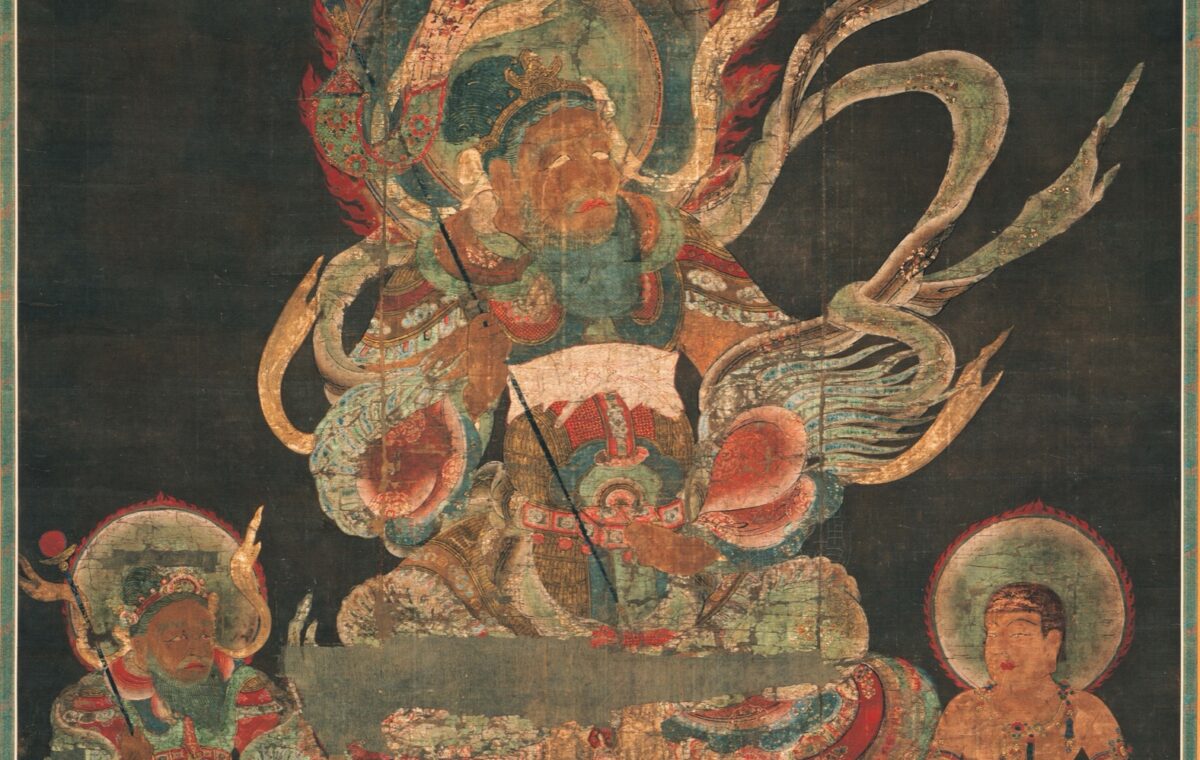
Twelve Devas in Buddhist art form a protective map rather than a random gathering of gods. In Japanese Esoteric Buddhist traditions, eight devas guard the cardinal and intermediate directions, while four more represent heaven, earth, the sun, and the moon. Paintings therefore work on two levels at once: each figure has an individual identity, and the complete set defines a ritual space.
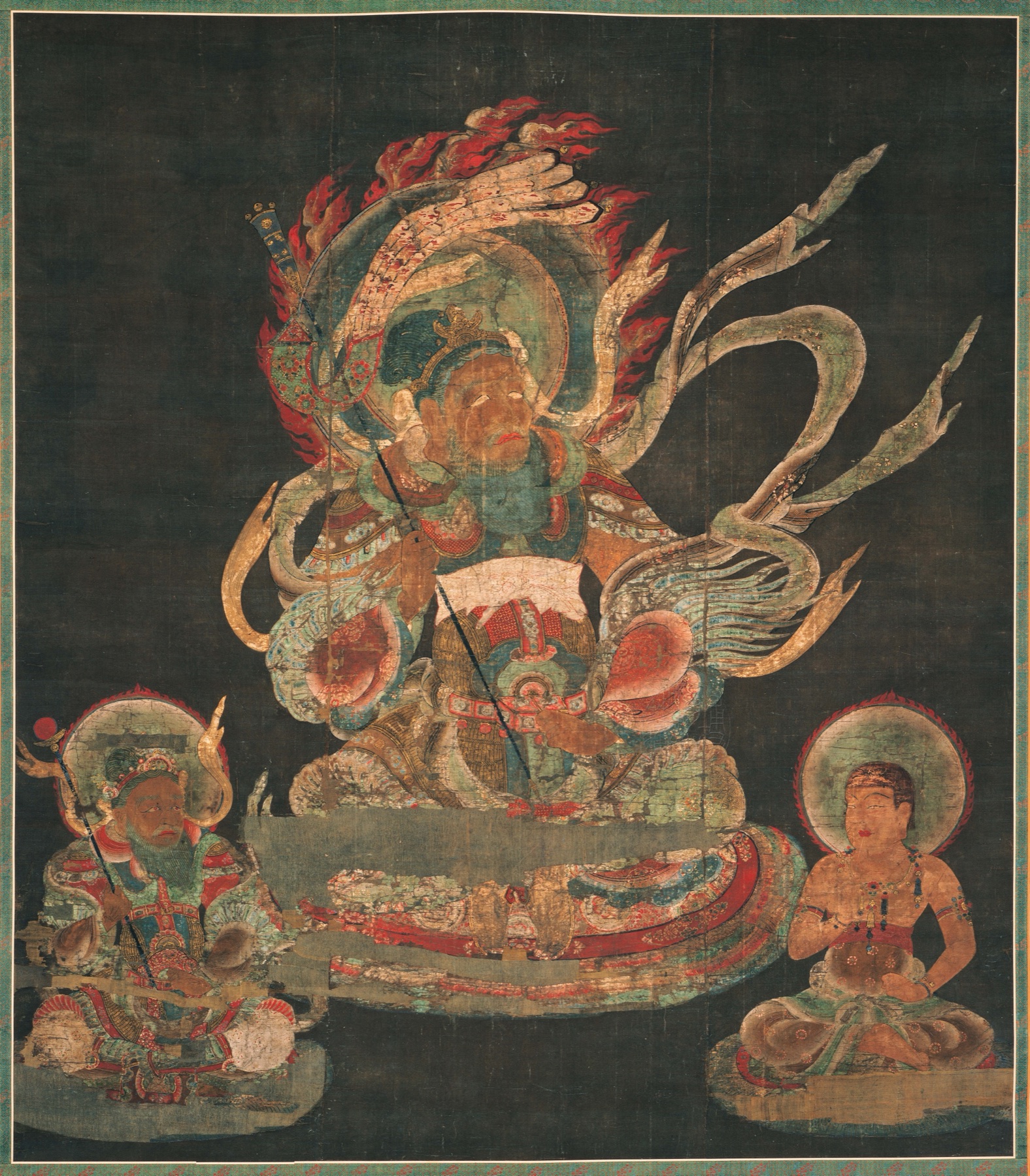
TK0618 provides a close-reading example. The local archive filename identifies the central figure as Futen, the Japanese form of Vayu, guardian of wind and the northwest. An aged, bearded deity sits against a dark ground with a staff-like attribute, streaming ribbons, and two attendants. Those features support the identification, but the exact date, artist, workshop, collection history, and provenance of this file remain uncertain.
Quick answer: what are the Twelve Devas?
The Twelve Devas are protective divinities incorporated into the Buddhist pantheon and organized around twelve spatial or cosmic positions. They became especially important in Japanese Esoteric Buddhist ritual and painting. Rather than treating them as twelve interchangeable heavenly beings, read them as a coordinated system of direction, attribute, posture, expression, and ritual placement.
Kyoto National Museum describes its celebrated set as guardians of the four cardinal directions, four intermediate directions, heaven, earth, the sun, and the moon. The museum also records that its twelve hanging scrolls were used in an annual New Year esoteric ceremony at the Imperial Palace. This context explains why orientation is not decorative trivia: it is the principle that turns separate portraits into a protective enclosure.
How the twelve-part directional system works
The eight directional guardians
The directional sequence usually begins in the east with Taishakuten, or Indra. Katen, or Agni, occupies the southeast; Enmaten, or Yama, the south; Rasetsuten, or Rakshasa, the southwest; Suiten, or Varuna, the west; Futen, or Vayu, the northwest; Bishamonten, or Vaishravana, the north; and Ishanaten, or Ishana, the northeast. Spellings vary between Sanskrit, Japanese, and English catalogues, so a responsible record should preserve the terminology used by its source.
Heaven, earth, sun, and moon
The remaining four extend the diagram beyond a flat compass. Bonten, or Brahma, represents heaven; Jiten, or Prithivi, earth; Nitten, or Surya, the sun; and Gatten, or Chandra, the moon. Together they surround a ritual center vertically, horizontally, and cosmically. That is why a Twelve Devas painting can be studied alongside a Mandala boundary: both organize sacred space, even though their formats and iconographic systems are not identical.
From older divinities to Buddhist protectors
Many members of the set originated in older Indian religious traditions. In Buddhist use, their identities were not simply erased. Their powers, attributes, and directional associations were reframed as guardianship of Buddhist ritual space. Kyoto National Museum notes that wind, water, fire, and the realm of the dead retain recognizable functions within the group.
This layered history helps explain the set’s visual variety. Some figures appear calm and courtly, others aged, energetic, or wrathful. A single stylistic expectation will not identify all twelve. The viewer must compare facial type, vehicle, hand-held object, attendant figures, seed syllables, inscriptions, and position within the series.
How to read Futen (Vayu) in TK0618
The aged face and wind attribute
The central deity in TK0618 has an aged face, prominent beard, and forceful gaze. A narrow rod rises beside the body. The official e-Museum record for Futen describes the deity as an old man who holds a wind scepter in his right hand and guards the northwest. That comparison supports the archive label, but it does not by itself prove that TK0618 reproduces the same physical scroll.
Streaming fabric makes invisible air visible
Long, curling bands move around the shoulders and across the dark field. Their repeated curves give the otherwise frontal figure a sense of turbulence. In visual terms, the artist turns wind—which cannot be painted directly—into the movement of fabric, flame-like contours, hair, and slender attributes. This is a stronger identification clue when it agrees with the aged face and staff than when it is read in isolation.
Attendants, pedestal, and black ground
Two smaller figures occupy the lower corners. Their reduced scale establishes a hierarchy around the central guardian. The broad dark ground removes most landscape detail, making the pale ribbons, patterned robes, and circular halos easier to follow. The effect is closer to a formal icon than to a narrative scene: the figure is presented for recognition and ritual orientation rather than caught in an episode.
Do not confuse the Twelve Devas with other guardian groups
- Four Heavenly Kings: this group protects four directions and commonly appears at temple gates or around a central Buddha. The Twelve Devas use a larger directional and cosmic scheme. Compare our Four Heavenly Kings visual guide.
- Vaishravana alone: Vaishravana is both an independent protector and, as Bishamonten, the northern member of the Twelve Devas. His presence does not automatically mean the entire set is represented. See the Vaishravana iconography guide.
- Eight directional protectors: some systems stop at eight directions. Confirm whether heaven, earth, sun, and moon are present before cataloguing a work as a Twelve Devas set.
- Mandala gate guardians: guardians placed at gates or boundary rings serve a related protective function, but their names and arrangement may belong to a different ritual system.
Twelve Devas in Buddhist art: identification checklist
- Start with the proposed position: east, southeast, south, southwest, west, northwest, north, northeast, heaven, earth, sun, or moon.
- Record the figure’s age, expression, body color, crown, jewelry, armor, and robes before assigning a name.
- Identify the hand-held object, vehicle, pedestal, halo, and attendant figures.
- Check whether the work is a single hanging scroll, part of a series, a folding screen, or a preparatory drawing.
- Compare the complete set whenever possible; attributes are easier to distinguish through relationships.
- Use museum records for controlled comparisons, not as automatic proof of identical provenance.
- Mark the artist, date, ritual use, collection, and provenance as uncertain when the image file lacks a connected object record.
This evidence-first method also applies beyond Japanese Buddhist painting. The beginner’s guide to reading a Thangka explains how to separate direct observation from iconographic interpretation, especially when a digital file has incomplete catalog data.
Painting format and ritual use change the image
Twelve Devas survive in several formats, including sets of hanging scrolls, paired folding screens, masks, and line drawings. Format affects posture and spacing. Kyoto National Museum explains that later folding-screen compositions favored standing figures suited to tall panels, whereas earlier sets could show the devas seated on individual supports.
As a documented example of Shingon ritual art, the Kyoto hanging-scroll set is dated 1127 and uses color and gold on silk. Museum descriptions emphasize layered color, patterned robes, cut-gold decoration, and attendants flanking seated figures. The associated Futen has also been discussed as possibly preserving features of an earlier 1040 set. These dates belong to that museum object, not automatically to TK0618.
Condition changes what can be identified
TK0618 shows abrasion, losses, creases, darkened areas, and horizontal bands that interrupt the lower figures and central pedestal. Fine designs in the garments and the exact shape of the staff are partly obscured. A digital image can support iconographic study, but it cannot establish the object’s materials, repairs, or structural condition without examination. Use the condition-report checklist to keep observation separate from proposed causes.
Conclusion
Twelve Devas in Buddhist art should be read as a spatial system: eight directional guardians joined by heaven, earth, sun, and moon. TK0618 is consistent with Futen (Vayu) because its aged central figure, wind attribute, streaming bands, attendants, and formal presentation agree with museum-documented iconography. The identification is plausible and useful, while the exact date, maker, workshop, ritual history, and provenance remain uncertain until a reliable object record is connected to the file.
Download the full Thangka image collection
Continue comparing directional guardians, ritual paintings, and Buddhist iconography, and browse and download the full TANGKAWORLD image collection. The archive supports close comparison of attributes, gestures, formats, and regional visual traditions.