
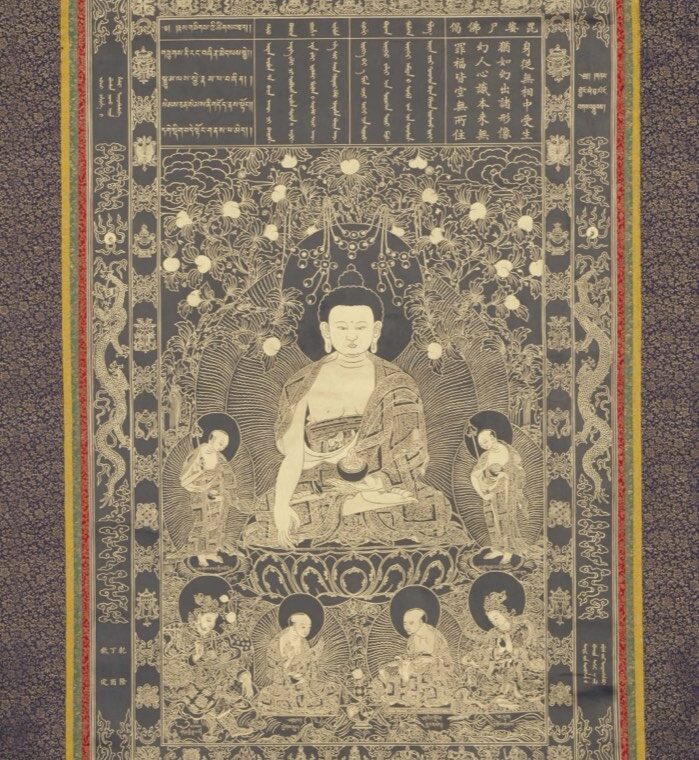
Thangka border documentation starts at the edges, not only at the central deity. Textile surrounds, painted frames, cords, seams, inscription panels, corner wear, and changes in color can clarify how an object was made, mounted, displayed, repaired, or photographed. They can also prevent a common error: treating every detail around a sacred image as original to the same moment and workshop.
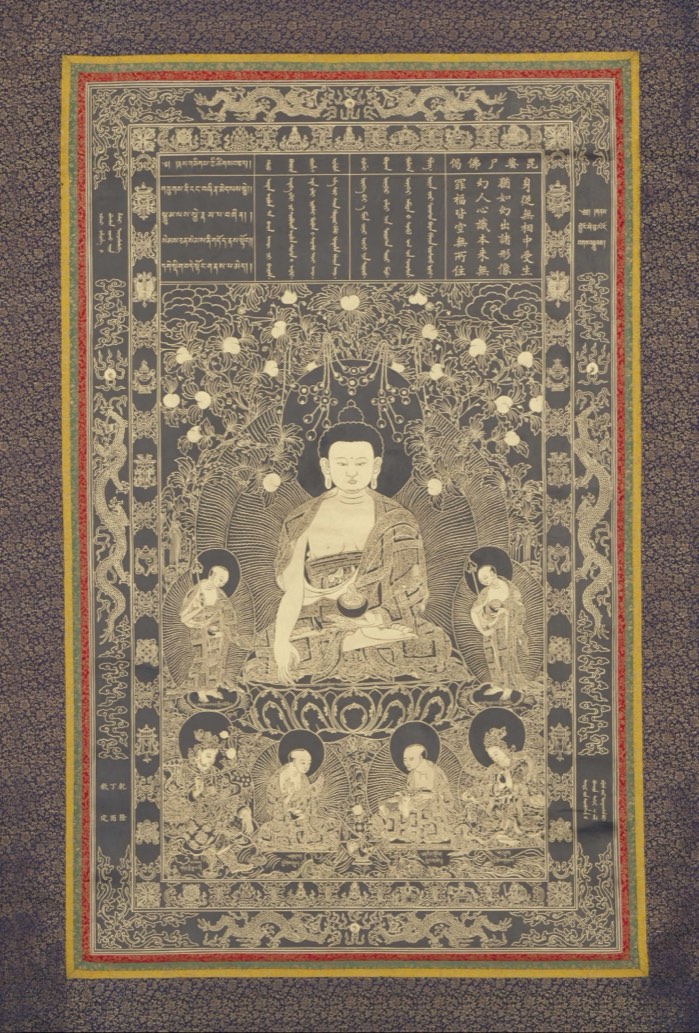
TK1144 is a useful working example. A central seated figure is enclosed by dense gold-line ornament, a red inner band, a wider patterned textile surround, top and side text panels, dragons, and small decorative forms. The edge zones carry as much visual information as the central figure, yet they should be read in layers. Some may belong to the painted composition, some to the textile mounting, and some may reflect later interventions or the way this particular photograph was framed.
Why the border is part of the Thangka
A Thangka is not simply a painting cut to the edge of its iconography. Project Himalayan Art defines a Thangka as a Tibetan hanging scroll, usually painted on cloth and then mounted in a silk brocade surround. The mount supports display, rolling, and handling as well as visual presentation. Its Thangka glossary notes that a wooden dowel at the bottom assists rolling and helps hold the scroll flat when hung.
That principle does not authorize a blanket identification of every border. Himalayan Thangka mounts, Chinese hanging-scroll mountings, Japanese mounting traditions, later museum frames, commercial mats, and digital crops have different histories. The first task is to say what is visible, then distinguish a likely textile surround from a painted border, a modern backing, or an uncertain image edge. Do not assign a material, date, region, or workshop merely because a frame looks familiar.
Read TK1144 from the outside inward
1. The outer patterned surround
The outermost visible field in TK1144 is a dark patterned textile-like surround. Its repeated small motifs form a continuous field outside the inner gold-line image. The color, repeat, and texture suggest a separate surrounding material, but the photograph alone cannot establish fiber, weave, dyes, or whether this portion is original to the central painting. It may be silk, another textile, a printed reproduction, or a photographed surface whose material is uncertain.
Record this zone with its measured visible width on all four sides. If the widths differ, note the difference rather than immediately calling it damage or an alteration. Variation can result from asymmetrical design, cropping, perspective, mounting, camera angle, or a genuinely later repair.
2. Colored bands and inner cords
Inside the outer surround, TK1144 has a narrow yellow-green band and a red band before the main dark field. These bands create a sequence of thresholds: textile or framing zone, colored separator, then iconographic field. In a full object examination, a cord, stitch line, fold, or change in thread direction can help determine where one component ends and another begins. In a digital image, those details may be too small to resolve.
Use neutral language such as “red band,” “yellow-green strip,” or “visible dividing line” unless material evidence is available. Calling a band a silk brocade, sewn cord, or original border is an interpretation that needs support.
3. The gold-line ornamental frame
The dark inner field is bordered by elaborate gold-colored lines: dragons across the top and bottom, cloud-like scrolls, vases, floral forms, and other decorative devices. These marks function as an ornamental frame, but their exact iconographic meanings should not be extracted one motif at a time from a reduced image. A similar-looking dragon, vessel, or lotus may be conventional decoration, a specific donor reference, a ritual emblem, or a later addition.
The practical contribution of the frame is structural. It separates text panels from the central image, controls the viewer’s path, and gives the overall composition a hierarchy. Compare this with the related reading of movement and visual hierarchy in wrathful Buddhist art: borders can slow, contain, or redirect the eye even when the central subject is very different.
4. Text panels are evidence, not instant translations
TK1144 visibly contains several writing systems or script styles. There are vertical columns in the upper field, side panels, and lower areas, but this web-sized image is not adequate for a reliable transcription. A single mistaken character can change a title, date, donor name, lineage reference, or ritual formula. Do not copy text from a blurred screenshot into a catalog record.
Instead, document each panel by position, direction, line count, approximate dimensions, script appearance, color, and legibility. Photograph close details at the highest available resolution and keep the original file. For a careful example of treating multilingual framing without inventing a reading, see Sikhin Buddha Thangka: How Four Languages Frame the Image.
What conservation research adds
Border materials can reveal later repairs as well as original construction. In its conservation study of an appliquéd silk Tibetan Thangka of Kurukulla, the Metropolitan Museum of Art found adhesive-backed fabric used in earlier repairs to lining and border areas. Close examination of the fabric, selvedge, weave, thread count, and color made it possible to separate later material from historic components and to select an adhesive-free replacement. The Met’s conservation account is a useful reminder that a visually harmonious border can still be a later intervention.
Project Himalayan Art likewise describes a finished Thangka being stitched to its brocade mount, with proportional relationships between the central painting, inner border, sides, top, and bottom. Those proportions are useful comparison points, not a measuring rule for every object. A damaged, remounted, cropped, or regionally distinct Thangka may depart from them for many reasons.
A practical Thangka border documentation checklist
- Start with a complete view. Photograph the entire object front and, where appropriate, back, including rods, cords, and any cover.
- Map zones from outside inward. Give each visible surround, colored band, cord, painted frame, text panel, and central image a neutral label.
- Measure visible proportions. Record top, bottom, left, and right widths separately; do not assume symmetry.
- Locate construction evidence. Note seams, stitches, joins, hems, folds, backing changes, rod pockets, and attachment points.
- Record condition by location. Map fraying, losses, abrasion, fading, staining, splitting, creases, detached threads, and old repairs.
- Document text without guessing. Capture panel position, line direction, script appearance, and legibility before attempting transcription.
- Separate image layers. Mark what appears painted, printed, woven, embroidered, or mounted as observed, proposed, or uncertain.
- Compare safely. Use securely documented examples, but do not transfer their date, identity, or material to the object in front of you.
- Preserve the chain of evidence. Link photographs, condition reports, previous mounts, labels, collection records, and treatment documentation to the same object record.
For a condition vocabulary and a damage-first workflow, use our Thangka condition report checklist. The surrounding fabric should also be recorded as its own component; our guide to Buddhist scroll cover fabric explains why external textiles can preserve evidence even when their relationship to the painting is uncertain.
Observed, proposed, and uncertain in TK1144
Observed: a central seated Buddhist figure; upper and side text panels; multiple visible script styles; gold-colored dragons and ornamental forms; a red band; a yellow-green band; a dark patterned outer surround; and several lower figures or attendants.
Proposed only: that the outer surround functions as a textile mounting; that the colored bands divide mounting and painted zones; and that the elaborate frame was designed to organize the composition. These are plausible visual readings, not confirmed technical findings.
Uncertain: the exact figure identity, whether Vipaśyin is correct, text transcriptions and translations, the number and names of lower figures, medium, materials, fiber, weave, date, artist, workshop, school, original dimensions, collection, provenance, conservation history, and whether every visible border belongs to the same historical phase.
Conclusion
Thangka border documentation turns decorative edges into research evidence. By mapping outer textiles, bands, ornamental frames, text panels, construction clues, and condition separately, researchers can make a record that remains useful even when identity and date are uncertain. TK1144 shows why the edges deserve the same disciplined attention as the central image: they carry clues about use, presentation, repair, and the limits of what a photograph can prove.
Download the full Thangka image collection
Continue exploring and download the complete TANGKAWORLD image library from our free downloads page. The full collection helps you compare border systems, textile surrounds, inscriptions, condition details, and central iconography across a wide range of Thangka images.