
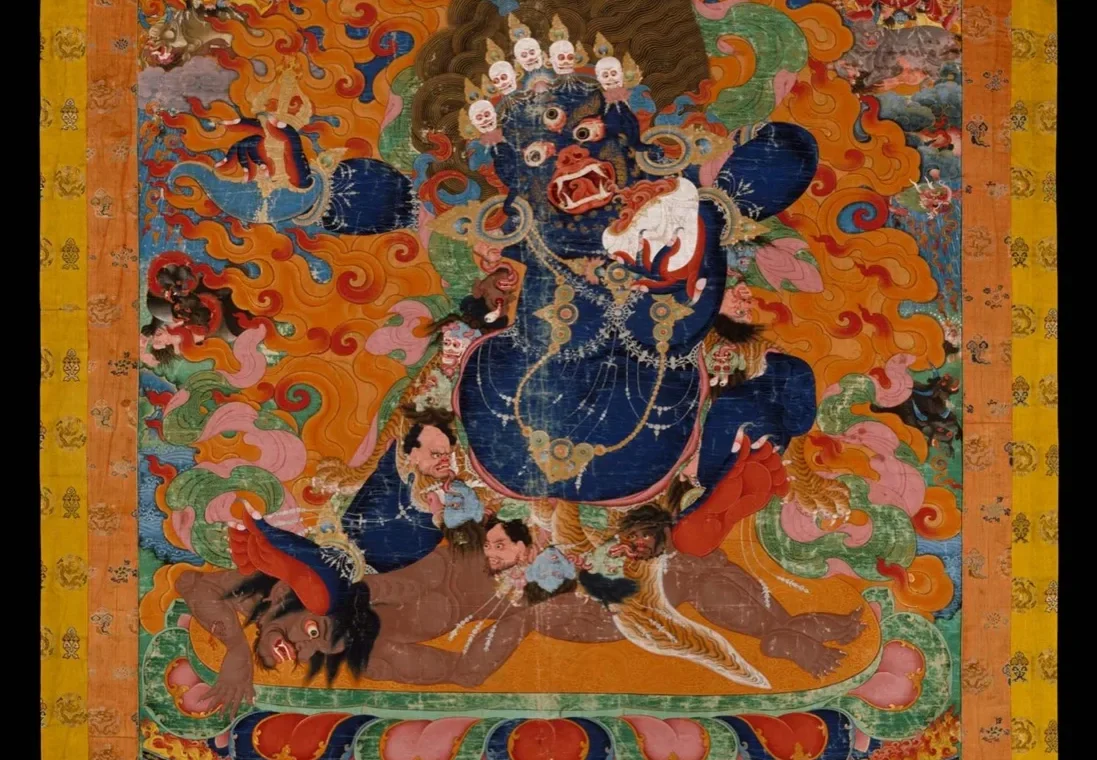
Yama vs Yamantaka is a difficult identification problem because both figures can appear wrathful, dark blue, crowned with skulls, surrounded by flames, and associated with death. Yet they are not interchangeable. Yama is the lord and judge of death in Buddhist visual culture, while Yamantaka—whose name means “Destroyer of Yama” or “Conqueror of Death”—is a wrathful manifestation of Manjushri, the bodhisattva of wisdom. A correct reading therefore depends on more than a fierce face or a buffalo head.
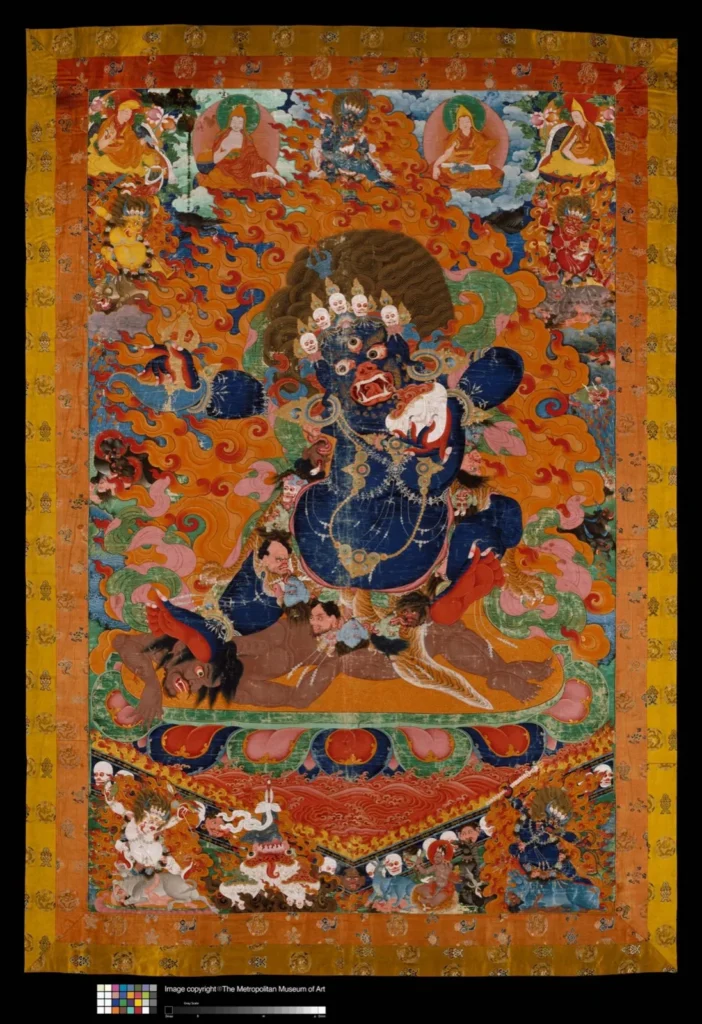
This guide uses TK0482 as a close-looking case study. The local archive title identifies the image as Yama, while the current museum catalog identifies the same painting as Yamantaka. That disagreement is useful: it shows why responsible Thangka research must compare the central figure, subsidiary deities, attributes, inscriptions, provenance, and catalog history before settling on a name.
Yama vs Yamantaka: the essential distinction
Yama entered Buddhist traditions as the ruler of the realm of the dead and a reminder that actions have consequences. In Tibetan art he may appear as a protector, a judge, or a figure within teachings on impermanence and rebirth. His forms vary. Some are buffalo-headed, while others have an ogre-like human face. A skull crown, flayed skin, flames, and a trampled body express his mastery of terrifying forces; they do not by themselves identify one precise form.
Yamantaka belongs to a different conceptual structure. He is the wrathful wisdom that defeats death, usually understood as a fierce form of Manjushri. The iconography turns wisdom into overwhelming force: ignorance, fear, and attachment are confronted in a visual language powerful enough to resemble the obstacle being conquered. Some Yamantaka forms are extraordinarily complex, with many heads, arms, and legs. Others are less elaborate. Counting limbs is therefore helpful, but never sufficient on its own.
The difference can be summarized simply: Yama personifies or governs death; Yamantaka conquers Yama and symbolizes wisdom overcoming death. Confusion arises because artists intentionally use related visual signals. A buffalo head can point toward Yama, toward Yamantaka’s victory over Yama, or toward a member of a retinue. Context decides.
What TK0482 actually shows
TK0482 centers on a dark blue wrathful figure with three eyes, a skull crown, bared teeth, and flame-like hair. The figure stands in a blaze above a prostrate body. One hand raises a curved chopper; another holds a skull cup. A tiger skin and a garland of severed heads intensify the charnel-ground imagery. Smaller wrathful figures surround the center, while teachers sit in the upper register.
Those details create a coherent protector image, but they do not make the title self-evident. The chopper cuts delusion, the skull cup transforms what is feared or rejected, and the flames indicate awakened activity. Similar attributes occur in several wrathful deities, including Mahakala and Vajrapani. Iconographic identification works through combinations, not isolated symbols.
Why the retinue matters
The smaller figures are especially important. The current Metropolitan Museum of Art record for object 69.71 identifies the central deity as Yamantaka and describes five surrounding “Yama-conquerors.” It also dates the painting to the early eighteenth century and identifies its culture as Tibetan. The upper teachers are proposed as the Panchen Lama and Atisha, but that identification is tentative. “Tentative” is meaningful catalog language: it marks a reasoned possibility, not a proven fact.
The local bilingual archive preserves the English title “Yama” with TK0482. Rather than choosing one label and hiding the other, the most accurate record keeps both pieces of evidence visible. The current museum attribution is the strongest available identification for the artwork, while the archive title remains part of its digital documentation history.
How to identify Yama in a Thangka
Begin by asking what role the figure performs. A Yama image often emphasizes death, judgment, karmic consequence, protection, or the impermanence of worldly life. Buffalo-headed forms may stand with a consort, wield a skull-topped club or other implements, and trample an animal or human figure. Ogre-faced forms may instead carry a chopper and skull cup. Lineage-specific variations mean that no single checklist applies universally.
Look next for supporting figures and inscriptions. A composition tied to the Wheel of Life, judgment scenes, or a known protector cycle provides a stronger Yama context than a buffalo head alone. If a reverse inscription, consecration text, donor record, or historical inventory survives, it may outweigh a modern visual guess. Our beginner’s guide to reading a Thangka explains how the central deity, registers, offerings, landscape, and lineage figures work together.
How to identify Yamantaka iconography
For Yamantaka, look for evidence connecting the wrathful form to Manjushri and to the conquest of death. A buffalo face may be accompanied by additional heads, including a peaceful head associated with Manjushri. Multiple arms hold ritual weapons and implements; multiple legs subdue an array of beings and obstacles. In the most elaborate Vajrabhairava forms, the multiplication of heads, arms, and legs makes the figure visually unmistakable. Simpler forms require more contextual evidence.
The lineage above the deity can also be decisive. Teachers may connect a painting to a particular transmission or practice cycle. A surrounding group of Yama-conquerors, as described in the museum record for TK0482, supports a Yamantaka reading because the retinue expresses the central theme of overcoming death. When studying details at full scale, use the methods in our guide to high-resolution Thangka iconography: inspect the central face, then hands, feet, retinue, upper register, and inscriptions in a fixed order.
A practical identification checklist
1. Record the source label exactly
Copy the title, TK number, museum accession number, date, and source as given. Do not modernize a name silently. If two catalogs disagree, retain both labels and note which source is current.
2. Describe before interpreting
Write down observable features: face type, number of heads, eyes, arms, and legs; hand implements; animals or bodies underfoot; consort; flames; attendants; teachers; and inscriptions. Description prevents an early guess from controlling everything that follows.
3. Read attributes as a set
A skull cup is not a name tag. Neither is a chopper, flame halo, skull crown, or buffalo head. Compare the full cluster of attributes with reliable iconographic references and closely related works.
4. Inspect the hierarchy
The largest figure is usually the compositional focus, but the upper lineage and surrounding retinue can reveal the intended practice. Ask whether the smaller figures repeat, oppose, empower, or transmit the central deity.
5. Separate identity from condition
Abrasion, darkened varnish, retouching, cropped borders, and low-quality reproduction can hide crucial features. Use a visual condition checklist before treating a missing attribute as evidence that it never existed.
6. State uncertainty precisely
Use language such as “current catalog identification,” “possibly,” “tentatively identified,” or “uncertain.” For TK0482, Yamantaka is supported by the current museum record; the archive title Yama is documented but should not be presented as the only uncontested identification.
Common mistakes when comparing Yama and Yamantaka
The first mistake is equating every buffalo-headed deity with Yama. The second is assuming that every multi-armed wrathful deity is Yamantaka. A third is translating theological meaning directly into a visual label without checking the composition. “Conqueror of death” explains Yamantaka’s name, but it does not eliminate the need to identify the depicted form.
Another mistake is treating museum titles as timeless. Catalog records change when curators compare inscriptions, lineages, related paintings, and newer scholarship. Digital archives may preserve older titles long after a museum updates its record. Good collection research records the date and authority of each label, then explains the discrepancy. This approach makes a catalog more useful, not less certain.
Image files also travel separately from their catalog records. A filename may reflect an older exhibition label, a donor’s description, a broad subject heading, or a translation chosen for an earlier database. Once copied into another archive, that label can look definitive even when its original context has disappeared. Researchers should therefore match the visible image to stable identifiers such as an accession number, dimensions, composition, and institutional record. TK0482 can be connected to museum object 69.71 through those shared details. That match explains the naming history without pretending that the filename alone settles the deity’s identity.
Conclusion: identify the relationship, not one dramatic feature
The most reliable way to solve Yama vs Yamantaka is to identify relationships: the central deity’s full attribute set, the beings underfoot, the surrounding retinue, the teachers above, and the record attached to the object. TK0482 demonstrates why this matters. Its archive title says Yama, while the current museum catalog supports Yamantaka and interprets the surrounding figures as Yama-conquerors. The responsible conclusion is transparent: use the current Yamantaka attribution, preserve the historical Yama label, and keep tentative details marked as uncertain.
Wrathful Thangka imagery is precise rather than chaotic. Flames, skulls, weapons, and trampling figures form a visual grammar in which fierce appearance serves wisdom and protection. Reading that grammar patiently is more dependable than recognizing one memorable symbol.
Download the full Thangka image collection
Continue browsing and download the complete TANGKAWORLD image collection on our free Thangka downloads page. Use the high-resolution images to compare deity attributes, retinues, inscriptions, and painting details across the full gallery.