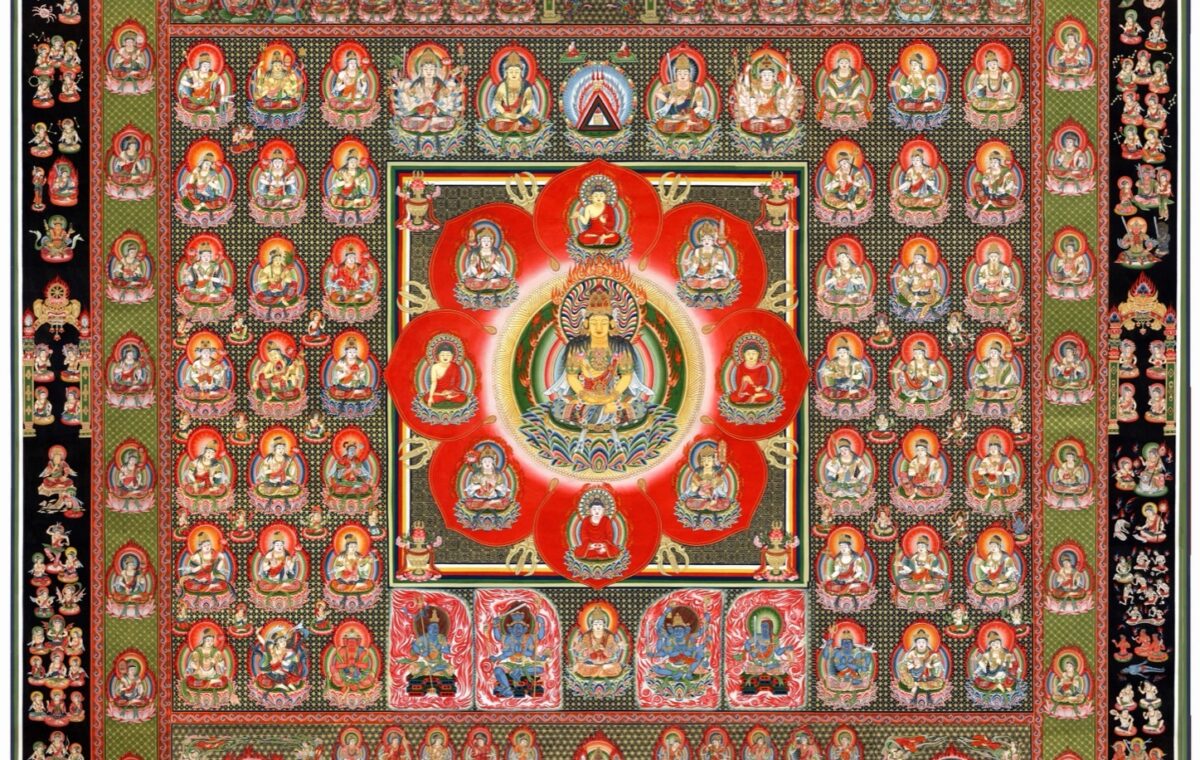
A Womb Realm Mandala is not simply a dense chart of Buddhist figures. It is a carefully ordered visual field in which a central awakened presence expands into courts, families, guardians, bodhisattvas, and ritual relationships. The composition is often called the Womb World Mandala, Garbhadhatu Mandala, or Taizokai Mandala. These names refer to a shared tradition, although individual paintings, prints, and ritual copies may differ in layout and detail.
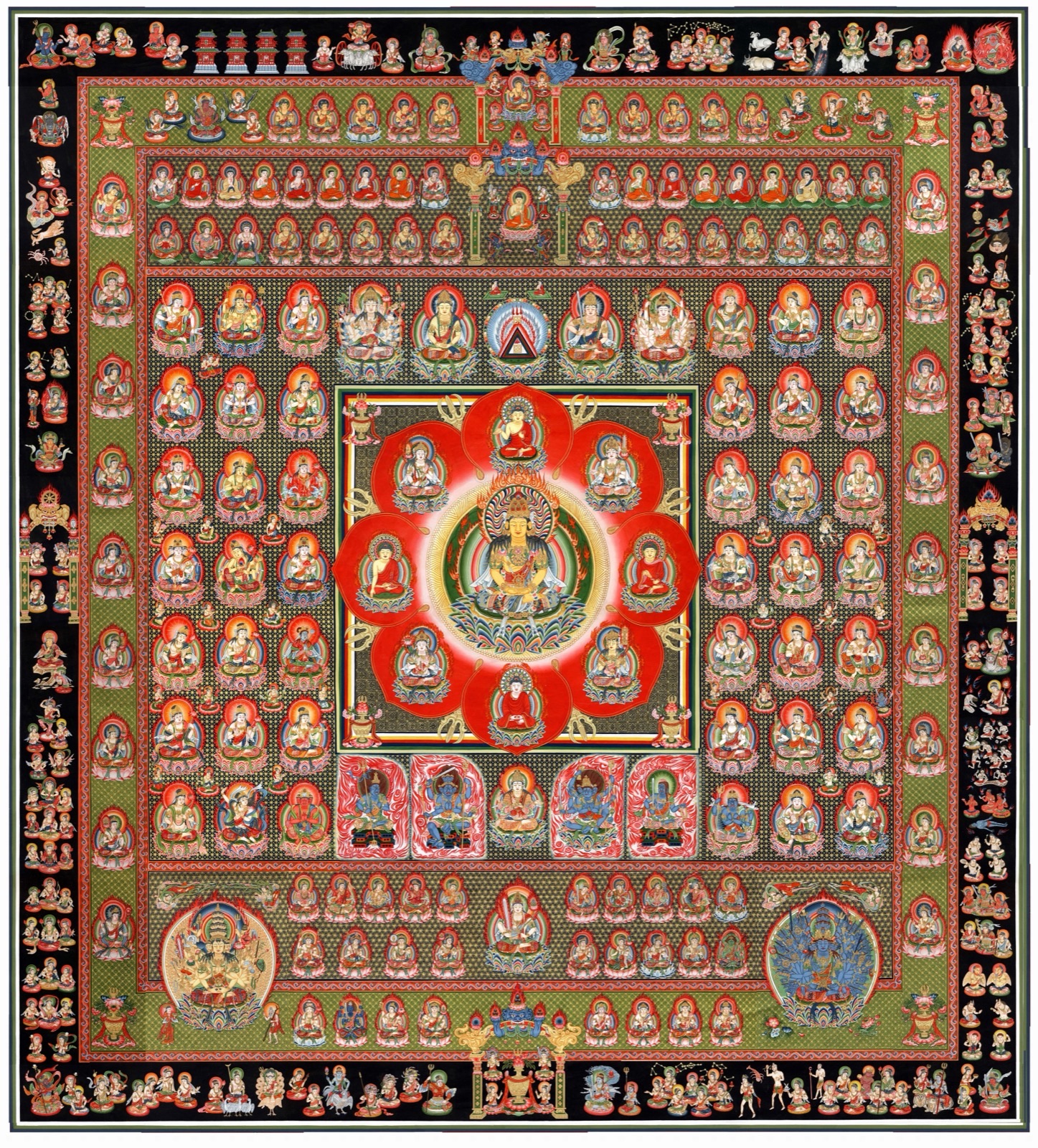
TK0570 is catalogued in the TANGKAWORLD library as a Womb Realm Mandala. The large image presents a central lotus assembly within multiple rectangular zones and a crowded outer border. Its file record does not establish the artist, date, temple, ritual lineage, or provenance, so those details remain uncertain. The safest way to study it is to identify the structural principles first, then treat individual names as provisional unless inscriptions or a reliable catalogue confirm them.
Womb Realm Mandala identification at a glance
Start with geometry before counting figures. Common clues include:
- A central lotus or lotus-like enclosure organized around Mahavairocana.
- Multiple surrounding courts rather than one simple palace square.
- Rows of Buddhas, bodhisattvas, wisdom figures, and guardians arranged by function.
- Strong axial order connecting center, cardinal directions, gateways, and borders.
- A visual movement from concentrated awakening at the center toward diverse compassionate activity at the edges.
- Association with the Diamond Realm Mandala as a complementary ritual and doctrinal image.
Not every complex Buddhist diagram is a Womb Realm Mandala. A Kalachakra Mandala usually emphasizes a geometric palace with nested levels and symbolic architectural features. A Medicine Buddha Mandala centers a healing Buddha and retinue. A Womb Realm identification depends on the central lotus assembly and the organization of characteristic courts.
What does “Womb Realm” mean?
The English term “Womb Realm” translates a name that evokes generation, nurture, potential, and the unfolding of awakening. It should not be read as a literal anatomical diagram. In the visual tradition, the central source of awakened wisdom manifests outward through many forms suited to different beings and circumstances. The result is both cosmic and practical: a map of relationships used in ritual, contemplation, teaching, and initiation.
The mandala is closely associated with the Mahavairocana tradition and became especially important in East Asian esoteric Buddhism. In Japanese contexts it is commonly known as the Taizokai Mandala and is paired with the Kongokai, or Diamond Realm Mandala. The British Museum, for example, catalogues an Edo-period hanging scroll as a “mandala of the Womb World,” showing that the design circulated across media and periods rather than belonging to one single surviving original.
Begin at the central lotus
Mahavairocana at the center
The visual and doctrinal center is Mahavairocana, also called Vairocana or Dainichi Nyorai in Japanese contexts. He represents universal awakened illumination rather than a historical event from the life of Shakyamuni Buddha. Body color, hand gesture, crown, and costume can vary across versions, so the central placement is as important as any single attribute.
TK0570 shows a large central enthroned figure within a red lotus-like arrangement. Surrounding petals hold additional Buddhas or bodhisattvas. Before assigning each name, note the direction, gesture, color, and object. If the digital file lacks readable inscriptions, describe them as surrounding figures rather than guessing.
The eight-petal arrangement
The central enclosure is often called the Central Eight-Petal Hall. Its lotus geometry expresses a unified center opening into differentiated awakened forms. In a clear ritual copy, the eight surrounding figures may be identified individually through established iconographic charts. In a general web image, however, tiny details can be lost. The reliable observation is the petal structure itself and its role as the mandala’s organizing heart.
How to move through the surrounding courts
After examining the center, move outward one zone at a time. Do not jump randomly between attractive figures. Each court gathers deities by role, textual association, or ritual function. The exact number and naming of courts can depend on the version and scholarly convention, but the reading method remains stable.
First ring: immediate awakened family
Study the figures nearest the central lotus. Their scale, halo, seat, mudra, and direction show how the central principle unfolds. Record repeated colors and gestures. Symmetry may reveal pairs even when names are uncertain.
Middle courts: bodhisattvas and specialized activity
Further out, rows of bodhisattvas, wisdom figures, and deities represent forms of compassion, knowledge, protection, and ritual action. A figure holding a lotus, sword, vajra, wheel, or vase should be described by the object before being named. The same attribute can appear in more than one iconographic setting.
Outer courts and guardians
Outer zones often contain guardians, directional figures, celestial beings, and a wider sacred community. Their placement marks a transition between the ordered ritual world and ordinary space. Fierce expressions at the border protect the mandala; they do not indicate moral evil. In TK0570, the crowded black border and lower register greatly expand the assembly, but the file alone does not confirm every identity.
Womb Realm and Diamond Realm Mandalas
The Womb Realm Mandala is frequently presented with the Diamond Realm Mandala. The pair should not be reduced to a simplistic opposition. Broadly, the Womb Realm emphasizes the generative unfolding and compassionate expression of awakening, while the Diamond Realm emphasizes indestructible wisdom and systematic realization. Ritual interpretation is more precise within a specific lineage, teacher, and text.
When two mandalas hang together, their relative placement, orientation, and use matter. A museum photograph may reverse an installation or crop out labels, so avoid reconstructing ritual placement from an isolated image. If a work is identified only as “mandala,” compare its central assembly and court structure before deciding which realm it represents.
Womb Realm Mandala versus other mandalas
Compared with the Kalachakra Mandala
The Kalachakra Mandala usually reads as a multi-level palace built from precise geometric walls, gates, and internal zones. The Womb Realm is also ordered, but its identity is strongly tied to the central lotus and surrounding deity courts.
Compared with a deity mandala
A deity mandala may place one meditational deity and a compact retinue inside a palace. The Womb Realm encompasses a much broader sacred universe. Scale alone is not decisive; the pattern of courts and central Mahavairocana assembly matters most.
Compared with a narrative Buddhist painting
Narrative paintings guide the eye through episodes, landscapes, or repeated appearances of a protagonist. A mandala organizes relationships around a ritual center. Even when TK0570 contains hundreds of figures, their placement is not a chronological story.
A practical Womb Realm visual checklist
- Find the geometric and visual center before naming any figure.
- Check for a central lotus with a principal Buddha and surrounding petals.
- Map the nearest, middle, and outer courts as separate zones.
- Record direction, color, mudra, seat, and attribute for each figure studied.
- Look for paired documentation connecting the image with the Diamond Realm.
- Distinguish court structure from the palace geometry of Kalachakra.
- Use inscriptions or authoritative iconographic charts for individual names.
- Mark artist, date, school, installation, and provenance as uncertain when undocumented.
How to describe a complex mandala responsibly
Use layers of certainty. A strong first sentence might read: “Complex Buddhist mandala organized around a central lotus assembly, catalogued as the Womb Realm Mandala.” Then describe visible structure: “Mahavairocana occupies the center, with surrounding petal figures, multiple rectangular courts, guardians, and an extensive border assembly.” Finally state limits: “Individual outer figures, date, maker, and ritual provenance are uncertain in the available file.”
This approach makes the description valuable even when the reproduction is too small for complete iconographic identification. It also prevents a common error: copying a standard diagram’s labels onto a painting that may preserve a different version.
Conclusion
The clearest way to read a Womb Realm Mandala is from center to edge: Mahavairocana, the central lotus, immediate family, surrounding courts, guardians, and border. Geometry establishes the map, while attributes and inscriptions refine individual identifications. For readers new to sacred painting structure, our beginner’s guide to reading a Thangka provides a useful foundation.
Sources and further reading
- Himalayan Art Resources: comparative records for Womb Realm Mandala
- The Kagawa Museum: Mandala of the Two Realms (collection record)
These references support comparative iconographic study. The TANGKAWORLD TK number is an internal catalogue identifier; artist, date, collection history, and provenance remain uncertain unless separately documented.
Download the full Thangka image collection
Continue exploring and download the complete TANGKAWORLD image library from our downloads page.