
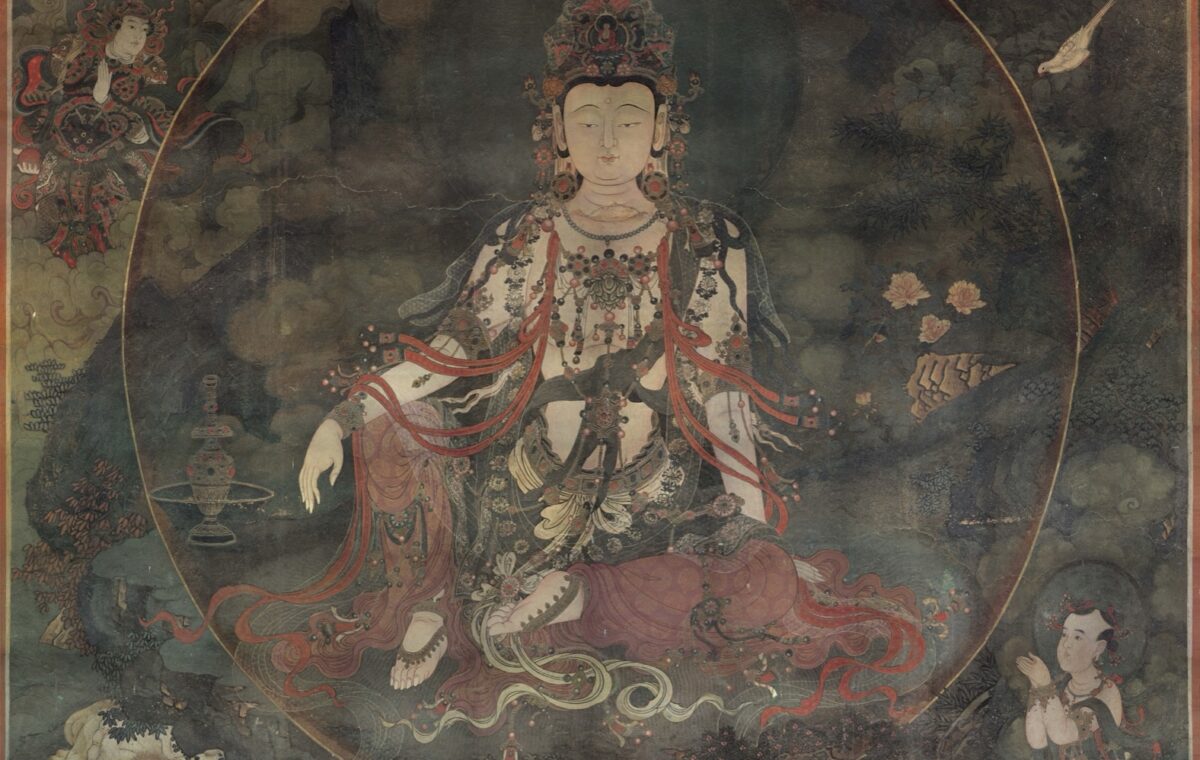
Water-Moon Avalokiteshvara is recognized less by a single handheld object than by a complete poetic setting: the bodhisattva sits at ease beside water and rock, enclosed by a luminous moon-like halo, attended by figures and animals, and surrounded by a landscape that turns contemplation into visible form. The celebrated Fahai Temple mural brings this image into a monumental Ming-dynasty ensemble whose fine line, mineral color, gold detail, and carefully controlled atmosphere reward slow looking.
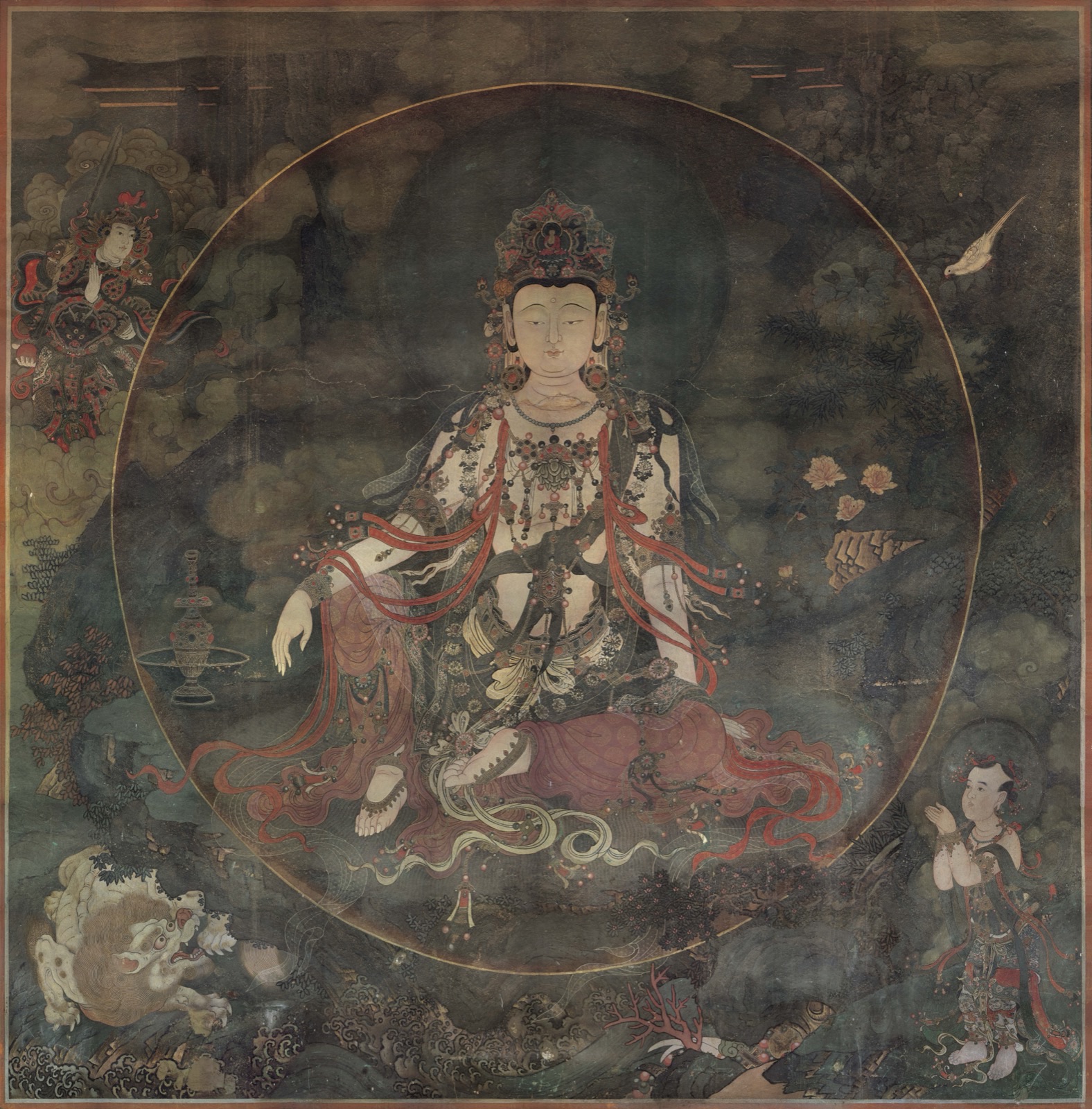
TK0745 is catalogued in the TANGKAWORLD library within the Fahai Temple Water-Moon Avalokiteshvara group. It shows the seated bodhisattva inside a great circular halo, accompanied by a youthful worshipper, a guardian figure, animals, waves, coral, flowers, and a ritual vessel. The digital file does not establish whether it is a direct photograph, a reproduction, or a later copy of the mural. Its immediate object history is therefore uncertain, even though its visual relationship to the famous Fahai composition is clear.
Water-Moon Avalokiteshvara identification at a glance
Read the environment and pose together. Common features include:
- Avalokiteshvara seated in royal ease, with one knee raised and the body relaxed.
- A large circular halo that suggests the moon’s full disc.
- Water, waves, shoreline, rock, or a grotto-like landscape.
- A crown bearing a small image of Amitabha, although the detail may be tiny.
- Rich jewelry, flowing scarves, and a fine transparent veil.
- A water vessel, willow, lotus, coral, bamboo, or other symbolic landscape elements.
- Attendants such as the boy Sudhana and a guardian or transformed local deity, depending on the version.
- Animals and natural motifs arranged within a contemplative cosmic setting.
The relaxed pose and moon disc are the strongest initial clues. A crowned bodhisattva seated stiffly on a lotus may be another form of Avalokiteshvara. A landscape alone is also insufficient; Water-Moon imagery depends on the union of figure, pose, halo, and watery environment.
Fahai Temple and its Ming-dynasty murals
Fahai Temple stands in Beijing’s Shijingshan District. Official Beijing sources describe its surviving murals as authentic Ming-dynasty works and among the oldest and best-preserved palace-style murals in the city. They cover a large area inside the temple and have survived for nearly six centuries. The murals are now viewed under protective conditions, while an associated art center presents high-resolution digital interpretation.
The Water-Moon Avalokiteshvara is one of the ensemble’s best-known figures. Official descriptions emphasize the exceptional rendering of the transparent gauze veil, fine gold work, natural mineral pigments, and minute details that can be difficult to see under normal illumination. For current visitor and preservation information, consult the Shijingshan District government’s Fahai Temple page.
Historical importance does not remove the need for object-level caution. A digital image may reproduce the mural, a collotype, a reconstruction, or a related painted copy. Unless a file includes photography and rights metadata, describe what is visible and identify the source relationship without claiming that the web image is the original wall surface.
How to read the bodhisattva’s pose
Royal ease
Water-Moon Avalokiteshvara commonly sits in a posture called royal ease. One leg is folded while the other is raised or descends, and an arm may rest naturally on the lifted knee. This asymmetry creates a calm presence that is neither formal meditation nor dynamic dance. It suggests alert repose: the bodhisattva is at ease but attentive to the suffering world.
The head and crown
A small Buddha image in the crown often identifies Avalokiteshvara through the connection with Amitabha. In TK0745, the crown is elaborate and contains a small seated figure, although compressed reproductions can make the identity hard to verify. Describe it first as a small Buddha in the crown; identify it as Amitabha only when the iconographic context and detail support that reading.
Jewelry and transparent veil
The bodhisattva wears necklaces, armlets, earrings, and layered textiles rather than the simple robes of a historical monk. The transparent veil is especially famous in the Fahai mural. Fine painted lines and gold create a fabric that seems almost weightless over the body. This virtuosity is not merely decoration: it distinguishes celestial presence while allowing the underlying form to remain visible.
The moon halo, water, and landscape
The circular halo dominates the composition. It functions as a sign of sanctity and evokes the moon reflected on water, a long-standing metaphor for appearance, clarity, and the relationship between awakened reality and the changing world. The image should not be reduced to a literal nighttime scene. Its moon and water belong to a contemplative visual language.
Below and around the figure, rocks, waves, coral, flowers, bamboo, birds, and animals construct an idealized sacred environment. TK0745 includes a lion-like creature at lower left, an aquatic or dragon-like form at lower right, and a bird near the upper edge of the halo. Exact species or mythic identities should remain uncertain unless supported by the mural’s scholarly documentation.
A ritual vessel placed near Avalokiteshvara may allude to purified water and compassionate response. In other Water-Moon images, a willow branch may accompany the vessel. Absence of one object does not invalidate the identification because versions vary and damage or cropping can remove details.
Attendants and narrative clues
A youthful worshipper often represents Sudhana, the pilgrim of the Gandavyuha tradition, approaching Avalokiteshvara during his search for wisdom. A guardian figure may appear on the opposite side, contributing to a balanced devotional encounter. In TK0745, a small figure kneels at lower right while an armored figure appears at upper left. These placements support a narrative and devotional reading, but individual names should be presented carefully if no inscription accompanies the file.
The attendants also clarify scale. Avalokiteshvara is monumental and calm, while the smaller figures turn toward the center. Their gestures direct the viewer’s attention and model reverence. This is a useful recognition principle: iconography is carried not only by what the main figure holds but by how every surrounding figure responds.
Water-Moon Avalokiteshvara compared with other forms
Four-Armed Avalokiteshvara
Four-Armed Avalokiteshvara is usually seated frontally with two central hands joined at the heart and outer hands holding a lotus and mala. Water-Moon Avalokiteshvara normally has two arms and a relaxed landscape pose. Compare the hand arrangement in our Four-Armed Avalokiteshvara guide.
Thousand-Armed Avalokiteshvara
The thousand-armed form is organized around multiple arms, eyes, and heads, expressing compassion reaching in every direction. The Water-Moon form communicates compassion through repose, reflection, and encounter. See Thousand-Armed Avalokiteshvara symbols.
White Tara
White Tara is usually seated on a lotus and recognized by seven eyes, including eyes on the palms and soles. A white or pale body alone can cause confusion in faded reproductions. Count limbs and eyes, then check the royal-ease pose, crown Buddha, moon halo, and landscape.
A practical Water-Moon visual checklist
- Confirm a crowned bodhisattva seated in a relaxed royal-ease posture.
- Look for the large circular moon-like halo.
- Check the crown for a small Buddha image.
- Read water, rock, vessel, bamboo, animals, and landscape as a connected setting.
- Note transparent textiles, jewelry, gold detail, and fine line work.
- Study attendants by gesture and placement before assigning names.
- Compare the two-armed relaxed form with four- and thousand-armed Avalokiteshvara.
- Separate the historic mural from the uncertain status of any digital reproduction.
Conservation and responsible digital viewing
Wall paintings are inseparable from their architecture, surface preparation, pigments, repairs, light exposure, and visitor environment. Official information notes that access to the original Fahai murals is controlled and that high-resolution displays and reproductions help reduce pressure on the fragile works. A web image is valuable for study, but it cannot reproduce scale, wall curvature, surface texture, or the changing visibility of gold under directed light.
When saving research notes, record the image source, TK number, download date, visible crop, and uncertainty about reproduction type. Do not apply aggressive color correction and then treat the result as evidence of original pigment. Digital contrast may reveal details while simultaneously distorting the mural’s tonal relationships.
Conclusion
Water-Moon Avalokiteshvara at Fahai Temple is read through an entire visual ecology: royal-ease pose, crown Buddha, moon halo, transparent veil, water, rock, vessel, attendants, animals, and luminous ornament. The image demonstrates how Buddhist iconography, Ming court painting technique, landscape, and conservation history meet in one composition. For foundational reading methods, continue with How to Read a Thangka.
Sources and further reading
- Himalayan Art Resources: comparative records for Water-Moon Avalokiteshvara
- The Metropolitan Museum of Art: Water-Moon Avalokiteshvara (object record)
These references support comparative iconographic study. The TANGKAWORLD TK number is an internal catalogue identifier; artist, date, collection history, and provenance remain uncertain unless separately documented.
Download the full Thangka image collection
Continue browsing and download the complete TANGKAWORLD image library from our downloads page.