
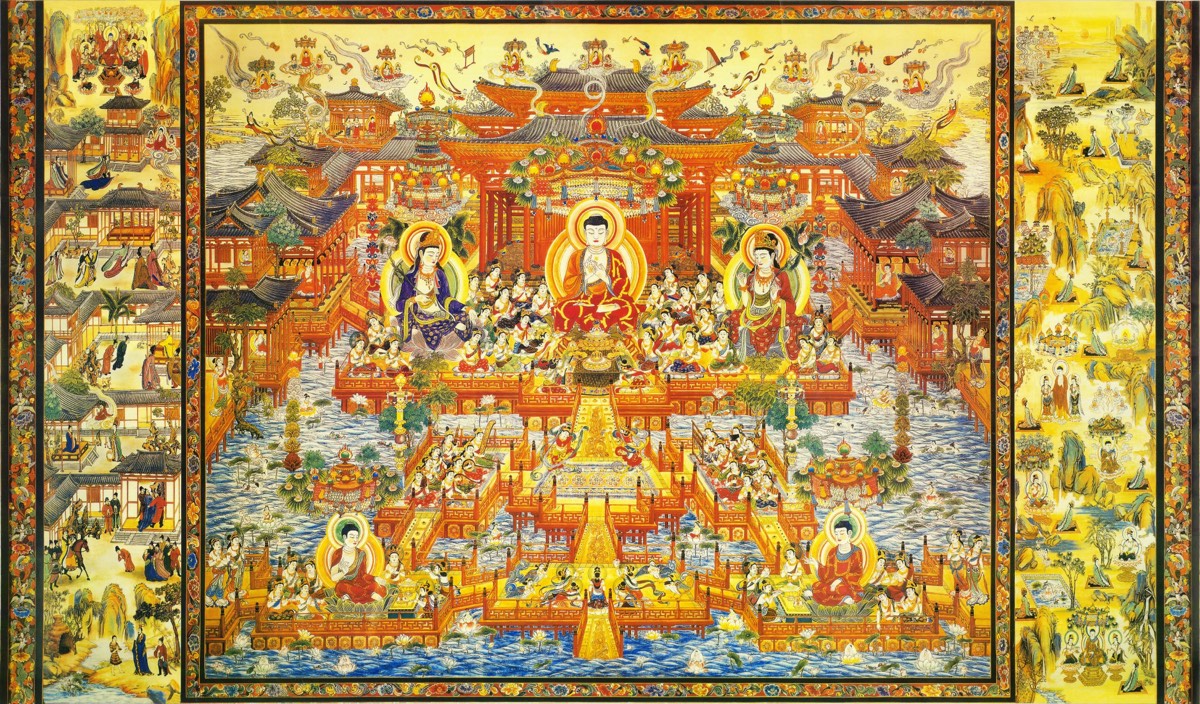
An Amitabha Pure Land painting is designed as a complete sacred environment, not merely a portrait of one Buddha. Amitabha presides over Sukhavati, the Western Pure Land, while palaces, lotus pools, bridges, attendants, musicians, rebirth scenes, and narrative episodes translate a doctrinal realm into an image that can be explored. The crowded surface is therefore purposeful: scale, symmetry, and placement tell the viewer where to begin and how to move through the vision.
This guide uses TANGKAWORLD image TK0271, catalogued as Western Pure Land, as a visual case study. Its central assembly, architectural terraces, lotus-filled water, upper celestial groups, and side panels make the subject credible. However, its artist, date, school, exact region, collection history, and original source are uncertain. Individual small figures and side episodes should not be named without better documentation or legible inscriptions.
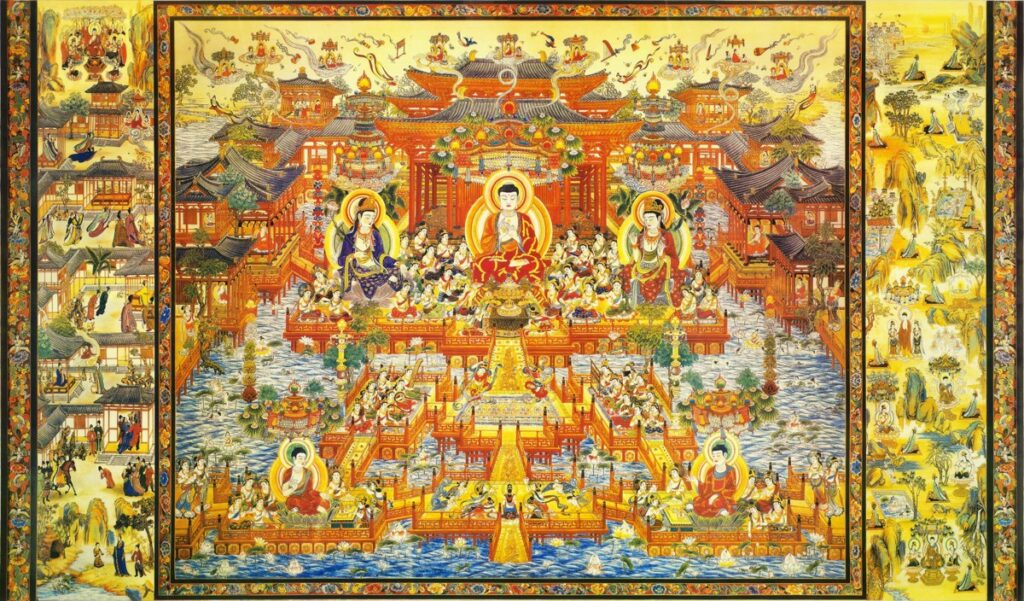
What is an Amitabha Pure Land painting?
Amitabha is the Buddha associated with Sukhavati, the Pure Land of the west. Paintings of this realm often place him at the center of an ordered paradise where teaching, music, offering, architecture, landscape, and lotus rebirth coexist. The image is both iconic and spatial: it presents a Buddha for devotion and a world structured around his presence.
Museum examples show how flexible the format can be. The Metropolitan Museum of Art’s Taima Mandala describes a vast palace and golden pond surrounded by celestial beings and narrative scenes. A Tang-dynasty Western Pure Land painting at the British Museum similarly combines Amitabha, attendant bodhisattvas, architectural platforms, a lotus tank, musicians, rebirth imagery, and side narratives. TK0271 belongs to this broad visual family, although it must not inherit either museum object’s date or provenance.
Start with the central Amitabha triad
The visual center of TK0271 is a large seated Buddha beneath a decorated canopy. Two crowned bodhisattvas sit or stand prominently to either side, forming the principal triad. In many East Asian Pure Land compositions, these attendants are Avalokiteshvara and Mahasthamaprapta. Their presence balances compassion and spiritual power around Amitabha, but exact left-right identification can vary with format and regional convention.
Read the hierarchy before the attributes. Amitabha is largest, centrally aligned, and positioned on the main axis extending from the foreground bridge through the altar and into the palace. The attendants are slightly smaller but far larger than the surrounding assembly. This use of scale is a strong identification clue even when hand gestures or crown emblems are too small to read. For a closer study of one attendant’s better-known forms, compare our Four-Armed Avalokiteshvara iconography guide; do not assume that every Pure Land Avalokiteshvara has four arms.
How the palace organizes the Western Pure Land
Architecture as sacred order
In TK0271, red-pillared halls, roofs, balustrades, platforms, and bridges form a symmetrical enclosure around the central assembly. The architecture is not a realistic plan of a known earthly temple. It makes the Pure Land legible as an ordered realm: Amitabha occupies the highest-value central position, while attendants and secondary assemblies extend outward in balanced tiers.
Follow the centerline from bottom to top. The foreground bridge crosses water and leads toward successive platforms. The central altar then points to Amitabha’s throne, while the palace roofs rise behind him. This sequence creates visual movement from the viewer’s space into the sacred assembly. It differs from the nested diagrammatic logic of a tantric Womb Realm Mandala. Both are ordered sacred worlds, but a Pure Land painting often reads as inhabited landscape and palace rather than a plan viewed from above.
Water, bridges, and lotus platforms
A blue lotus pond fills much of TK0271’s lower and middle field. Bridges link platforms across the water; blossoms and small figures occupy the pond. In Pure Land art, the lotus can signify purity and rebirth, and museum catalogues describe souls emerging from lotus buds in the paradisal lake. Yet every tiny lotus figure in TK0271 cannot be securely identified at the available scale. The correct catalogue note is “probable lotus-rebirth imagery,” followed by the limits of the evidence.
Repeated railings and platforms create depth without using a single Western-style vanishing point. The result is a realm that is simultaneously panoramic, hierarchical, and accessible to close reading.
Assemblies, music, and celestial abundance
Rows of small figures gather around the principal triad and on lower platforms. Some appear seated in worship or listening; others occupy procession-like groups. Instruments, banners, canopies, offerings, birds, and airborne figures communicate abundance and continuous activity. A Pure Land is not pictured as an empty landscape but as a realm filled with teaching, praise, and auspicious presence.
Compare this structure with the elder-centered groups discussed in our guide to Arhat paintings. Arhats are identifiable through monastic dress, individualized faces, attendants, and landscape settings. The miniature assemblies in TK0271 are too small to label collectively as Arhats. Their role in the composition is clearer than their individual identities: they amplify Amitabha’s central authority and populate the sacred realm.
Why the side panels matter
TK0271 has narrow narrative registers on both sides of the main paradise scene. The left side is arranged through architectural episodes; the right side uses landscape settings with teachers, worshippers, and visionary groups. This combination of central icon and side narrative is a known feature of Pure Land imagery. The side scenes can connect a timeless paradise with stories, contemplative practices, or events that explain access to it.
The specific episodes in TK0271 remain uncertain. The British Museum’s documented example includes stories associated with Queen Vaidehi and the visualization tradition, but visual similarity does not prove that every side panel in TK0271 illustrates the same textual sequence. A responsible reading records the narrative format, checks inscriptions if available, compares complete iconographic programs, and avoids assigning names from one museum painting to another without evidence.
Amitabha is not the same cataloguing label as Amitayus
Amitabha and Amitayus are closely related in Buddhist traditions, and museum records sometimes discuss overlap between the names. For precise TANGKAWORLD cataloguing, however, the visual forms should not be collapsed. Amitabha is the appropriate label for the Buddha presiding over the Western Pure Land in TK0271. Amitayus is used for the longevity form, typically shown as a crowned bodhisattva-like figure holding a long-life vase.
Our Amitayus Thangka guide explains the vase, crown, ornaments, and meditation posture that distinguish that imagery. A central Buddha in red monastic robes, surrounded by a Pure Land palace and lotus pond, answers a different search and cataloguing question. Maintaining that distinction prevents the Western Paradise subject from competing with an existing longevity-iconography page.
How to distinguish a Pure Land painting from a Mandala
Both formats can include symmetry, a central sacred figure, concentric zones, gates, and large retinues. The difference lies in how space functions. A Mandala is generally a ritual diagram of a deity’s palace and ordered cosmos, often read through geometric boundaries and directional gates. An Amitabha Pure Land painting presents paradise as an inhabited visionary landscape, with pools, bridges, pavilions, worshippers, musicians, and narrative time.
The distinction is not always absolute, especially when titles use “mandala” broadly. Start with visible evidence. Does the composition emphasize a top-down geometric palace, as in a Medicine Buddha Mandala? Or does it invite the eye through landscape depth, architectural terraces, a lotus pond, and surrounding stories? TK0271 strongly supports the second reading.
Amitabha Pure Land painting identification checklist
- Locate the center: Look for Amitabha as the largest Buddha on the main vertical axis.
- Check for a triad: Two prominent bodhisattvas may flank him; identify them only when attributes or documentation support the names.
- Read the setting: Palaces, pavilions, terraces, bridges, and jeweled-looking ornament suggest a paradisal realm.
- Find the lotus pond: Water, lotus platforms, and probable rebirth figures are strong Pure Land clues.
- Study the assembly: Attendants, worshippers, musicians, offerings, birds, and celestial groups convey abundance.
- Inspect the borders: Side panels may preserve narrative or contemplative sequences, but their exact stories require evidence.
- Separate related forms: Do not relabel an Amitabha paradise as an Amitayus longevity image.
- Record uncertainty: Mark artist, date, school, region, materials, provenance, and unclear figures as uncertain when documentation is absent.
Conclusion
An Amitabha Pure Land painting becomes readable when its crowded details are organized around a few anchors: the central Buddha triad, axial palace, lotus pond, bridges, assemblies, celestial abundance, and narrative borders. TK0271 contains all of these features, so the Western Pure Land identification is well supported. Its smaller figures, side stories, artist, date, school, materials, and provenance remain uncertain. Keeping those limits visible makes the guide more useful for students, collectors, and future cataloguing research.
Research references
- The Metropolitan Museum of Art: Taima Mandala — palace, pond, lotus rebirth, retinue, and narrative structure.
- British Museum: Pure Land of Amitabha — central triad, architecture, musicians, lotus tank, and side scenes.
- The Metropolitan Museum of Art: Amitabha in Sukhavati — a Tibetan comparison with offerings, assemblies, courtyards, and lotus pools.
- British Museum: Amitabha welcoming triad — Amitabha with Avalokiteshvara and Mahasthamaprapta in another Pure Land format.
Download the full Thangka image collection
Continue exploring Pure Land paintings, Buddhas, bodhisattvas, Mandalas, and comparative Buddhist art in the complete TANGKAWORLD gallery. Browse and download the full Thangka image collection for further visual study.