
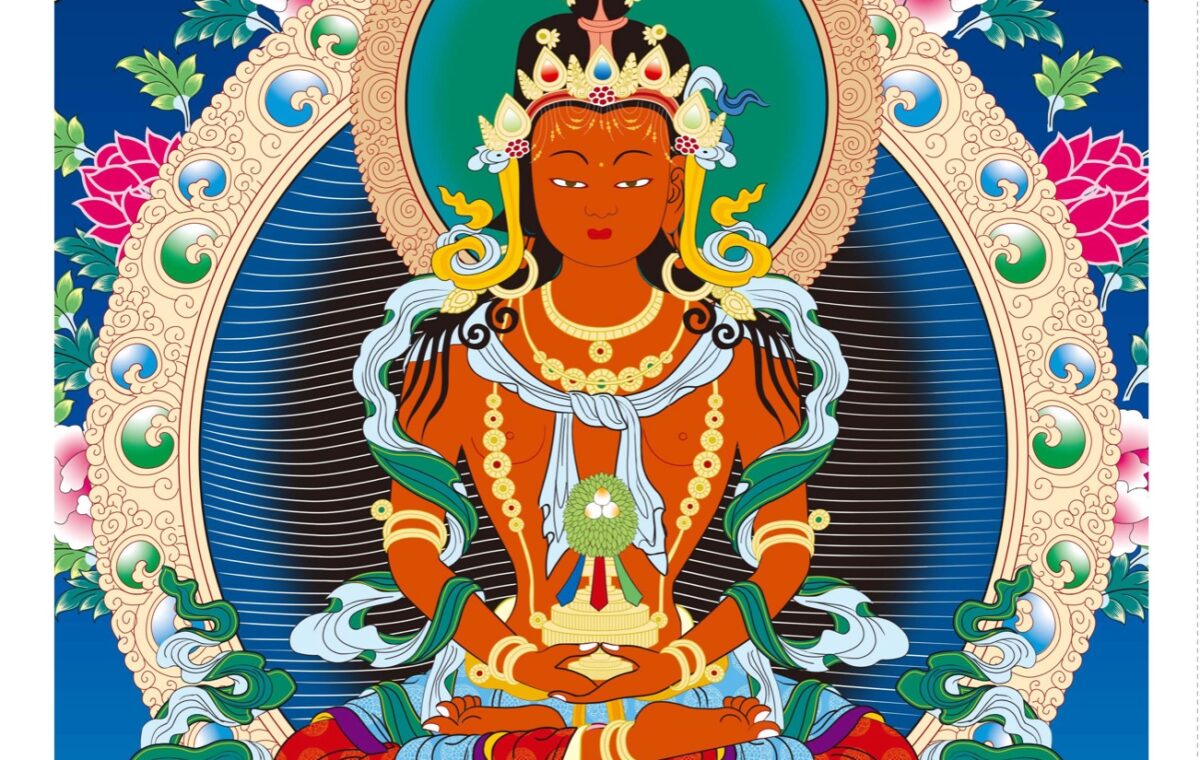
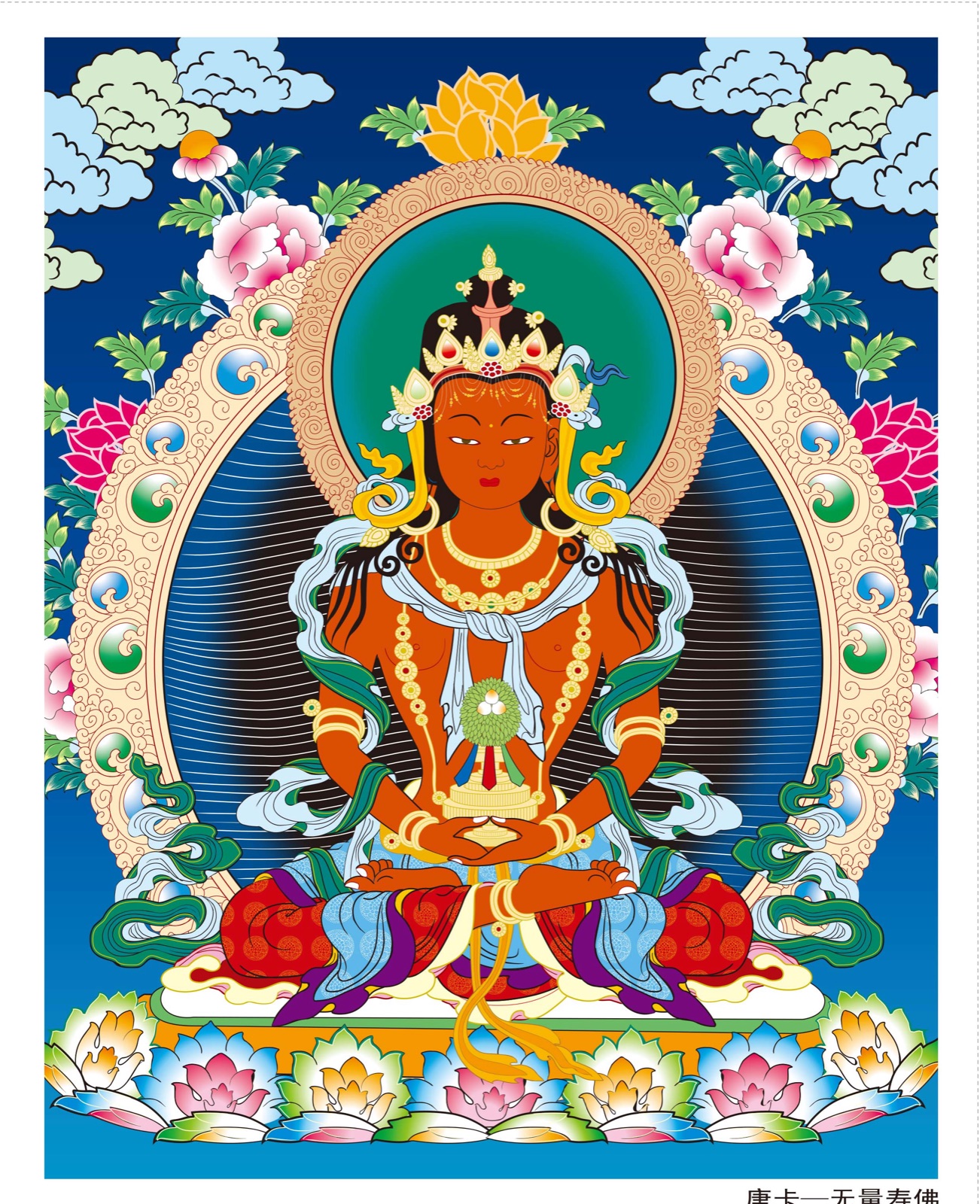
An Amitayus thangka is built around one of the clearest attribute combinations in Tibetan Buddhist art: a red, richly ornamented figure seated in meditation and holding a longevity vase in both hands. That cluster matters because red color alone can point to several deities. The vase, the hand position, the crown, and the bodhisattva-like jewelry make the identification far more dependable.
Who is Amitayus?
Amitayus is the Buddha of immeasurable life and a central longevity figure in Vajrayana Buddhism. His Sanskrit name joins ideas of immeasurable or infinite duration with life. He appears in practices concerned with longevity, the conditions that support practice, and the cultivation of wisdom and compassion over time. In art, those meanings are communicated through a regal, peaceful body and the vessel held at the center of the composition.
Amitayus is closely related to Amitabha, but the names should not be treated as interchangeable labels for every image. In common iconographic usage, Amitabha is shown as a Buddha in monastic robes, usually with hands in meditation, while Amitayus wears a crown, jewelry, and celestial garments and holds the vase of longevity. For the broader paradise context, compare the Amitabha Pure Land painting guide. The Metropolitan Museum of Art’s record for an enthroned Amitayus identifies the ornate longevity vase in the meditation gesture as his defining attribute.
How to identify an Amitayus thangka
The red body and peaceful expression
Amitayus is commonly red, a color that can convey magnetizing activity, vitality, and the family of Amitabha. His expression remains composed and contemplative. Wrathful teeth, aggressive movement, or a flame-filled halo would point away from the standard Amitayus type. Yet photographic saturation can shift red toward orange or brown, so color should support rather than replace attribute reading.
The crown, jewelry, and celestial garments
Unlike a monk-robed Buddha, Amitayus usually appears in the ornamented form of a sambhogakaya Buddha: jeweled crown, earrings, necklaces, armlets, bracelets, and layered silk garments. Long scarves may loop around the shoulders and arms. These details place him in a celestial visual register and help distinguish him from Amitabha’s simpler monastic presentation.
The vase of longevity
The decisive object is the vase held in the lap. It may be described as a longevity vase or a vessel containing the nectar of immortality. A leafy or floral form can rise from its mouth. Both hands support it within the meditation gesture, producing a stable triangular focus at the center of the body. When a red crowned figure holds this vessel in this way, Amitayus is a strong identification.
In TK1264, the vase is especially prominent. A green leafy form and pale jewel-like element rise above its neck, while both hands cradle the base. The image therefore works well for teaching the core visual grammar even though its workshop and date remain undocumented.
Amitayus versus Amitabha
The two figures are related, which explains why catalogues sometimes collapse them. A careful visual record should preserve the distinction:
- Amitayus: crowned and jeweled, red body, celestial garments, longevity vase held in the lap.
- Amitabha: typically monastic robes, no crown or princely jewelry, hands in meditation, often connected with the Western Pure Land.
- Shared features: red coloration, peaceful face, lotus seat, and meditative composure.
If the vessel is hidden by damage or cropping, examine the ornaments and clothing. If both the vessel and the upper body are missing, the identification may remain uncertain. Do not “correct” an ambiguous catalogue title without enough visible or documentary evidence.
Reading the composition around Amitayus
Amitayus may appear alone or within a larger longevity assembly. White Tara and Ushnishavijaya can accompany him in paintings devoted to the three long-life deities. Teachers, donors, offering goddesses, and other Buddhas may occupy the upper or lower registers. Their identities depend on attributes, inscriptions, and lineage context; their mere proximity to Amitayus is not sufficient.
The throne, lotus, halo, and floral setting establish sacred space. The central symmetry slows the eye and emphasizes meditation. In some works, lavish gold and textiles magnify the theme of inexhaustible life. In others, a more restrained palette keeps attention on the vase. These stylistic differences may help comparison, but they do not independently prove a region or period.
Scale also changes the reading. A small personal image may compress the attendants, while a large temple painting can expand the longevity assembly without changing Amitayus’s central attributes.
Practical identification checklist
- Find a peaceful red central figure seated on a lotus.
- Check for a jeweled crown, earrings, necklaces, and celestial scarves.
- Confirm that both legs are folded in meditation.
- Inspect both hands for the meditation gesture supporting a vase.
- Look for a leafy or nectar-related form emerging from the vessel.
- Compare the clothing with Amitabha’s monastic robes.
- Mark date, artist, school, and provenance as uncertain unless documented.
Cataloguing and condition notes
Record the exact wording of the source title and retain the TK number. Describe the visible body color, ornaments, vessel, mudra, lotus, halo, and secondary figures. Note whether the image is an original photograph, a scan, a modern reproduction, or a digitally redrawn version if that information is known. Bright, uniform colors and hard edges may reflect reproduction technique rather than the appearance of a historical painting. For a repeatable zoom sequence, use the high-resolution Thangka iconography method.
Condition can alter identification. Use the Thangka condition report checklist before treating a hidden attribute as absent. Abrasion may remove the small plant above the vase; a crease may cross the face; an old mount may crop attendants. State what is missing instead of reconstructing it silently. When iconography is clear but historical metadata is not, a responsible label can read “Amitayus; date and provenance uncertain.”
Conclusion
An Amitayus thangka is best identified by the combined evidence of red color, jeweled celestial dress, meditation posture, and the longevity vase held in both hands. That same method prevents the common mistake of calling the figure Amitabha. For related longevity imagery, see the White Tara thangka guide. For a broader reading method, use How to Read a Thangka.
Sources and further reading
- Himalayan Art Resources: comparative records for Amitayus
- The Metropolitan Museum of Art: Amitayus, the Buddha of Eternal Life (object record)
These references support comparative iconographic study. The TANGKAWORLD TK number is an internal catalogue identifier; artist, date, collection history, and provenance remain uncertain unless separately documented.
Download the full Thangka image collection
Continue exploring TANGKAWORLD and browse and download the full Thangka image collection, with image groups for Buddhas, Tara, Buddhist masters, protectors, Mandalas, and collection research.