
A Medicine Buddha Mandala is not simply a portrait of a blue healing Buddha placed inside a decorative circle. It is a structured sacred environment: a palace, a field of awakened figures, and a visual program that guides the eye from the outer world toward a concentrated center. Reading one well requires more than matching a color or counting deities.
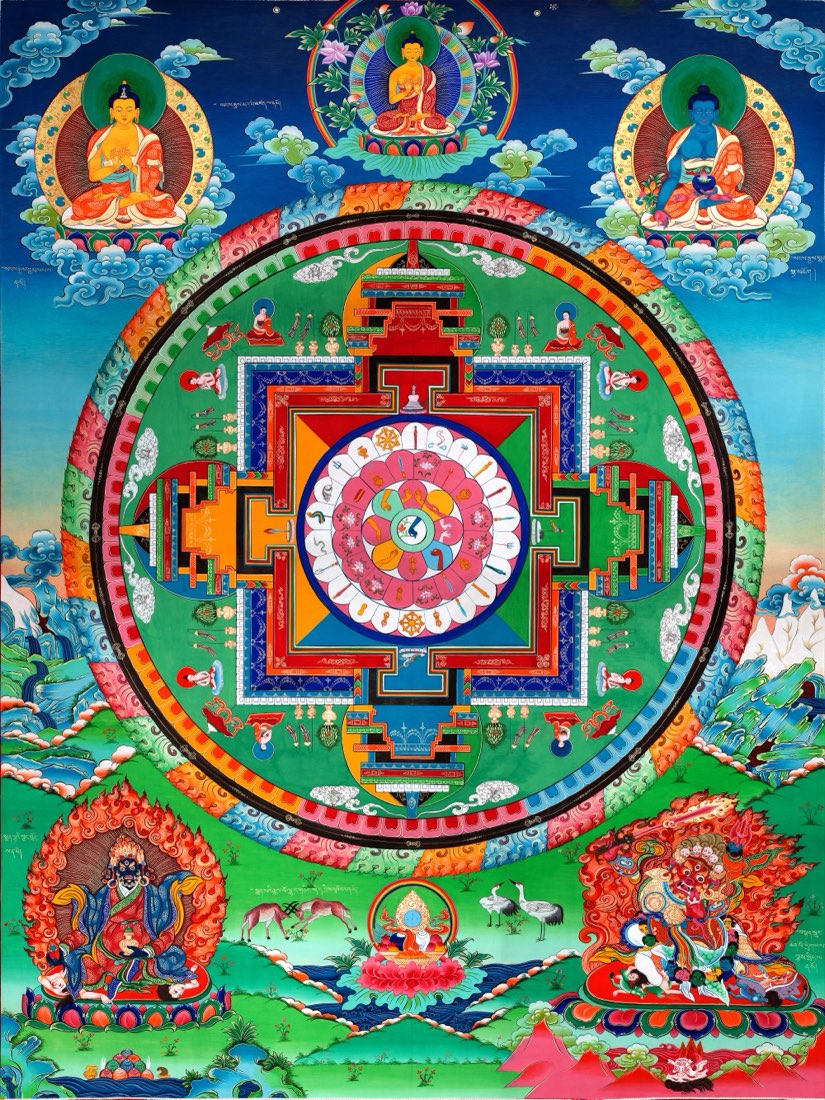
This guide uses TANGKAWORLD image TK0573 to explain the main visual clues: the four-gated palace, concentric zones, a blue Buddha, ritual emblems, surrounding figures, and protectors. It also explains why some details must remain uncertain without an inscription, lineage text, or reliable collection record.
What a Medicine Buddha Mandala represents
Medicine Buddha is known in Sanskrit as Bhaishajyaguru. In familiar painted forms he is dark blue, holds a begging bowl, and may display the medicinal arura plant. These attributes connect the figure with healing practice, but a mandala expands that single image into an ordered cosmos. Architecture, direction, color, emblems, and retinue figures all contribute to the meaning.
A mandala can serve as a ritual support, a map for visualization, and a model of an awakened realm. The palace is therefore functional, not ornamental. Its walls and gates organize access; the rings around it mark thresholds; and its inhabitants express relationships within a particular practice tradition.
Begin with the right identification question
Locate the blue Buddha, but do not stop there
In TK0573, a blue Buddha appears above the mandala at the upper right. He holds a bowl and provides the clearest visible link to Medicine Buddha imagery. Two additional Buddhas occupy the upper left and upper center. Their exact identities are uncertain from the image alone, so they should not be assigned names merely by position.
Color is useful evidence, not absolute proof. Blue bodies appear elsewhere in Himalayan Buddhist art, and pigment may change through fading, restoration, photography, or digital processing. A sound identification combines color with hand gestures, implements, seating, location, inscriptions, and the composition as a whole. For the single-figure form, compare our guide to Medicine Buddha Thangka symbols and identification.
Expect more than one possible center
A common mistake is to assume that every Medicine Buddha Mandala must place a large blue Bhaishajyaguru at its center. Documented examples show important variations. Some center Medicine Buddha directly. Others place Prajnaparamita, the personification of transcendent wisdom, or a book representing the Prajnaparamita text at the center while the Medicine Buddhas occupy surrounding positions.
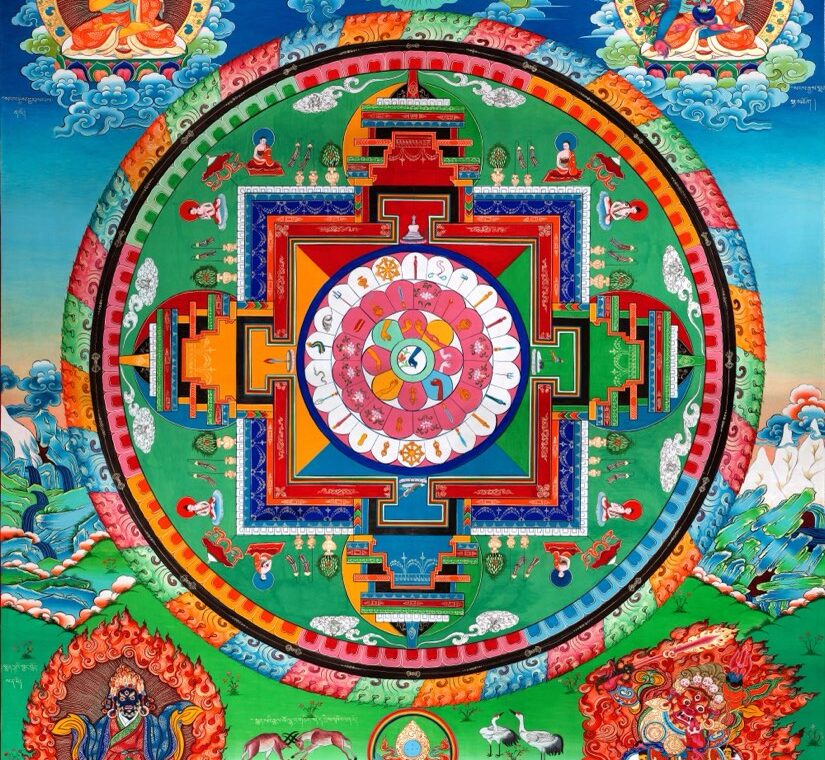
TK0573 has a compact symbolic wheel at its core rather than an easily readable large deity. The concentric petals contain implements and emblems, but the precise ritual identities of every sign are uncertain at this resolution. The correct conclusion is not that the subject label is wrong; it is that the mandala may encode its central program symbolically and requires lineage-specific evidence for a complete reading.
How to read the mandala palace
Four gates establish the sacred architecture
The large square within the circle is a palace seen from above. Four projecting gateways face the cardinal directions. In TK0573, the gates and walls use sharply contrasting red, blue, green, orange, and white areas. These colors make the directional structure legible, but assigning a fixed doctrinal meaning to each painted color would be unsafe without knowing the exact ritual system.
Start at the outer edge, identify the four entrances, and then follow the geometry inward. This movement helps separate architectural features from the figures and offerings placed around them. Readers new to this method can use the broader beginner’s guide to reading a Thangka before comparing more specialized mandalas.
Concentric circles organize the inner program
At the center of TK0573, nested circles and petal-like compartments hold small emblems. Their repetition creates rhythm and hierarchy. The innermost sign receives visual priority; the surrounding bands form successive registers. This is different from a narrative painting, where the eye follows a story from one scene to another. Here, meaning depends on spatial relationship.
Do not read every object as a literal medical instrument. Medicine Buddha practice includes healing symbolism, but mandala emblems can stand for offerings, enlightened qualities, ritual families, or specific members of a retinue. A secure label requires a matching textual or iconographic source.
Retinue figures, guardians, and directional protectors
Published Medicine Buddha mandalas may include the Eight Medicine Buddhas, sixteen bodhisattvas, the Twelve Yaksha Generals, guardians of the directions, and the Four Great Kings at the gates. The exact arrangement varies by textual tradition and workshop. These groups are especially easy to misidentify because small figures may share armor, colors, flames, or gestures.
TK0573 shows numerous small figures and ritual objects around the palace, plus two large wrathful figures at the lower corners. Their protective function is visually plausible, but their personal names are uncertain. The lower left figure wears robes and sits within flames; the lower right group is more dynamic and also surrounded by fire. Without readable inscriptions or a verified catalog record, calling either one a specific Yaksha General or protector would be guesswork.
Medicine Buddha Mandala identification checklist
- Check the catalog title and TK number. Here the source filename identifies “Medicine Buddha — Mandala” and preserves TK0573.
- Find a blue Buddha and inspect the attributes. Look for a bowl, arura plant, monastic robes, and characteristic gestures, but use them together rather than separately.
- Trace the palace. Confirm a square enclosure with four directional gateways instead of treating the composition as a generic decorative circle.
- Examine the center carefully. Ask whether it contains Medicine Buddha, Prajnaparamita, a sacred text, or a symbolic program. If the details cannot be resolved, mark them uncertain.
- Count only what is visible. Do not force damaged, tiny, or partly hidden figures into a standard retinue count.
- Separate common structure from object-specific claims. A known iconographic pattern can guide comparison, but it does not prove this painting’s date, school, or lineage.
- Record the evidence. Note inscriptions, labels, dimensions, materials, restorations, and provenance before proposing a detailed identification.
How it differs from other mandala types
The strongest distinction is the iconographic program, not the presence of a circle. A Kalachakra Mandala uses the architecture and deity system of Kalachakra practice. A Vajra Realm Mandala may organize multiple assemblies in a very different grid. Medicine Buddha mandalas instead belong to healing-oriented ritual cycles centered on Bhaishajyaguru and associated figures, texts, and protectors.
Visual similarity can still be misleading. Four gates, concentric rings, lotus forms, and directional colors occur across many mandala traditions. Identification should therefore proceed from the central and surrounding iconography outward, then be checked against reliable textual or collection evidence.
What TK0573 allows us to say safely
Visible and supported observations
The painting is a vertically oriented Thangka image with a large circular mandala palace, four projecting gates, nested symbolic circles, three Buddhas above, a small lotus-seated figure below the center, landscape elements, and two prominent wrathful figures near the lower corners. The upper-right Buddha is blue and holds a bowl. These observations support the Medicine Buddha Mandala title supplied with TK0573.
Details that remain uncertain
The exact central referent, names of all retinue figures, identities of the lower protectors, ritual lineage, date, artist, workshop, school, geographic origin, materials, and provenance are uncertain. Stylistic comparison may suggest possibilities, but it cannot replace documentation or technical examination. This boundary is essential for responsible collection research.
Viewing and preservation notes
To study a dense mandala, begin with a full-frame image and then inspect high-resolution details by register. Keep a diagram of the four directions and number figures provisionally rather than naming them too early. Compare multiple documented works, because one visually similar example may belong to a different practice cycle.
Sources and further reading
- Rubin Museum: Medicine Buddha Mandala, a documented comparison object with a described central text and retinue.
- Himalayan Art Resources: Medicine Buddha Mandala, item 902, with a detailed iconographic description.
- Himalayan Art Resources: Medicine Buddha, for common forms and related compositions.
- The Metropolitan Museum of Art: Mandalas—Mapping the Buddhist Art of Tibet, for broader historical and visual context.
Conclusion
A Medicine Buddha Mandala rewards slow, evidence-based viewing. In TK0573, the blue Buddha, four-gated palace, nested emblems, surrounding figures, and protectors establish a healing-oriented sacred environment. Yet the painting also demonstrates why responsible iconographic work must distinguish what is visible from what is merely expected. Start with the architecture, compare attributes and retinue patterns, and leave unresolved identities uncertain until stronger evidence appears.
Download the full Thangka image collection
Continue browsing and download the complete TANGKAWORLD image library on our Complete Collection page. The collection preserves English titles and TK numbers so you can compare Medicine Buddha imagery, Mandala structures, and related Buddhist art across the archive.