
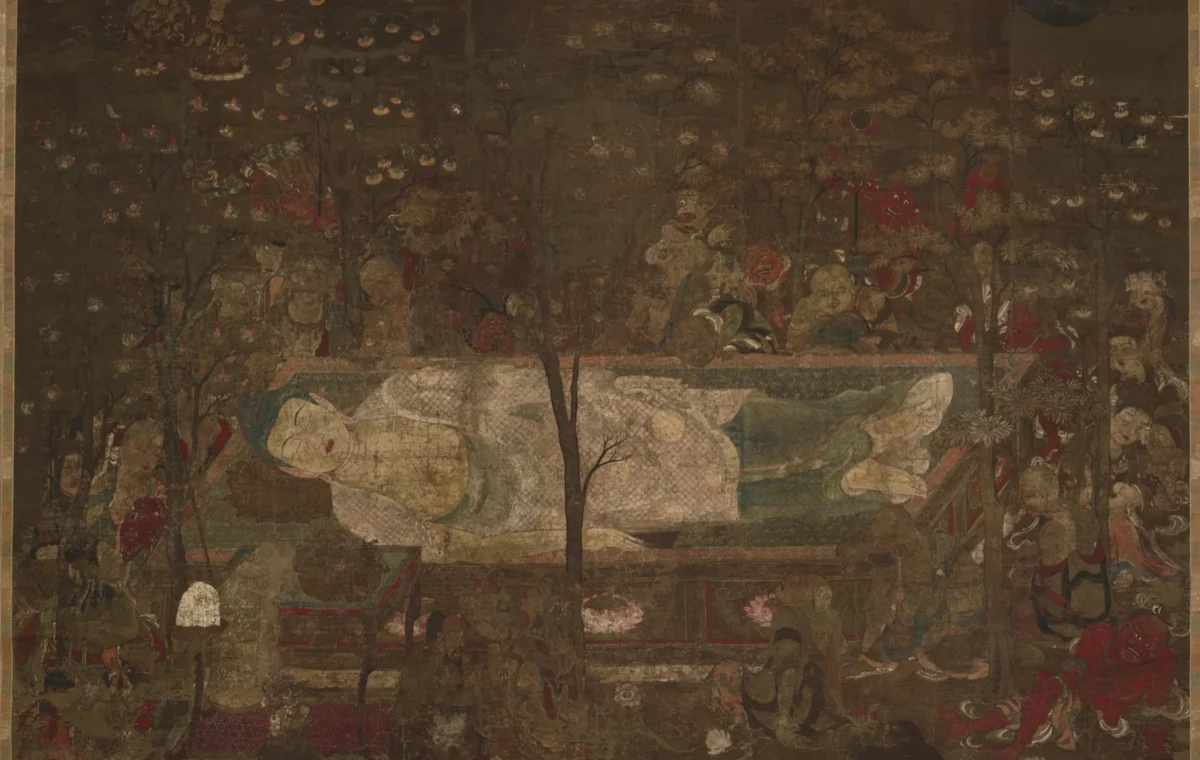
Buddha’s Parinirvana in art is usually shown as a horizontal scene: the historical Buddha reclines on a raised couch while monks, bodhisattvas, guardians, lay followers, animals, and celestial beings gather around him. The subject is not merely a deathbed portrait. It presents Shakyamuni’s final passing and the end of rebirth, while the different responses of those present turn the painting into a lesson about attachment, grief, understanding, and liberation.
TANGKAWORLD image TK0629 bears the archive title “Buddha’s Parinirvana” and comes from the Japanese Buddhist Art section. The image clearly supports that subject through the reclining Buddha, crowded mourners, animals, trees, and figures in the upper field. However, the artist, date, school, temple, original ritual setting, collection history, and provenance are uncertain. This guide therefore reads the visible composition first and uses securely cataloged museum works only as comparisons.
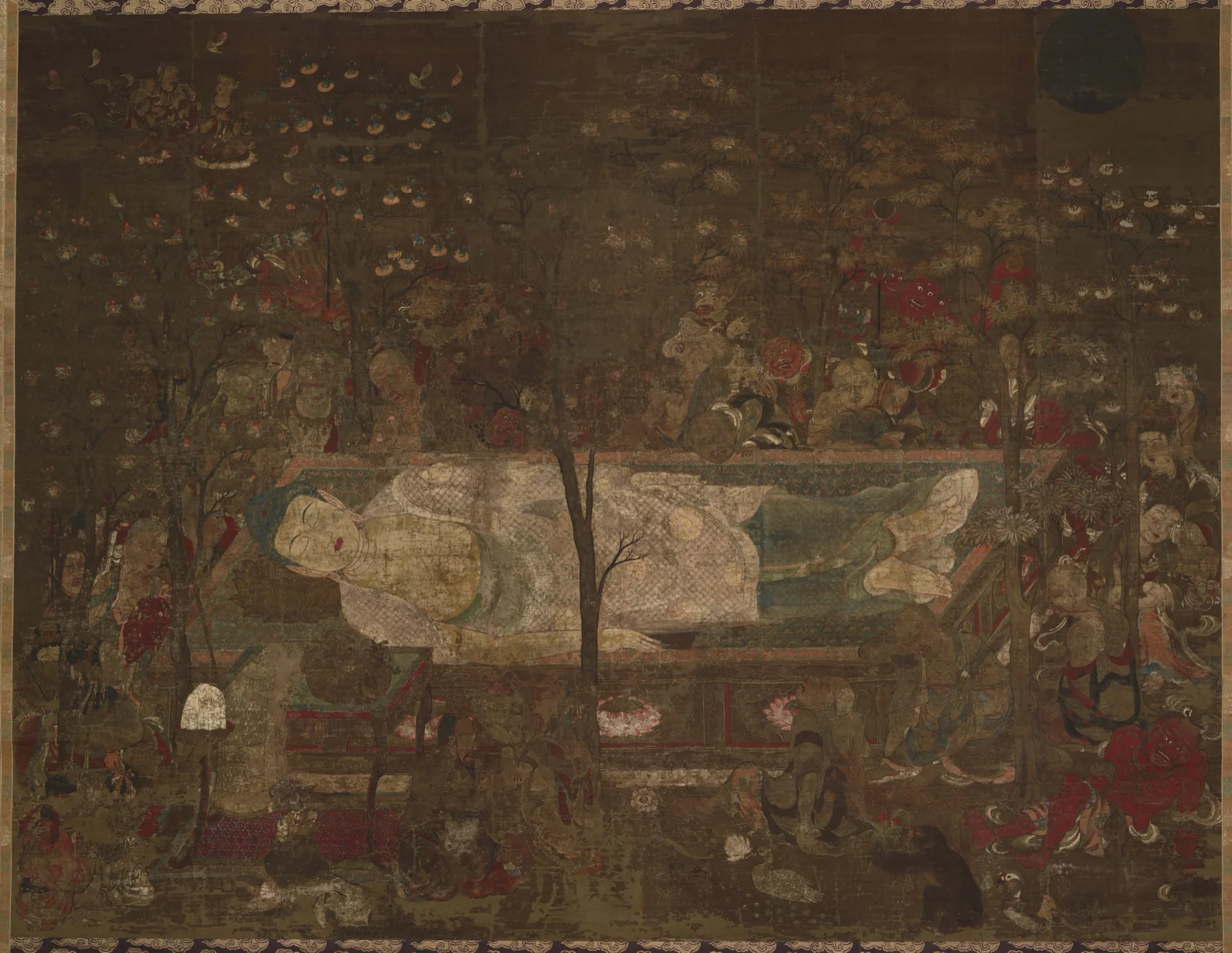
Quick answer: Find the reclining Buddha at the center, then compare the emotional responses around him. Monks, bodhisattvas, guardians, animals, trees, and celestial visitors expand one final event into a picture of the whole sentient world confronting impermanence.
What Parinirvana means in Buddhist art
Parinirvana refers to the final passing of an awakened Buddha. In Buddhist accounts, Shakyamuni died near Kushinagara after a lifetime of teaching. Because awakening had ended the causes of future rebirth, his death was understood as final release from the cycle of conditioned existence. A Parinirvana image therefore combines a historical narrative with a doctrinal idea: the body is impermanent, but liberation is not represented as defeat.
The scene is often included among the major events of the Buddha’s life. Early Gandharan reliefs already show the reclining Buddha surrounded by mourners. A third-century Parinirvana panel at The Metropolitan Museum of Art contrasts grieving lay and monastic figures with the calm monk Subhadra. Later paintings across Asia enlarged the gathering, added regional figures, and adapted the composition for different ritual and visual traditions.
How to find the visual center
1. Follow the horizontal body and couch
In TK0629, the Buddha’s pale body stretches across a decorated platform in the lower middle of the image. The long horizontal form interrupts the many vertical bodies, trees, and staffs around it. His larger scale, light color, closed eyes, and still posture establish the center even before any attribute is identified. The couch or bier also creates a visual boundary between the Buddha and the gathering crowd.
2. Notice stillness against movement
The Buddha is quiet while nearly everything around him appears active. Figures bend forward, raise their hands, turn toward one another, or press close to the platform. This contrast is one of the scene’s most useful identification clues. The composition does not depend on one ritual object; it depends on the relationship between the unmoving reclining figure and the emotionally varied assembly.
3. Read scale before facial detail
High-resolution files tempt viewers to begin with small faces, but hierarchy should come first. Record the largest figure, the direction of the body, the support beneath it, and the way surrounding groups face inward. Only then inspect crowns, robes, halos, staffs, or animal features. This center-out method also works in the site’s beginner’s guide to reading a Thangka.
Why the mourners do not all react alike
Monks, bodhisattvas, and lay followers
Parinirvana paintings often distinguish degrees of understanding through posture and expression. Some shaven-headed disciples grieve openly, while enlightened or more composed figures may remain solemn. Rich clothing can mark bodhisattvas, rulers, or divine beings; simple robes can indicate monks. These categories should not be assigned from clothing alone in TK0629, because abrasion and the darkened surface obscure many details.
Guardians and converted deities
Wrathful faces and powerful bodies do not turn the scene into a protector painting. Guardian-like figures can participate as witnesses to the Buddha’s final passing. Their agitation increases the emotional range of the assembly. Compare their role with the organized protectors in the Four Heavenly Kings visual guide, but do not transfer those names automatically to every fierce figure.
Animals and the wider sentient world
TK0629 includes animals along the lower edge and within the crowd. In Japanese Nehan-zu paintings, animals frequently join human and divine mourners. Their presence broadens the event beyond one community: creatures of different kinds share the consequences of impermanence. Species identification should remain cautious when paint loss, scale, or stylization makes anatomy unclear.
Sal trees, flowers, and celestial visitors
Trees rise behind the platform in TK0629, while flowers and small figures populate the upper field. Cataloged Parinirvana paintings often connect the setting with sal trees and show the Buddha’s mother, Queen Maya, descending from heaven. The Met’s fourteenth-century Japanese Nehan-zu includes grieving beings, more than thirty animals, changing blossoms, and Queen Maya descending from the upper right.
That comparison helps explain the visual vocabulary, but it does not prove that every upper figure or tree in TK0629 has the same identity. Describe the local image as containing trees, flowers, clouds, and celestial figures unless an inscription, reliable catalog, or close attribute study supports a more specific name.
Nehan-zu and the Japanese ritual context
In Japan, paintings of the Buddha’s death are called Nehan-zu. They may be displayed for the Parinirvana observance, or nehan-e. The Kyoto National Museum notes that Japanese temples hang Death of the Buddha paintings for this ritual and that many examples are monumental. Large scale and dense groups can make viewers feel physically present before the reclining Buddha.
TK0629’s wide, crowded composition is consistent with this general Japanese tradition, but its original format is not established by the local file alone. A digital image cannot show whether the work retains an original hanging-scroll mounting, whether sections were trimmed, or whether later conservation changed its appearance.
What TK0629 shows—and what remains uncertain
Visible evidence supports a careful description: a reclining Buddha lies on a raised decorated couch; numerous human, divine, and guardian-like figures gather around him; animals occupy the lower zone; trees frame the upper middle; and additional figures appear among clouds and flowers. The darkened tone, abrasion, creases, and uneven legibility also matter because they affect what can safely be identified.
Do not use the archive title to invent a precise date or school. The work may relate to Japanese Nehan-zu conventions, but the painter, workshop, temple, region, pigments, support, mounting history, restorations, and route into the archive are uncertain. For condition vocabulary, use the Thangka condition-report checklist; a digital inspection is only a preliminary record, not a conservation diagnosis.
How the composition guides a viewer
The crowd in a Parinirvana painting is not arranged like a neutral inventory of characters. Repeated glances, bent bodies, raised hands, and clustered animals direct attention back toward the Buddha. The wide couch slows that movement and gives the eye a stable horizontal path. In TK0629, the dark trees divide parts of the pale body while the surrounding reds, greens, and patterned robes create pulses of activity. This produces a deliberate tension between visual disturbance and bodily stillness.
Practical Parinirvana identification checklist
- Locate the reclining Buddha. Confirm the dominant horizontal body and the support beneath it.
- Map the inward gaze. Check whether surrounding figures orient toward the reclining center.
- Separate stillness from grief. Record calm, lamenting, kneeling, and gesturing figures without assigning names too early.
- Count social and sacred groups. Distinguish monks, richly dressed figures, guardians, laypeople, and animals by visible evidence.
- Inspect the landscape. Note trees, flowers, clouds, and upper registers before calling them sal trees or a heavenly descent.
- Compare securely cataloged works. Look for several matching features, not one familiar pose.
- Check the physical image. Abrasion, darkening, repairs, cropping, and mounting changes can hide or alter iconographic clues.
- Preserve uncertainty. Separate subject identification from claims about artist, date, school, ritual use, and provenance.
Parinirvana or simply a reclining Buddha?
A reclining Buddha alone does not always provide the full narrative context. A Parinirvana scene usually adds witnesses, grief, trees, a couch, and a clearly organized final gathering. Sculptures may communicate the subject with fewer figures, while paintings can expand it into a crowded world. Compare the central body with the earth-touching pose in the Shakyamuni Buddha identification guide and the active teaching hierarchy in the Buddha preaching assembly guide.
Related guides for closer study
Use the Arhat paintings guide to compare elderly monastic figures, and follow the high-resolution iconography workflow when examining small mourners and animals. These comparisons work best when they clarify a visible feature rather than supply a missing label.
Conclusion
Buddha’s Parinirvana in art is recognized through relationships: the still reclining Buddha, the raised couch, the inward-facing mourners, the animals, the trees, and the celestial field. TK0629 preserves this visual structure even where age and image condition reduce detail. Its subject can be studied with confidence, while its individual figures and historical attribution should remain uncertain until stronger documentation appears.
Download the full Thangka image collection
Continue browsing and download the complete TANGKAWORLD image library through the full Thangka image collection, with high-resolution material for narrative comparison, iconographic study, and collection research.