
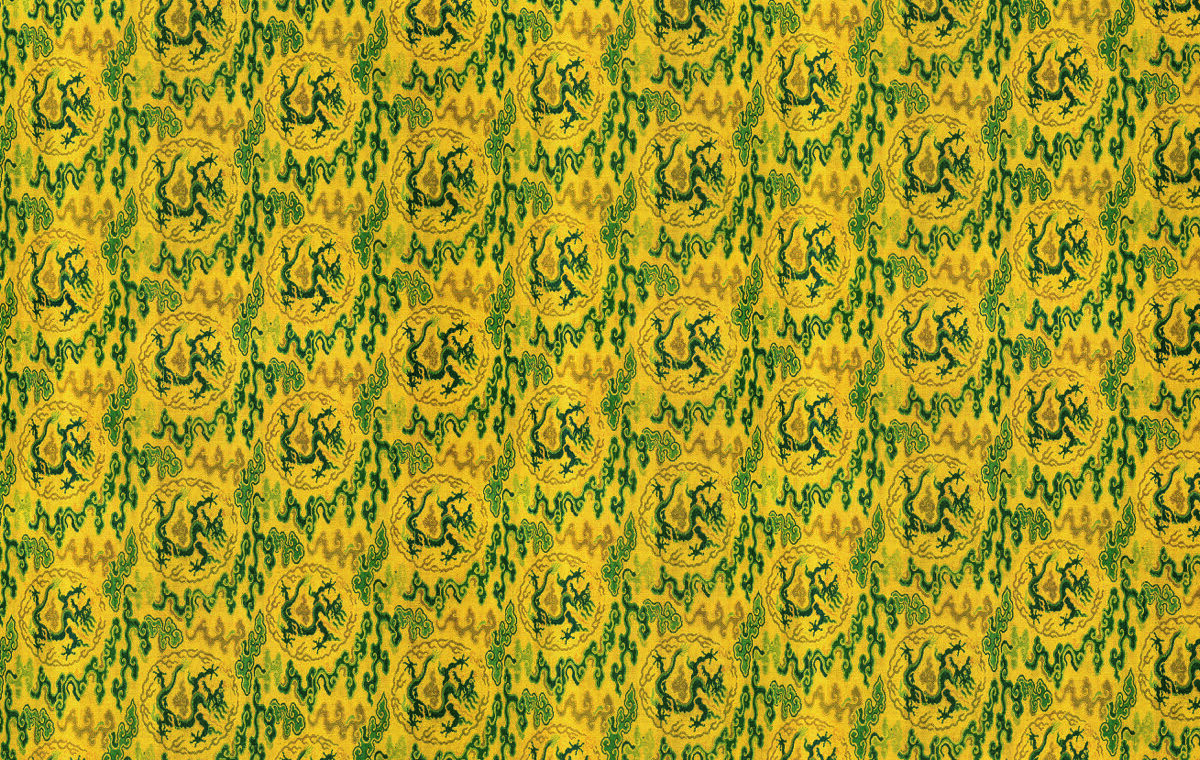
Buddhist scroll cover fabric can preserve evidence that the painted image alone does not show. Color, pattern scale, seams, edge wear, fading, and the way a textile was attached may record how a scroll was displayed, stored, handled, or remounted. A cover can also become a source of risk when its fibers weaken, its dyes change, or its layers begin to transfer material to the painting.
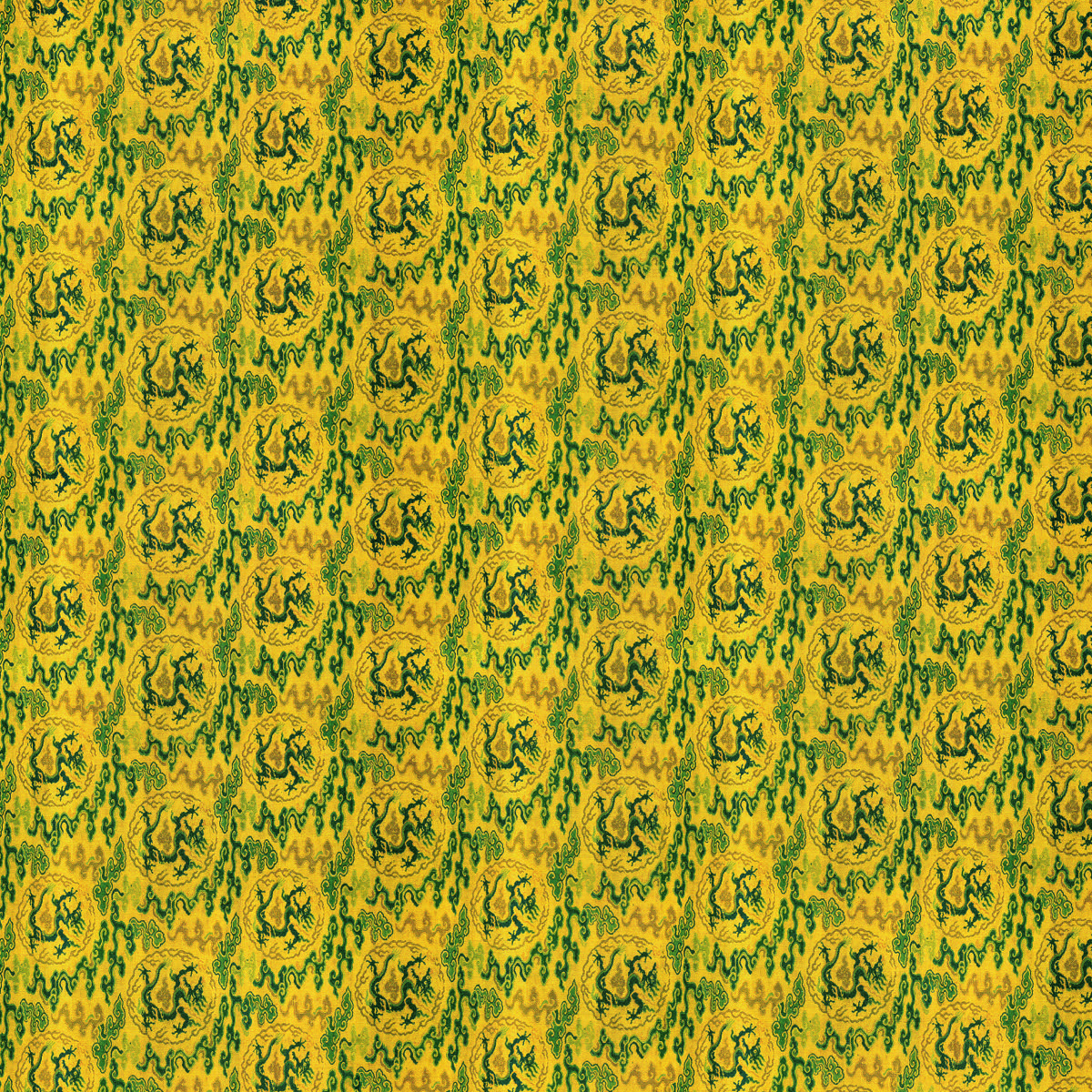
TK0778 offers a useful case study because it records the cover as an object rather than treating it as background decoration. The square image shows a dense yellow-green field organized into repeating roundels and scrolling forms. Subtle vertical divisions may reflect pattern repeats, joins, folds, lighting, or photographic stitching; the image alone cannot decide which. Close looking can generate good documentation, but it cannot replace fiber analysis, weave examination, provenance, or direct study of the reverse.
Why the mounting belongs in the object record
A mounted Buddhist painting is more than its painted center. Paper linings, textile borders, cover fabric, rods, cords, labels, and repairs affect how it functions and survives. The British Museum’s conservation glossary notes that the mount of an Asian painting—including a hanging scroll, handscroll, folding screen, or Thangka—is part of the object and is conserved for safe display, handling, and storage.
This does not mean that every Buddhist scroll uses the same construction. Chinese, Japanese, Korean, Himalayan, and other traditions have different materials, formats, terminology, and workshop practices. TK0778 is cataloged as a scroll outer cover, not as a confirmed Thangka mounting. Its value for Thangka research lies in the method: document the surrounding material separately, respect the tradition to which it belongs, and do not use one regional mounting system as a universal template.
What a Buddhist scroll cover fabric can reveal
Pattern can establish visual organization
In TK0778, roundels recur in staggered rows while green outlines and smaller scrolling forms fill the intervals. Repetition creates a continuous surface suitable for wrapping or framing without a single dominant center. Pattern scale may help researchers compare fragments or determine whether photographed sections belong to the same textile, but it does not by itself prove a date or workshop.
Motif names require caution. A compressed photograph may suggest birds, animals, clouds, flames, or plant forms, yet those readings can change under higher magnification or when the weave direction is known. The accurate record is therefore “repeated roundels and scrolling forms.” A proposed motif should be labeled uncertain until supported by a clear detail, a comparable textile, or specialist analysis.
Color differences may record exposure
A cover can shield the painting while the scroll is stored, but the cover itself receives light, dust, handling, and environmental exposure. Uneven yellowing, fading, darkening, or abrasion may correspond to exposed edges, folds, ties, or contact zones. The Smithsonian’s introduction to Japanese painting mounts explains that mounts protect rolled paintings from light and dust, while repeated use can create creases, discoloration, and separation between layers.
Color in a digital file is not a measurement. Camera settings, white balance, compression, display calibration, and later editing can all shift the apparent hue. For that reason, TK0778 can be described as yellow-green in this reproduction, but its original dye colors and present color change remain uncertain.
Wear can map handling and movement
Edges, corners, fold lines, seams, ties, and rod-adjacent areas often receive different stresses. Broken threads or polished areas may indicate repeated contact. Creases can develop where layers flex during rolling. Small losses may reveal a different-colored lining beneath. These features become most informative when an overall view is paired with scaled details and a diagram showing their location.
Do not infer a complete handling history from one mark. A line could be a fold, seam, stain boundary, pattern repeat, or imaging artifact. Record its position, direction, length, and relationship to neighboring features before proposing a cause.
Why “brocade” should be a tested term
Ornate patterned fabrics are often casually called brocade, but a photograph does not reliably show how a pattern was woven. Identifying a textile may require examination of warp and weft, supplementary threads, fiber type, metallic strips, twist, density, and the reverse. Dye analysis can add another layer of evidence. Until those observations exist, “patterned cover textile” is safer than a technical weave name.
The Smithsonian’s conservation treatment of the Shuten Dōji handscrolls shows why this distinction matters. Conservators studied deteriorated gold-threaded cover fabrics, weave structure, and thread colors; because the original silk was unstable and threatened the paintings, reproduction covers were made and the historic fabrics were preserved separately for research. That treatment was based on object-specific analysis, not visual resemblance.
A non-invasive documentation checklist
Before any cleaning, flattening, or repair, build a record that another researcher can understand:
- Assign a stable identifier. Keep the TK number, archive title, filename, and known object relationship together.
- Photograph the whole cover. Include a scale and color target when possible, while retaining an unedited master file.
- Record orientation. Mark top, bottom, front, reverse, fold direction, and the position relative to the painting or roller.
- Map construction. Photograph seams, joins, linings, hems, ties, labels, cords, attachments, and exposed edges.
- Capture pattern repeats. Measure the repeat in both directions and photograph at least one complete unit.
- Document condition. Note creases, fraying, splits, losses, stains, fading, powdering, detached threads, insect evidence, and possible mold.
- Use varied light carefully. Normal, raking, and transmitted light may reveal different structures, but only when the object can be handled safely.
- Separate fact from interpretation. List visible features first; place proposed fiber, weave, dye, motif, date, and origin in an “uncertain” field.
- Link related records. Connect the cover to the painting, box, labels, seals, invoices, and earlier treatment reports without assuming they have always belonged together.
For a broader damage vocabulary, use the Thangka condition report checklist. Red ownership or collection marks should be documented through the separate workflow in our guide to Buddhist painting seals. When small structural details matter, compare the limitations described in studying Thangka images at high resolution.
Safe handling and preservation boundaries
Do not wash, iron, steam, tape, glue, vacuum, roll tightly, or pull loose threads based on an online guide. A weak outer cover may be mechanically connected to fragile paper, silk, pigment, adhesive, or metallic thread. A treatment that appears to improve the textile can stain, distort, abrade, or detach another layer.
Keep the object supported and minimize unnecessary rolling or unrolling. Isolate it from direct light, liquids, food, dust, pests, and abrupt humidity changes. If the fabric is powdering, actively splitting, stuck to another layer, showing fresh insect activity, smelling musty, or displaying suspected mold, stop handling and consult a conservator experienced with the relevant Asian painting tradition. A detached historic cover should not be discarded merely because it is no longer functional; it may retain evidence of an earlier mounting campaign.
What TK0778 does and does not establish
TK0778 establishes that the archive includes a square photograph of a yellow-green patterned textile labeled as an outer cover. We can describe repeated roundels, scrolling forms, color zones, and possible vertical divisions. Those observations support documentation and condition questions.
The image does not establish whether the textile is silk, brocade, embroidered, printed, or woven with supplementary threads. It does not confirm the dyes, motif names, date, maker, workshop, geographic origin, ownership, conservation history, or original associated scroll. Even the apparent color and divisions may be affected by photography. These points should remain uncertain until direct examination or dependable records provide evidence.
Conclusion
Buddhist scroll cover fabric is not expendable decoration. It can protect a rolled painting, shape its presentation, record repeated use, and preserve evidence of past mounting decisions. The best study begins with accurate photography, construction mapping, condition notes, and a strict separation between observation and attribution. TK0778 demonstrates how much can be learned from a cover while also showing why fiber, weave, dye, motif, date, and provenance must not be guessed.
Download the full Thangka image collection
Continue exploring and download the complete TANGKAWORLD image library from our free downloads page. The full collection lets you compare painted centers, textile borders, covers, inscriptions, seals, condition details, and other evidence across many Buddhist images.