
A lotus throne in Buddhist art is more than a decorative cushion beneath a sacred figure. It establishes a visual ground that separates the figure from the surrounding landscape, focuses attention on the body, and gives artists a flexible way to show hierarchy, openness, and support. In a Thangka, however, it is easy to read too much into a single blossom or color. A useful method begins with what is visible: the number and direction of petal rows, the central seat, stems, supporting leaves, and the figure’s relationship to the throne.
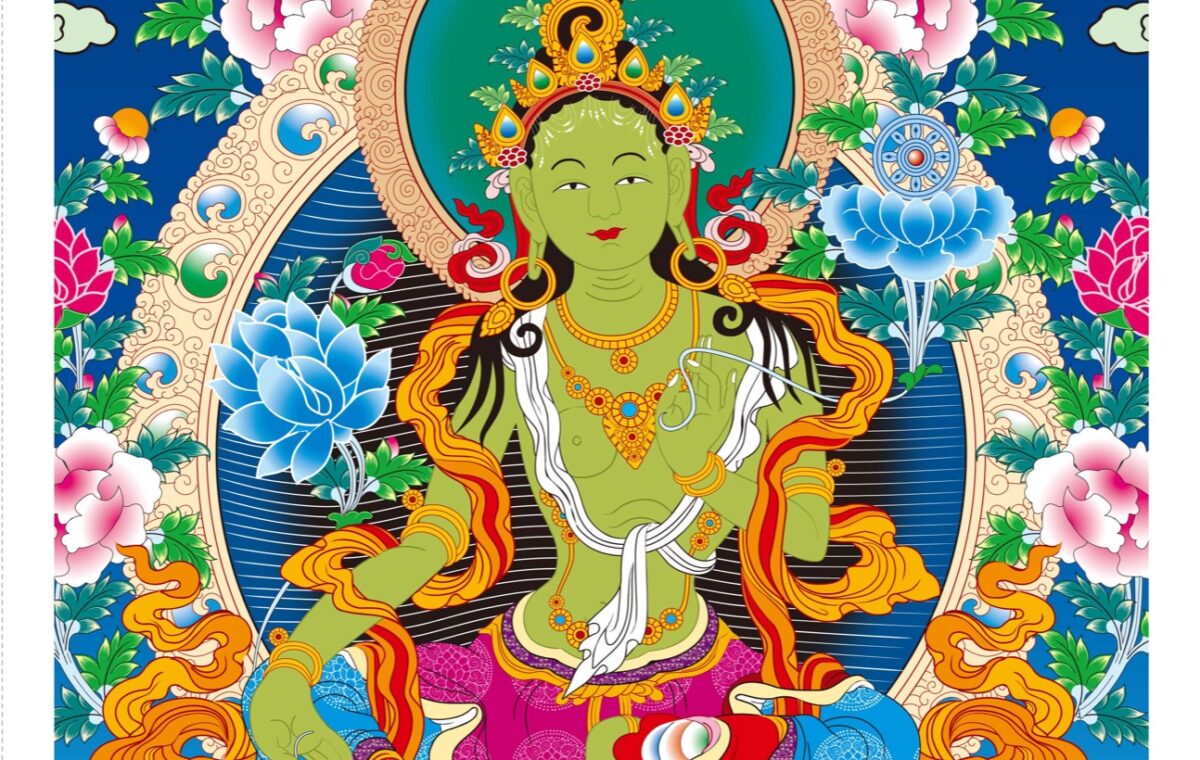
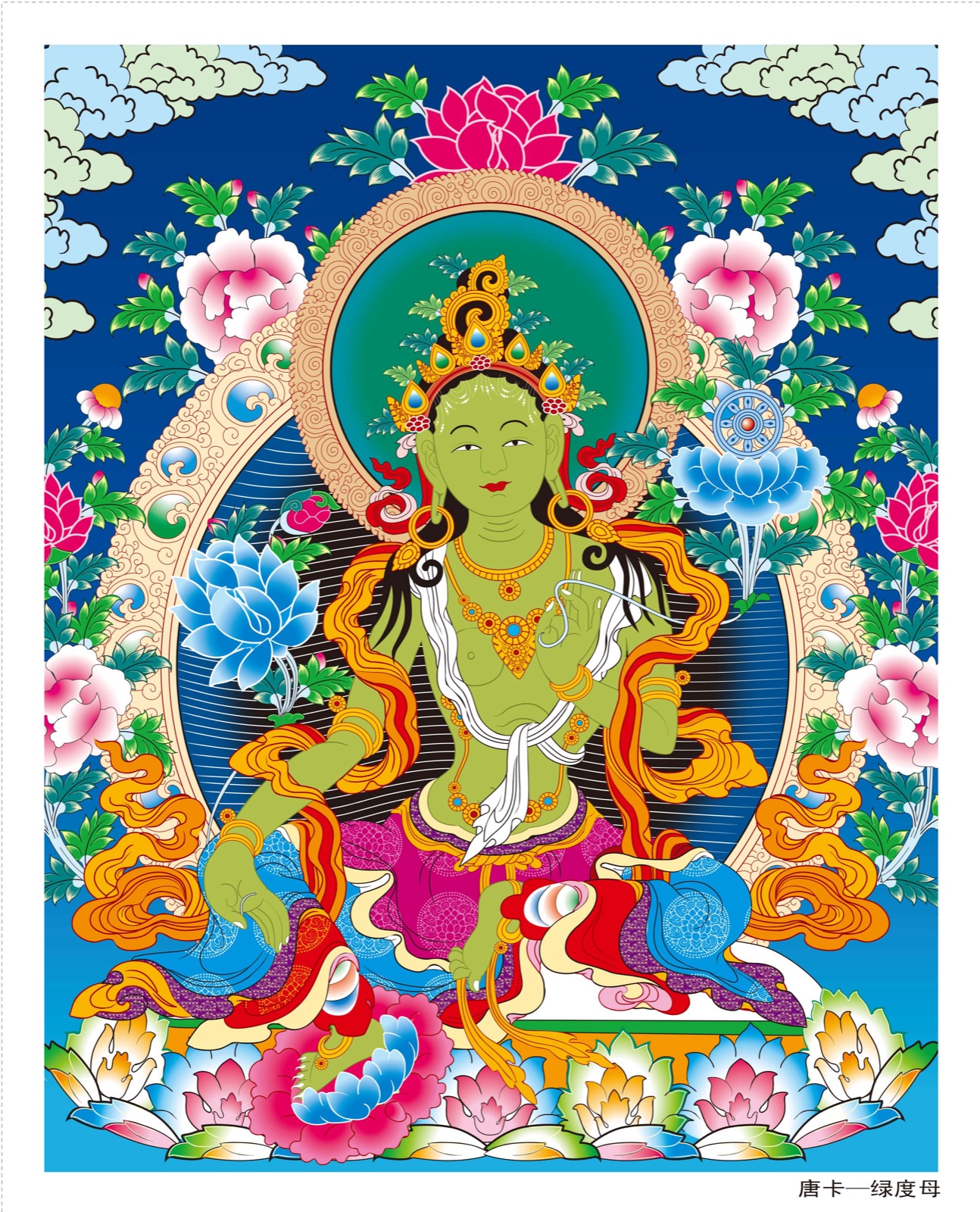
TK1268 provides a clear comparative example. Its central Green Tara is seated above a broad, multicolored lotus base, while additional lotus blossoms appear around the halo and at the lower edge. The image makes the throne easy to see, but it does not by itself prove a date, school, material, or specific ritual use. Those points remain uncertain without a reliable catalogue record or inscription.
What a lotus throne does in a Buddhist image
In Buddhist visual language, the lotus commonly marks a place of purity and emergence. A figure may sit on it, stand on it, or hold it as an attribute. The throne is therefore not identical to every lotus in the composition. When the lotus lies directly beneath the central figure and bears the body’s weight, it functions as the seat. Blossoms beside the shoulders, at the edge of a halo, or in the landscape usually have a different compositional role.
The throne also solves a pictorial problem. A seated figure needs a stable base, especially when the lower body is partly hidden by robes or scarves. Petal rows create a clear horizontal platform while their curves soften the transition between figure and background. In crowded compositions, a bright lotus seat can keep the main figure legible from a distance.
Read the throne from the center outward
1. Find the bearing surface
Start with the area that actually supports the body. In many paintings, it is a flattened or oval central zone framed by petals. In TK1268, Green Tara’s crossed leg rests above a layered base, while her extended right leg reaches toward a smaller support. The image is stylized, so the exact construction of the seat should not be inferred as a physical object. Still, the supporting relationship is visually clear.
2. Count layers, not meanings
Look for an upper ring of petals, a lower ring, colored bands, leaves, or a stepped base. Record their order and direction before assigning symbolic meaning. Petals that point upward may frame the body; downward-facing petals may broaden the base; a narrow band can separate the throne from the landscape. Different painters simplify or elaborate these parts, so a petal count is a description, not a universal code.
3. Separate throne flowers from hand-held flowers
In TK1268, stems with blue blossoms rise beside Green Tara’s shoulders. These are important to the figure’s iconography, but they are not the lotus throne. The lower pink, blue, and white blossoms likewise contribute to the setting. Distinguishing these zones prevents a common error: treating every flower as if it explained the seat below the figure.
Petals, color, and line
Petal shapes are often the first feature viewers notice. They can be rounded, pointed, tightly packed, scalloped, or outlined with gold or dark contour lines. These choices tell us more reliably about the picture’s design than about a single fixed doctrine. A modern digital image may show crisp, saturated blocks of color; an older painting may show mineral pigment, shaded modeling, abrasion, and restoration. Neither treatment alone establishes date or authenticity.
Color works in the same way. A pink or red lotus may contrast with a green figure, a blue background, or a warm halo. That contrast directs the eye. It is safer to say that a color creates visual emphasis than to claim that every hue has one invariant meaning across Buddhist traditions. Reproductions, lighting, scans, and later retouching can all alter color.
How the lotus throne helps identify a figure
A lotus throne is widespread in Buddhist art, so it rarely identifies a deity by itself. Instead, use it as one part of a larger reading. For Green Tara, the green body, peaceful female form, extended right leg, hand gestures, ornaments, and paired lotus stems are more diagnostic than the seat alone. Compare the full constellation of features with our guide to Green Tara iconography.
The same caution applies to other figures. White Tara, Avalokiteshvara, Manjushri, Amitayus, and many Buddhas may appear on lotus thrones. A seated figure on a lotus is therefore a starting point, not a finished identification. If the title, inscription, or collection data conflict with a visual impression, note the discrepancy rather than forcing a conclusion.
Documentation checklist for a lotus throne
- Photograph the full throne and details of the upper and lower petal rows.
- Describe the bearing surface and how the figure’s legs meet it.
- Record the number of visible layers, their colors, and petal directions.
- Separate the throne from hand-held lotuses, halo flowers, and foreground vegetation.
- Note contour lines, gilding, shading, losses, overpaint, and cracks without guessing their cause.
- Record whether text, seals, labels, or collection marks are present nearby.
- Keep unknown information marked as uncertain rather than completing the record from style alone.
This checklist fits into a broader condition and image-reading workflow. For a systematic approach to wear, losses, and visible alteration, see the Thangka condition report checklist. For a broader introduction to central figures, attributes, and composition, begin with How to Read a Thangka.
Why a careful description matters
“Lotus throne” is a useful search term, but a careful record is more valuable than a label alone. It gives another researcher enough information to compare petal structure, color relationships, and the figure’s posture without assuming that the image has already been securely identified. This is especially important for online images, where cropping and compressed color can hide the boundary between throne, cushion, landscape, and later restoration.
In TK1268, the broad petalled base supports a recognizable Green Tara image, while the surrounding flowers deepen the composition. The example demonstrates how a throne can organize an image without becoming the sole key to its interpretation. Read it together with the central figure, attributes, inscriptions, and reliable object records; where those records are absent, say so clearly.
Download the full Thangka image collection
Continue browsing and downloading the complete TANGKAWORLD image collection for close comparison of Thangka figures, lotus seats, borders, and painting details.