
Mandala boundary rings are the layered circular bands that surround a palace or central sacred space. They are easy to overlook because viewers are drawn first to the central figures, gates, and bright architectural forms. Yet the outer enclosure organizes the entire image. It separates zones, sets the scale of the palace, and turns a crowded composition into a sequence that can be read from outside inward.
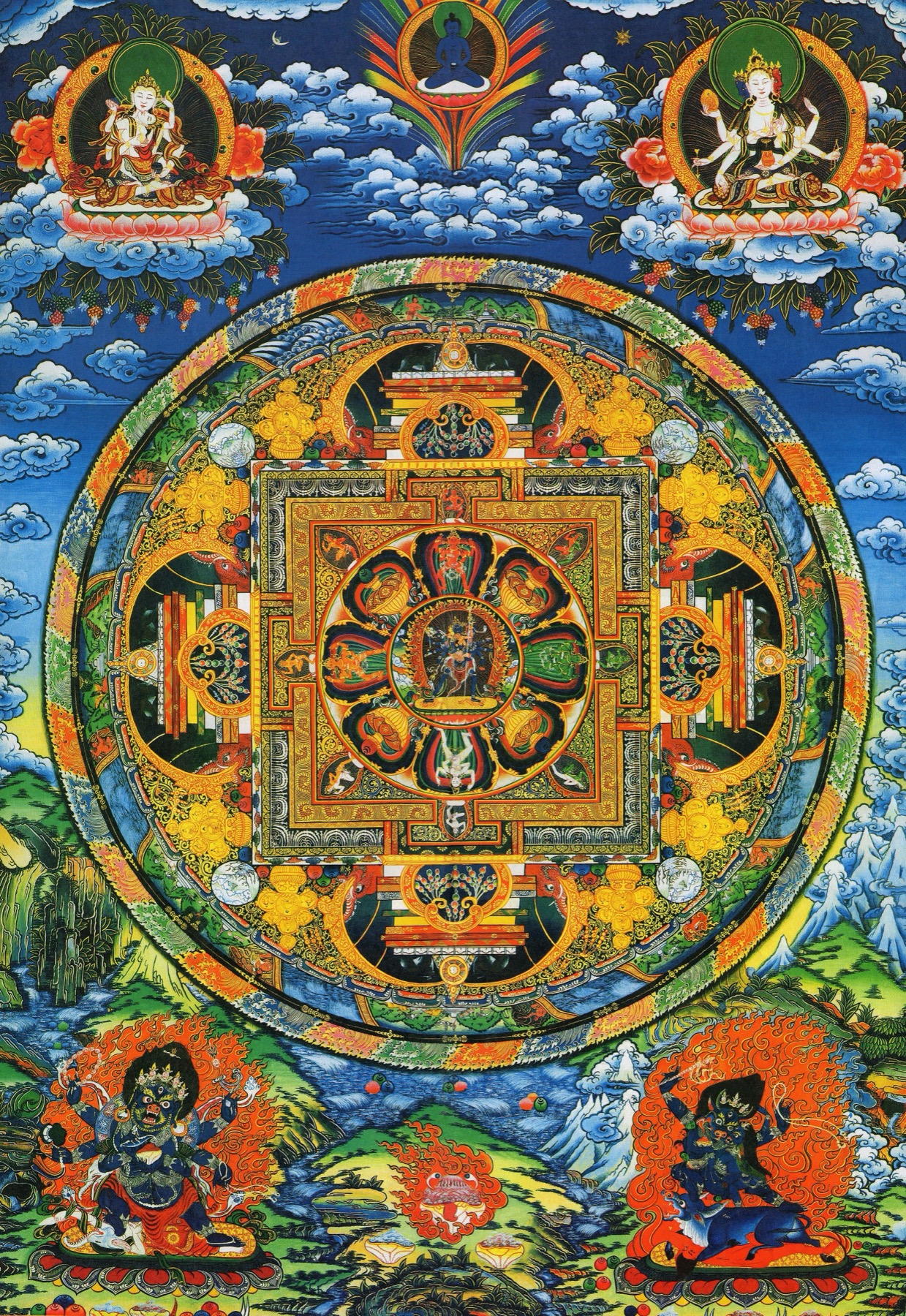
TK0554 offers a richly detailed example. A square palace occupies the center, with rings of ornament, landscape, and coloured forms around it. The image visually supports an analysis of enclosure and sequence. It does not, on its own, prove a specific initiation practice, date, painter, school, or original location; those remain uncertain unless supported by an inscription or reliable catalogue record.
Begin at the outer edge
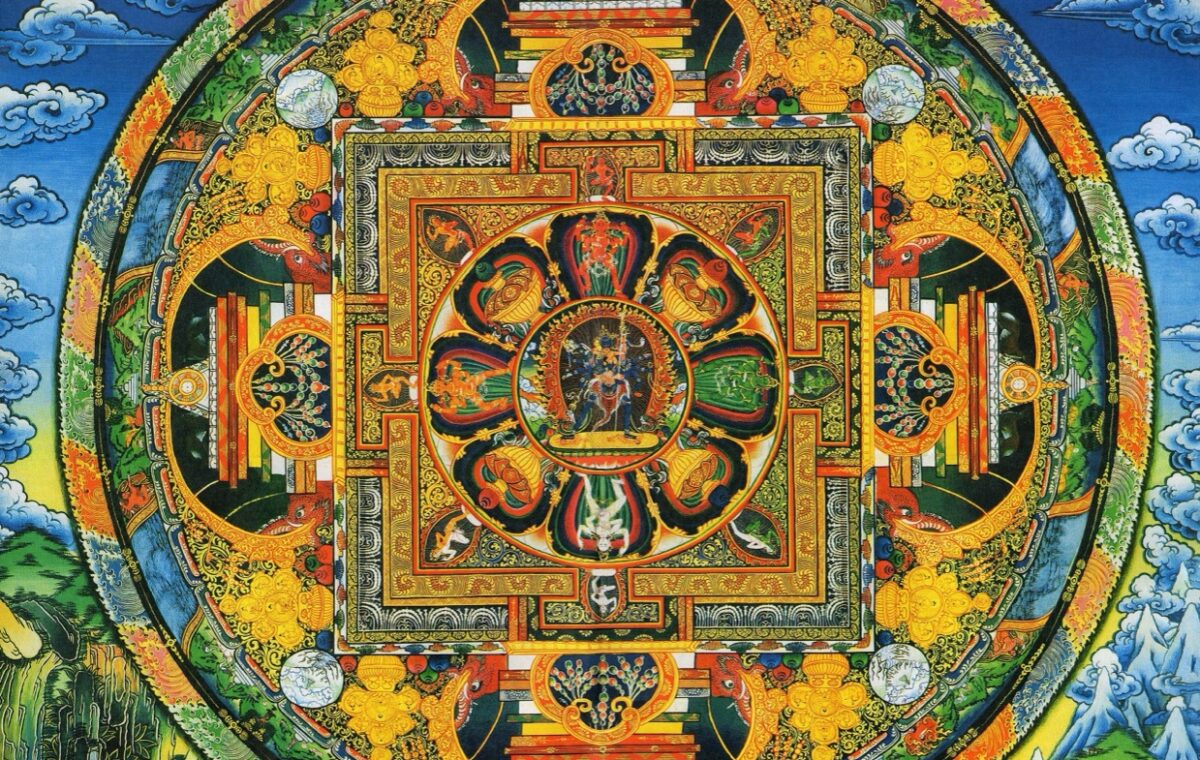
A Mandala is often treated as a diagram with a centre, but studying its boundary rings begins at the perimeter. Look first for the widest enclosing band. In TK0554, a dark outlined circle contains mountains, water, vegetation, and coloured patterned zones. This outer field creates a limit without functioning like a simple picture frame. It draws the eye into successive regions rather than ending the composition.
Do not assume that every circular line has the same name or ritual meaning. Artists can compress, expand, or decorate bands according to format, workshop practice, and reproduction quality. A careful description should record visible order before applying terminology from a text or catalogue.
How to read Mandala boundary rings
Trace the sequence
Follow the rings toward the centre in one direction, noting each change: a painted landscape, a dark outline, a gold ornamental band, a flame-like surround, a circular field of petals or vajra-like motifs, then the palace walls. This exercise makes the composition legible even when small figures cannot be identified with confidence.
Separate the ring from the palace
The square palace and its four gates form a different architectural zone. Boundary rings surround it; the palace contains it. In TK0554, the gates project at the cardinal sides while the circular forms continue around them. Keeping this distinction clear prevents a common mistake in image description, where every patterned element is called a “wall” or every line is called a “ring.”
Notice crossings and interruptions
Some rings appear continuous. Others are interrupted by gates, deities, offerings, clouds, or landscape. These interruptions are useful evidence about visual hierarchy. A figure placed over a band may be more important to the composition than a repeated motif within it, but the placement alone does not establish identity or ritual rank.
Fire, water, flowers, and ornament
Boundary rings can contain flame-like forms, lotus petals, jewels, textile-like patterns, or landscape. These features create both separation and movement. The lower corners of TK0554 include protectors framed by flame fields, while cloud and mountain forms occur outside the main circular enclosure. It is accurate to describe their position and relation to the ring. It is less secure to assign every form a single fixed symbolic meaning without a source tied to that work.
Colour is equally important but should be handled with care. Gold, green, red, blue, and black create contrast between zones and help viewers distinguish palace, enclosure, and surrounding scene. Digital images can alter saturation, and later conservation work can change surface appearance. Record observed colour before making broader claims.
Why boundary rings matter for identification
A Mandala boundary is not normally enough to identify a particular deity or ritual system. The central form, labels, inscriptions, attributes, and securely documented comparisons remain essential. In a Kalachakra image, the central palace and figures may be read alongside the enclosure; in a Womb Realm Mandala, the organization of courts provides another kind of structure. Compare this reading method with our guides to the Kalachakra Mandala and the Womb Realm Mandala.
The practical value of boundary analysis is that it slows down identification. Instead of beginning with a guessed name, start with location: outside field, enclosing ring, gate, palace, or centre. That vocabulary makes comparison easier across images with different palettes and levels of detail.
Documentation checklist
- Photograph the entire Mandala before taking close details.
- Record the outermost visible boundary and each inner band in order.
- Describe colour, line, repeated motifs, and interruptions.
- Mark the position of the four gates relative to the circular enclosure.
- Separate outer landscape, boundary rings, palace, and central field.
- Note losses, overpaint, cracks, or cropped edges without guessing their cause.
- Record labels, seals, or inscriptions separately from visual observations.
- Keep figure names, date, school, materials, and provenance marked uncertain where no evidence confirms them.
This checklist complements the Thangka condition report checklist. For a general method that moves from composition to attributes and written records, see How to Read a Thangka.
From enclosure to centre
Reading Mandala boundary rings is a way to understand how an image guides attention. The rings do not merely decorate the palace; they make approach visible. In TK0554, circular enclosure, patterned zones, outer landscape, gates, and the central palace work as connected layers. Describe those layers carefully, compare them with documented works, and avoid treating a vivid digital image as proof of every historical detail.
Use a consistent viewing path
For a useful comparison, begin every Mandala with the same viewing path: outer landscape, enclosing bands, gate zone, palace walls, and centre. Write one short observation for each zone before looking for names or meanings. This method is especially helpful when a photograph is cropped, when a lower band is partly obscured, or when the image has been reproduced at a scale that makes inscriptions unreadable. It also distinguishes what is visible from what is inferred. For TK0554, the square palace, four projecting gates, circular boundaries, and surrounding mountain and cloud forms are visible. Whether individual small figures belong to a particular cycle, and whether each band has a prescribed textual label, remain uncertain without supporting documentation.
When comparing two works, note proportional relationships as well as motifs. Ask whether the outer circle is close to the palace or separated by broad scenery; whether repeated petals or vajra-like forms create a distinct band; and whether flames or guardians sit inside, outside, or across a boundary. Those comparisons can reveal a shared visual convention without proving that two paintings came from the same workshop or period. Good documentation preserves that distinction and leaves room for later catalogue, inscription, or conservation evidence to refine the reading.
Download the full Thangka image collection
Continue browsing and downloading the complete TANGKAWORLD image collection for close comparison of Mandala structures, boundary rings, figures, and painting details.