
Sacred tree in Buddhist art is often read first as a symbolic background, yet a tree can do much more than fill space. It can frame a principal figure, establish a place within an image, connect upper and lower registers, and organize a viewer’s path through a crowded composition. The safest method is to begin with the tree’s visible features—trunk, branches, leaves, round forms, blossoms, and relation to figures—before deciding whether it represents a named species, a particular sacred site, or a narrative episode.
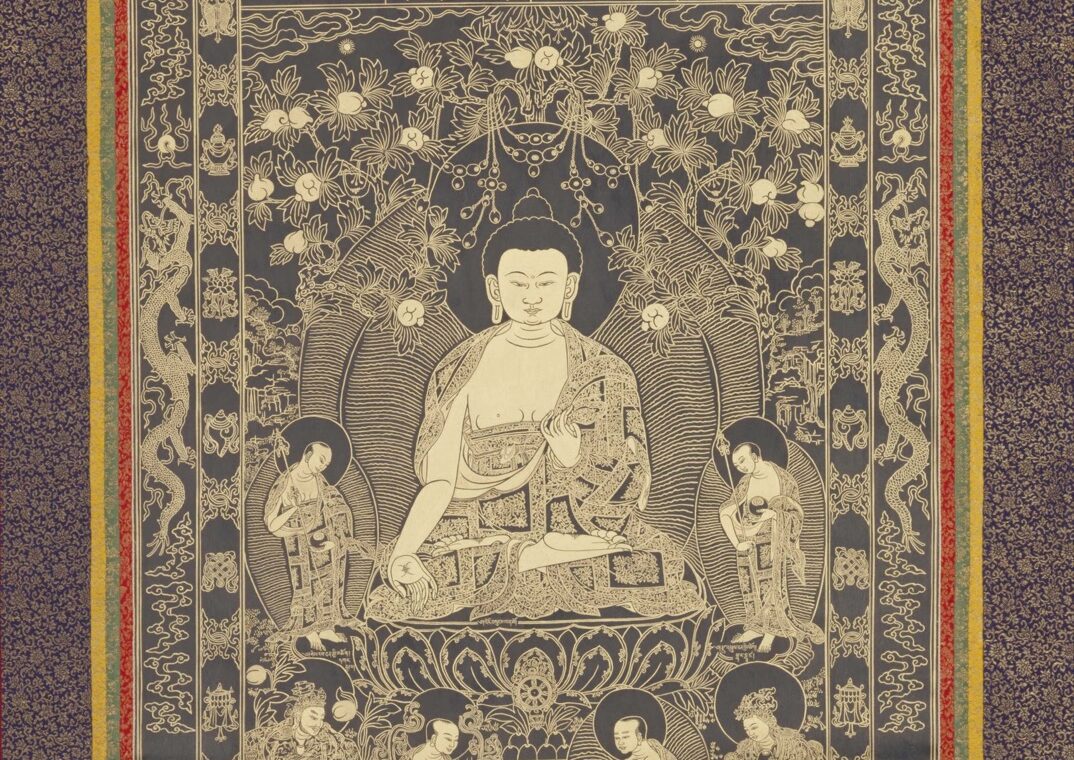
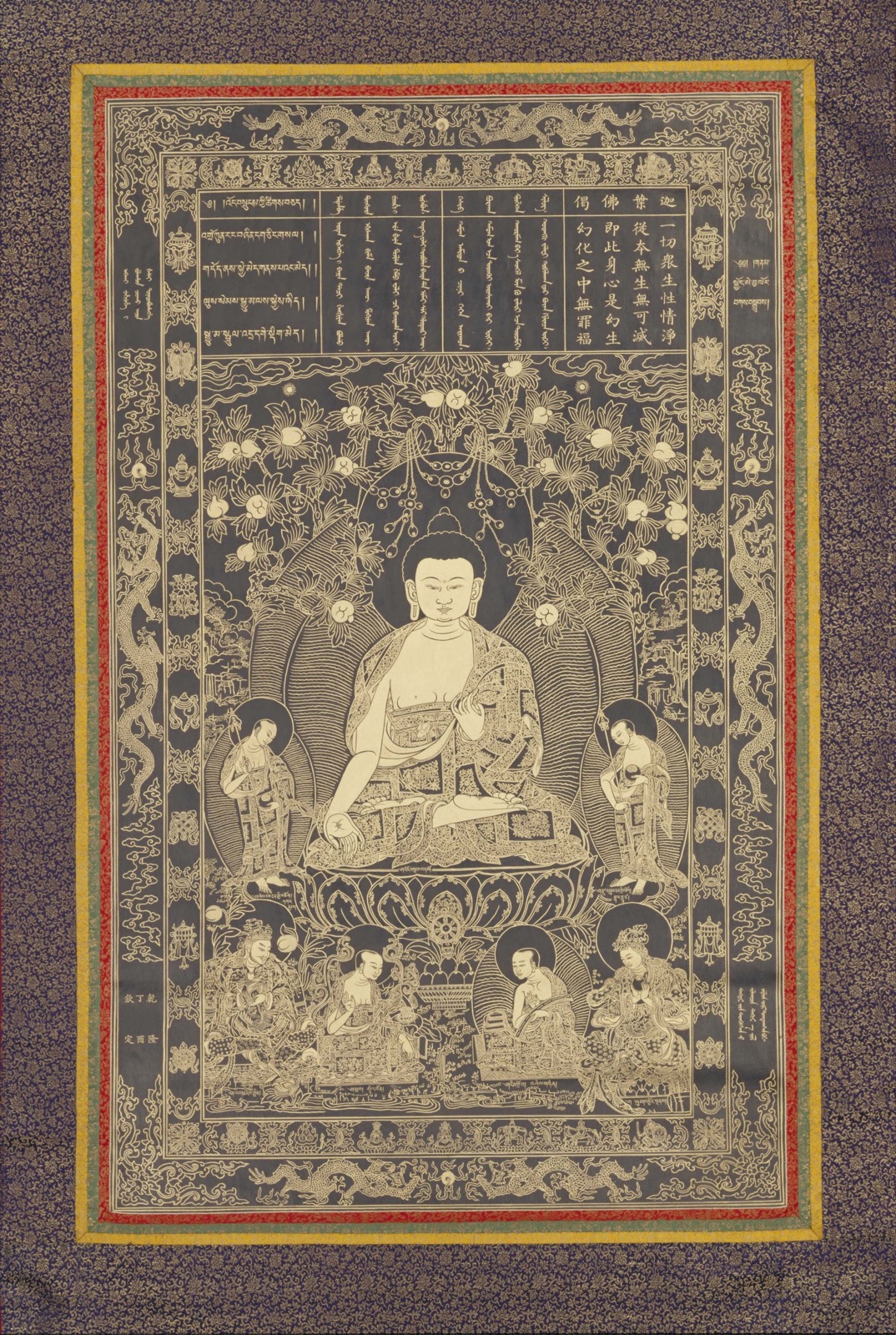
TK1148 offers a detailed example. A central seated Buddha appears beneath a broad branching canopy filled with leaves and round botanical forms. Two standing attendants flank the main figure, while four haloed figures occupy the lower register. Text panels, dragons, and layered borders surround the field. This structure supports a close reading of canopy and figure relationship. It does not, by itself, prove the tree’s botanical identity, the exact event depicted, or the archive filename’s association with Kasyapa; those points remain uncertain without reliable supporting evidence.
Start with the canopy’s position
Before identifying a tree, map where it sits. Is it behind the head, rising from the ground, arching around a halo, or extending across a text field? In TK1148, the canopy spreads above and behind the central seated Buddha. The branching form creates an enclosure that draws attention to the central figure without functioning as a simple halo. This positional description is secure even when individual leaves or fruit-like forms cannot be classified.
Next, distinguish the painted tree from other surrounding decoration. A floral canopy, textile pattern, cloud band, and border ornament can all appear in the same image. Trace the branches outward from the central trunk or branching mass. Keep leaves and round forms connected to that structure only where the visible lines support the connection.
How to read a sacred tree in Buddhist art
Map trunk, branches, and foliage
Describe the tree in three layers. First record the main trunk or branching source. Then note how the branches divide and whether they lean, curve, or form an arch. Finally record foliage, flowers, or round botanical forms as separate surface details. This sequence prevents a dense canopy from becoming a vague description such as “plants behind the Buddha.” In TK1148, branching lines, dense leaves, and pale round forms create a readable layered canopy.
Compare the scale with the figures
Tree scale affects meaning in a composition, but it does not automatically reveal historical scale. A canopy may appear very large because it is intended to frame a central figure; a small tree may identify a distant landscape zone. Compare the canopy with the seated Buddha, side attendants, and lower figures. In TK1148, the upper canopy is large enough to unite the central field, while the lower register remains visually separate.
Notice boundaries and overlaps
Look for places where branches cross a halo, reach toward a text panel, or stop before a border. These intersections reveal visual hierarchy. A tree that overlaps a background but avoids the halo may be deliberately held behind the principal figure. A canopy that rises into an inscription zone may create a strong vertical connection, but it does not give permission to use the text as an instant tree label. Describe the overlap first; interpret it later if the evidence allows.
What the image can and cannot identify
Many Buddhist images associate trees with awakening, teaching, pilgrimage, paradise, lineage, or a specific biography. Those associations are valuable, but they need to be tied to the actual work. A branching canopy alone cannot confirm a Bodhi tree, a named species, a temple location, or an episode from a Buddha’s life. Likewise, fruit-like circles or flower forms may be decorative conventions rather than a botanical record.
For TK1148, the visible evidence is a central seated Buddha beneath a detailed canopy. The filename provides a possible archival association, while the image preserves a visual arrangement. A careful catalogue note separates these layers: observed canopy, archive association, and unresolved historical claims. That distinction lets later inscription study, comparative research, or conservation examination refine the record rather than undo it.
A documentation checklist for painted trees
- Photograph the complete composition before cropping canopy details.
- Record the canopy’s position relative to the central figure, halo, and text panels.
- Describe trunk, branches, leaves, flowers, and round forms separately.
- Note scale, direction, and visible overlaps with figures or borders.
- Separate a painted tree from floral textile, cloud, landscape, and ornamental frame motifs.
- Record visible damage, loss, retouching, or cropped branches without guessing a cause.
- Keep named species, site, date, school, maker, and provenance uncertain unless evidence confirms them.
This approach complements our Thangka condition report checklist. For a wider method of reading composition, attributes, and written evidence together, see How to Read a Thangka.
Canopy, throne, and attendant figures
A painted tree works with the other structures around it. In TK1148, the canopy frames the seated Buddha above a layered lotus throne; attendants and lower haloed figures create a separate human or divine assembly. The tree is therefore not an isolated icon. It helps set the central figure apart while maintaining a relationship with the group below. Our guides to the lotus throne in Buddhist art and Buddhist attendant figures in Thangka offer useful comparison points.
Text panels create another important boundary. They can preserve names, verses, dedications, or later annotations, but only a reliable reading can establish their content. When a canopy approaches a text zone, document the relation without treating it as confirmation that the words name the tree or central Buddha.
From backdrop to visual evidence
Reading a sacred tree in Buddhist art means giving the canopy the same attention given to figures and attributes. In TK1148, branching lines, leaves, round forms, central Buddha, attendant figures, lower register, text panels, dragons, and borders form a coordinated field. Start with the visible structure, compare carefully documented works, and preserve uncertainty where the evidence ends. The result is a more useful image record and a more grounded interpretation.
Download the full Thangka image collection
Continue browsing and downloading the complete TANGKAWORLD image collection for close comparison of sacred trees, landscapes, figure groups, inscriptions, and painting details.